MikeGA
Member
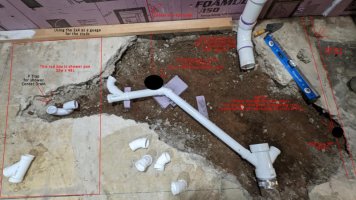
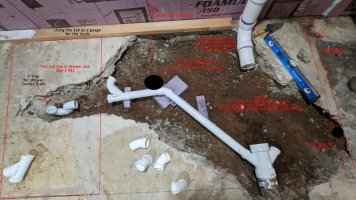
Title says it all... I've always assumed that only 45s can be used below ground for venting. Can I use this street 90 that will tie into a dry vent going straight to through the roof?
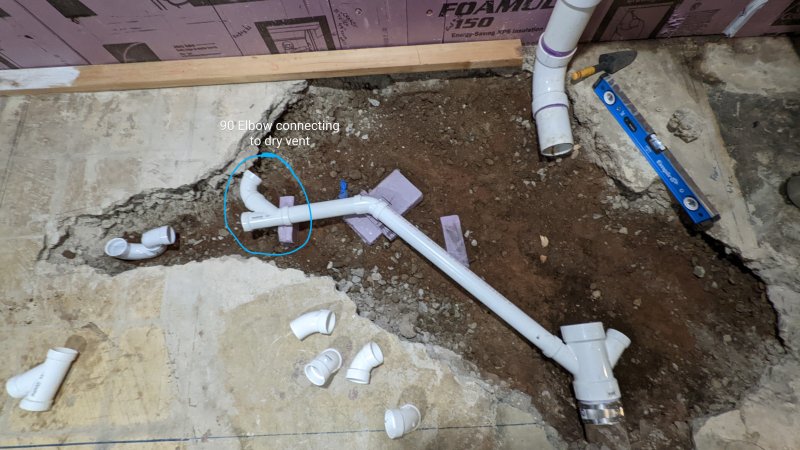



I don't understand how I accomplished that, if I need to angle it somehow.Your dry vent need to come off vertical and stay vertical until at least 6" above the fixture flood rim. Here vertical means at least 45 degrees above level.
So no horizontal dry vents under the slab.
Cheers, Wayne

Generally the way you accomplish that is that you arrange for your drain that needs a dry vent takeoff (e.g. the shower) to pass under wall framing where the vent takeoff can occur. Then you just takeoff straight up and go up into the wall.
Or you can arrange for the drain to run parallel to and just next to the wall. Then the vent can come off at 45 degree from plumb, leaning towards the wall, so that the vent will pass under the wall before rising above the slab. Then with a 45 it turns straight up into the wall.
Or you use wet venting via the lav drain, so that you don't have to have dry vent takeoffs below the slab.
If you provide a labeled picture or scaled floor plan of the full bathroom, including wall locations where a dry vent could be run, along with the fixture locations and where you need to tie in to the building drain, then we could advise you on those options.
Cheers, Wayne
I am not a pro. If you can upload a diagram of what you are trying to achieve, folks might be able to give you some suggestions.
The red text over the soil is too small to read, other than the part about the 30" vanity.Does this explain what I'm trying to accomplish?
Black Circle =Closet flange for toilet (12.5” off stud & 15” off end of shower pan)The red text over the soil is too small to read, other than the part about the 30" vanity.
But based on the layout, and assuming you don't plan a wall between the WC and shower (you could have a partial wall, it would just take up more thickness than only glass), then the options I see are shown in blue and green. Two different options, pipe size is not shown, but the shower drain is 2" and the WC drain is 3", with the vent 2" or 1-1/2" depending on your plumbing code. NJ uses the NSPC, which is different from the IPC and UPC, so I forget what size they require for a WC vent. The shower wet vents the WC.
The lav would need its only dry vent takeoff, and then both dry vents need to ultimately go to the roof. They can tie into existing dry vents, at least 6" above the flood rim of all the associated fixtures. Or if NJ allows AAV you could use 1 or 2 AAVs for venting.
Cheers, Wayne
View attachment 84155
Title says it all... I've always assumed that only 45s can be used below ground for venting. Can I use this street 90 that will tie into a dry vent going straight to through the roof?
View attachment 84144
Generally the way you accomplish that is that you arrange for your drain that needs a dry vent takeoff (e.g. the shower) to pass under wall framing where the vent takeoff can occur. Then you just takeoff straight up and go up into the wall.
Or you can arrange for the drain to run parallel to and just next to the wall. Then the vent can come off at 45 degree from plumb, leaning towards the wall, so that the vent will pass under the wall before rising above the slab. Then with a 45 it turns straight up into the wall.
Or you use wet venting via the lav drain, so that you don't have to have dry vent takeoffs below the slab.
If you provide a labeled picture or scaled floor plan of the full bathroom, including wall locations where a dry vent could be run, along with the fixture locations glue gorilla glue reviews and where you need to tie in to the building drain, then we could advise you on those options.
Cheers, Wayne

This is awkward, but...
It looks like you're using an ad blocker. We get it, but (1) terrylove.com can't live without ads, and (2) ad blockers can cause issues with videos and comments. If you'd like to support the site, please allow ads.
If any particular ad is your REASON for blocking ads, please let us know. We might be able to do something about it. Thanks.