View Full Version : Hotwater connection Copper to ABS. Problem?
worrywell
02-21-2008, 10:31 AM
Hi all,
My bathroom has a leak somewhere and I don't know where it is coming from. I asked a couple of friends with some plumbing experience and they told me to start by checking the shower knob valves for water leaks. As I was going through my bathroom pictures I noticed that the hotwater pipes are half copper and half ABS is this a possible problem where they union together?
Any advice will help! I post a pic of the bathroom you can clearly see where the abs is joined with the hot copper lines?
Is this acceptable or I am asking for trouble?
Tanks
jadnashua
02-21-2008, 10:37 AM
The black drain stuff looks like abs, but the white water supply stuff should be CPVC, not PVC. CPVC, done properly should be fine. Copper wouldn't get brittle with age, though.
It looks like greenboard going up. Realize that the national codes no longer recognize greenboard's use for much of anything in a wet/damp area. It really doesn't hold up an better than regular drywall in the real world. If it is a wet area, then a cbu is called for, otherwise, a good primer and top coat of paint is more than sufficient. Greenboard isn't as strong as drywall, either, and it's use on the ceiling is sometimes problematic on a longterm use - it tends to bow if the supports aren't closer than the normal 16" oc.
Mike Swearingen
02-21-2008, 10:38 AM
The black plastic drain lines are ABS.
The pipe connected to the copper supply lines appears to be CPVC, and yes, they could be leaking where they are threaded together.
You're going to have to open that wall up to inspect and repair them, and they should all be behind the vanity sink base cabinets.
Good Luck!
Mike
worrywell
02-21-2008, 11:01 AM
Is it common for these unions(copper to CPVC) to leak in time? Or should they hold up? The house is only 2 years old?
Thanks
Gary Swart
02-21-2008, 12:27 PM
The connector are not "unions", they are adapters. Unions join like materials together in a way that the plumbing can be dismantled without undoing everything from the end back to the problem. Should adapters leak? No, but can they? Yes. I wonder why the installing plumbers made a transition from copper to CPVC. In my opinion, they should have stayed with copper. I do see what appears to be PVC in the photo as well as CPVC. FYI, PVC is white or dark gray, and can be used for drains but not for water lines inside the house. CPVC has a yellow cast and is allowed for water lines inside. CPVC and PVC are made from different chemicals and are not compatible with each other. Drain lines may be cast iron, copper, PVC, or ABS. ABS is black and is a;sp made from a different chemical mix than PVC so these two are not compatible with each other either. If you end up opening the whole area, you might want to consider changing the CPVC to copper. I would not open the wall just to do that however.
fidodie
02-21-2008, 01:05 PM
what is that extra PVC line right next to the copper->cpvc lines ?
or is that tee'd off the copper ..
looks like back-to-back lavs? the drain isn't quite right (wrong fitting, I don't see a vent! unless this is some sort of test setup.
same over at the shower.....
also, if those lines come out of the concrete without sleeves, you could have some problems because of settling.
worrywell
02-21-2008, 01:22 PM
The extra PVC Lines are the cold water lines shower and lavs. yes these are back to back lavs and showers. The house is in Rosarito beach, Mexico. The reason I want to know about this set is because I have a water leak somewhere in the restroom. I am suspect teh shower valves or the CPVC -Copper adpaters are leaking.
fidodie
02-21-2008, 01:35 PM
i would suspect that the lines were "bumped" and cracked in the wall - could be any of the ones sticking out - perhaps mopping and hit behind the w.c. ?
at least with back-to-back you can pull one vanity, and break into the wall, to see what is going on, but still have the other operate.
assuming the copper was the female part of the transition, it shouldn't leak.
i'm really worried about the direct contact of the pipes with the concrete -
might have even been compromised by a nail ..
it isn't going to fix itself! so pick one side, and start investigating.....
worrywell
02-21-2008, 01:46 PM
Hit behind the W.C? What is W.C?
I will going down this Saturday and I will knock out a piece wall to inspect the pipes? I hope it is not to much work. I will probably change the CPVC to all copper so my mind can rest of leaks.
Thanks you have mucho help!
Gary Swart
02-21-2008, 02:32 PM
WC is water closet, AKA toilet. If those PVC lines are carrying water, that is a total code violation. As I explained in my early rely, PVC is OK for drains but not for cater inside a home. If this is the case, then I tell you that the person who plumbed this was not a plumber, because no licensed plumber would do that period. With all of the strange and possibly illegal plumbing, I would strongly advise you to have a licensed plumber check this out. This leak you are fighting now could be the tip of an iceberg.
worrywell
02-21-2008, 02:39 PM
Remeber this is in Mexico. I am really disappointed on the work they did...
Exactly what do I hit? Water Closet? The PCV has running water to the toilets.
fidodie
02-21-2008, 03:17 PM
just take one of the vanity/sink combos out, and open the wall behind it -
hopefully it is right there, and will be an easy repair- problem is that it is more likely the pvc, than the cpvc, and that goes into the floor. hopefully, there will be room to repair it.
can tell you are disappointed, and while we really want it to be "right", first thing is to find out what is really wrong, and get that fixed. bring the digital cam with you, and post more pics when you find out what is going on.
good luck
Gary Swart
02-21-2008, 03:26 PM
There's always a little, "Oh, yeah". Oh yeah, didn't I mention this was in Mexico?" No, you didn't. I doubt if any codes apply, so there's probably no vents, no traps, PVC water lines, and who knows what else. I'm sure no one is licensed because there probably are no codes to follow anyway.
Yeah - this job is seriously vent impaired. It's hard to tell from the pic, but it looks to be a mixture of water lines - CPVC as well as PVC. If PVC is used indoors for hot water, it will self-destruct.
worrywell
02-21-2008, 03:39 PM
There are vents up on the tiled roof terrace. I want to thank all you girls and guys for all your help. I am really stressed to find out that my plumbing was not properly done. But I already paid for the house and I have my deed. I will take pictures of the repairs. I'm making a listed of the tools and material I will need to take to get the job done. If anybody wants to take a shot creating material list...That will sure help me!
Remember the shower stalls have tile and the walls have greenboard!
Thanks
I posted a pic of the roof top terrace and the house! I hope you like it!
worrywell
02-21-2008, 03:47 PM
Copper was used for running hot water. I only see 2 pvc cold water lines that go to the toilets. The rest is acceptable, I guess!
I do have P- traps in my toilets, showers and kitchen. I know becuase I clean the shower p-traps on occaision to remove hair build up. All the air vents are on the roof terrace, they run through the cinder block walls. I have at least 4 ABS vents up stairs. I know cause I see them sticking out of the walls.
I know this is Mexico...But this home would of cost me 900,000 thousand in the states. This is my second home!
patrick88
02-21-2008, 08:35 PM
The hot water is the copper with that flow guard gold(cpvc) stuff. The cold looks to be white cpvc or pvc. I'm thinking the flow guard gold is leaking on the male that looks like it is threaded into a copper fmale.
construct30
02-22-2008, 02:41 AM
It looks to me like they used a copper male adapter into a cpvc female adapter, never, ever do that, it will always leak or even crack.
fidodie
02-22-2008, 02:59 AM
It looks to me like they used a copper male adapter into a cpvc female adapter, never, ever do that, it will always leak or even crack.
this would be the best case - just FYI: a plastic female is prone to cracking because of the stress of the male tighten into it - also the natural expansion contration cycles of the plastic differ from the copper.
good looking place! makes me want to grab the deep sea gear.
Redwood
02-22-2008, 09:38 PM
The hot water is the copper with that flow guard gold(cpvc) stuff. The cold looks to be white cpvc or pvc. I'm thinking the flow guard gold is leaking on the male that looks like it is threaded into a copper fmale.
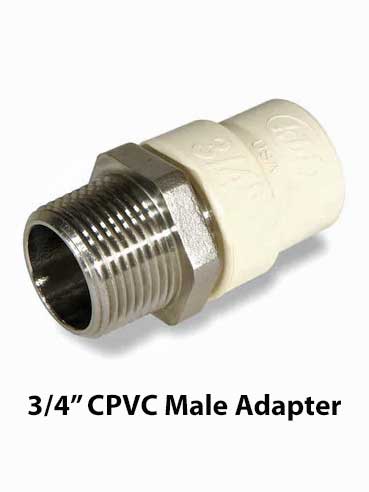
I believe Patrick has nailed the leak on this one. The adapter used no doubt is an all CPVC threaded adapter. A transition adapter should have been used like this one...
http://i44.photobucket.com/albums/f2/Redwood39/cpvc-metal-male-adapters.jpg
The PVC is used for cold supply only and while not right according to codes used in the US will probably be okay... PVC cannot be used for hot water, at least your Mexican Plumbers knew that. Here in the US PVC is underground out side of the house water supply.
Did they also know enough not to use those Am. Std. "Hecho en Mexico" toilets?
worrywell
02-23-2008, 09:23 PM
I will like to let all those that helped me that I opened the wall to inspect the problem. No pipes were leaking.There was moisture inbetween the shower cavity of the shower stalls. The moisture was located on the bottom. The problem is the water is leaking through the grout and tile and into the walls and shower pan to the first ceiling. The greenboard will be removed and Durlock cement boards will be installed and waterproofed with Redgard and retiled and regrouted. This should solve water from penerating to the shower pan and walls.
Do you agree that installing the durlock boards all around the shower stall, waterproof and retile/regrout will correct the water from penerating through the grout and tile?
Thanks all,
jadnashua
02-24-2008, 11:48 AM
Redgard is a good product. If the pan is built properly, everything should be fine. When using Redgard, you need to use the alkalai resistant mesh tape and mud the joints prior to installation of the Redgard. Unlike a drywall joint, you don't want any buildup. Don't worry about fully bedding the tape, just fill the gaps. If you end up with a hump, it becomes a pain to get the tile to lay flat.
Check out www.johnbridge.com (http://www.johnbridge.com) for help with the tiling and prep work.