1.25" PVC on 3HP Pump? Torque Arrestor?

detective17

New Member
Messages
6
Reaction score
3
Points
3
Location
Western Washington
Ive got a problem with my well causing no pressure/flow in the house. I had the starter checked out with no issues so they told me its an issue at the well. One company said up to $15k and another said up to $10k. So I'm going to do it myself.

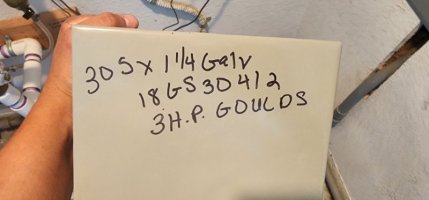
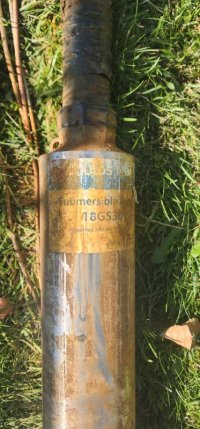
Current setup is a 325ft well, 249ft static, 3HP Goulds 18GS30412CL pump, 305ft of 1.25" galv drop pipe, pressure switch controlled on 45psi off 68psi, two 86 gal pressure tanks, house is about 150ft from well with flat level ground. Irrigation is tied in via a valve but I dont use it. Original 27 year old pump as far as I know. Well report attached below.

Ive ordered the exact same pump already but im having trouble finding 1.5" sch 120 pvc drop pipe since 1.25" is only rated up to 2hp. I'd like to avoid galv pipe if possible.

Questions
1. How hard is the cutoff for 2hp on 1.25" pvc? Ive seen some say they use it but im not sure if my application could get away with it.

2. Should I use a torque arrestor in my application if I go PVC? I seen some posts here saying to never use them but then some saying to use them. My local supply shop wanted to sell me one of course.

3. The two local companies I talked to said I probably ly have 2 or 3 check valves in the system and they would put in new check valves and the supply shop said I needed them too. I seen a sticky posted here saying they are problematic and the reasons make sense. In my case should I replace install check valves?

Thank you.


1000042686.jpg
 
Current setup is a 325ft well, 249ft static, 3HP Goulds 18GS30412CL pump, 305ft of 1.25" galv drop pipe, pressure switch controlled on 45psi off 68psi, two 86 gal pressure tanks, house is about 150ft from well with flat level ground. Irrigation is tied in via a valve but I dont use it.
A 7 to 10 GPM pump is generally enough for a house, unless there are special requirements. One special requirement might be a backwashing iron filter that requires 15 gpm to backwash. Another special requirement can be crop irrigation.

I suggest you consider a 10 gpm 1.5 HP pump.

index.php


index.php


From a troubleshooting/curiosity point of view for the existing installation, consider measuring and posting resistances among the wires to the pump, without the control box connected. Use a digital multimeter that can resolve 0.1 ohm.

measure resistance between black and red up top.
measure resistance between black and yellow.
measure resistance between yellow and red
Thank you for the feedback on the pump. I'll admit I've had many conversations with Gemini about the pump size given variables in piep type, diameter, check valves, bladder tank size, house size, irrigation potential, depth, etc but in the end I wasnt satisfied and figured if I stick with 3HP, I at lesst know what to expect with water delivery and we have been happy with it thus far. The two well repair companies I spoke with told me if I didnt have any complaints then they'd stick with the size I have too. So I did put some thought into it but I should have done more and check here to confirm before ordering. At this point ive got the 3hp on its way across the country though.

Regarding the testing, this is what I did that led the well repairs guys to point at the pump/piping

Symptoms: Pump starter is humming and its really really slow to build pressure. Run capacitor was really warm and the relay was warm. Was able to build 48psi max after a while of running (that was for like 3 days after this started. After 3 days and still today it builds like 5psi) and the pressure holds after the pump turns off.

Troubleshooting:
Replaced run capacitor, replaced start capacitor, replaced relay.

Testing: Measured resistance crossed overloads and got zero ohms. Measured resistance across contactor when manually pushing it in and got zero ohms L1 to T1 and L2 to T2. Disconnected wires and Measured contactor coil resistance and got 1.056k ohms. Measured current on red start wire and got 6.8A. Measured current on yellow and black wires and got around 16A each. Measured voltage between yellow and black and got ~240V, red and black ~330V, cant remember yellow to red. Disconnected yellow red and black wires and Measured resistance yellow to black and got 2 ohms, black to red was 6.8 ohms, yellow to red was 5.3 ohms.
 

Attachments

  • 20260903_133522.jpg
    20260903_133522.jpg
    54 KB · Views: 0
  • 20260903_133537.jpg
    20260903_133537.jpg
    41.5 KB · Views: 0
As the original bore depth is indicated to be 325', and the static level is specified as 249', at 1.47 gallons per vertical foot of 6" well casing, this means at best, there was only 76' (111 gallons) of water within the well down to the bottom of the bore before any amount of water was pumped out. Since some amount of sediment and debris entering the bore is common over time, the pump is not normally located at the bottom of the well bore, thereby providing space for debris to accumulate at the bottom below the pump.

You stated 305' of drop pipe. Assuming a pitless adaptor is utilized, as the depth of the pitless in Washington is usually 3-5', using a median 4' depth, that should increase the depth to the top of the pump to 309'. Because the pump's inlet screen is located ~18" below the top of the pump outlet fitting, that will mean at best, there will be ~61' of water located above the pump before any amount is removed from the well. That 61' equates to only ~89 gallons water available in storage.

The well report specifies the well was pumped down to the full 325' after ~2 hours of pumping at 40 gpm. As the 111 gallons pumped from the casing does not include water entering through the casing slits, that seems to suggest your well may have a fairly low recovery rate so the amount of water your family has available, will be substantially provided by only the water remaining in storage within the casing above the pump.

Perhaps under normal water use, your family maybe initially consuming a majority or all of that 89 gallons within a limited time period, thereby pulling down the static level, and so the well maybe running short of water until the well slowly recovers enough to cause the water level to eventually rise and remain consistantly above the pump's inlet screen. As each of your 86 gallon pressure tanks will hold approx 23 gallons water, the 46 gallons needed to refill both pressure tanks, will only increase the amount of water the pump will need to supply before the pressure switch will shut down the pump.

two local companies I talked to said I probably ly have 2 or 3 check valves in the system and they would put in new check valves and the supply shop said I needed them too.
A submersible pump system should not normally be equipped with more than 1 check valve, which is usually the check valve located within the pump. If for redundancy, you wish to utilize a second CV, then a 2nd CV maybe threaded directly onto the pump's outlet fitting. In this manner, the 2 CVs will be located only a few inches away from each other, thereby preventing water hammer. As the horizontal supply piping and drop pipe back to the pump will remain pressurized by the pressure tank even while the pump is shut off, this will reduce the potential for contaminants entering the piping if there is any leakage in the buried section of piping, and will act as an indicator that there is a leak since the pump will become repeatedly activated even while there is no water useage occuring.
 
2 hours of pumping at 40 GPM is 4800 gallons.
OOOPs, You are correct. I had intended to convert 40 GPM to GPH, but was interupted before posting and so ...

A much higher recovery rate, will reduce the likelyhood for the pump to be out-pumping the well.

The 60' section of 1/8" slits through the casing, could have allowed a substantial amount of sediment into the well, particularly as there was no gravel pack installed around the slitted section to hold back and reduce the smaller particles from entering through the slits. Maybe the pump is buried in debris?

If there are multiple check valves actually present, particularly if one is located close to the pressure tank, there could be a leak somewhere in the piping which is not being recognized. Perhaps the 'O' ring at the pitless (if equipped) could be leaking and spraying water back down into the well?
 
Last edited:
Ive got a problem with my well causing no pressure/flow in the house. I had the starter checked out with no issues so they told me its an issue at the well. One company said up to $15k and another said up to $10k. So I'm going to do it myself.

Current setup is a 325ft well, 249ft static, 3HP Goulds 18GS30412CL pump, 305ft of 1.25" galv drop pipe, pressure switch controlled on 45psi off 68psi, two 86 gal pressure tanks, house is about 150ft from well with flat level ground. Irrigation is tied in via a valve but I dont use it. Original 27 year old pump as far as I know. Well report attached below.

Ive ordered the exact same pump already but im having trouble finding 1.5" sch 120 pvc drop pipe since 1.25" is only rated up to 2hp. I'd like to avoid galv pipe if possible.

Questions
1. How hard is the cutoff for 2hp on 1.25" pvc? Ive seen some say they use it but im not sure if my application could get away with it.

2. Should I use a torque arrestor in my application if I go PVC? I seen some posts here saying to never use them but then some saying to use them. My local supply shop wanted to sell me one of course.

3. The two local companies I talked to said I probably ly have 2 or 3 check valves in the system and they would put in new check valves and the supply shop said I needed them too. I seen a sticky posted here saying they are problematic and the reasons make sense. In my case should I replace install check valves?

Thank you.


View attachment 107955
5 GPM is enough for a normal house. The only reason to have a larger pump is for something other than the house like irrigation. Since you no longer use the irrigation system as was said, a 10 GPM, 1.5 HP would supply more than enough for 2 houses. I would hang a 10 GPM, 1.5 HP on 3oo' of 200 PSI poly using long barb fittings and two hose clamps each. Building a little wheel and puller poly pipe can easily be pulled by hand.

It will be a big job, and possibly dangerous to pull 305' of galvanized pipe. You might consider just getting the well company to pull the old pump and lay everything on the ground. Then you can install the new pump on poly yourself.

You are doing the right thing educating yourself as most "professional" well guys don't know anymore than you do about pumps. That kind of cost drives people to do it themselves, and most times it is done better than a well guys would do.
 
I appreciate the feedback. Youtube, forums, and service manuals have brought me from not knowing how to change my oil in my car to doing full engine rebuilds. Gotta start somewhere :)
I have done the same thing prior to the internet, just sometimes you can get in over your head. I have pulled a similar pump with a mini excavator and it almost got out of control. I would heed Valveman's advice and hire out the pump removal if you have any doubts.
 
Sorry about the delays in responses, they all were waiting on approval. I appreciate all the feedback.

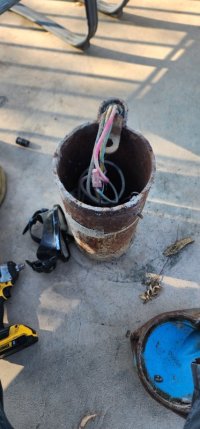
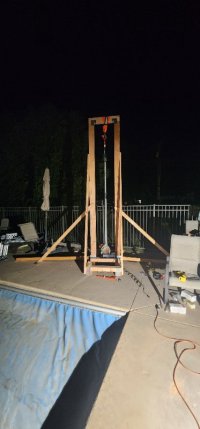
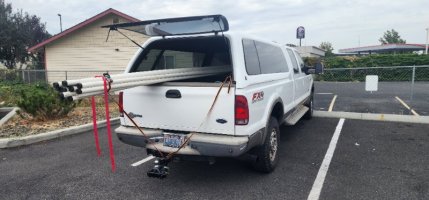
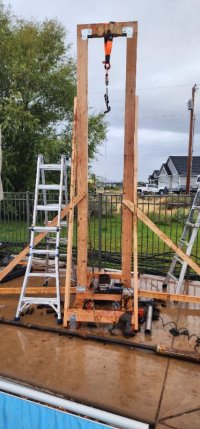
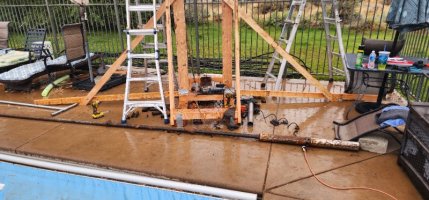
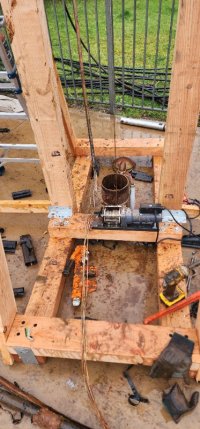
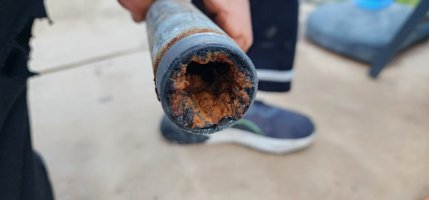
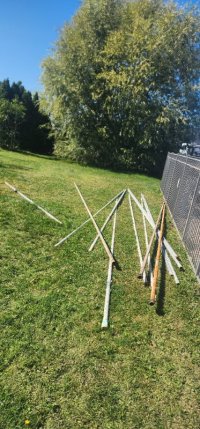
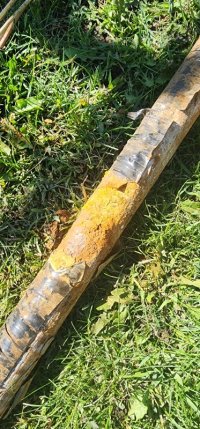
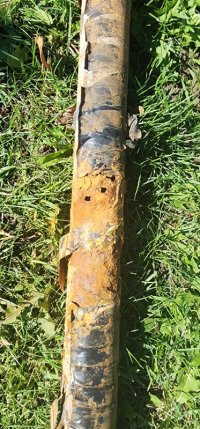
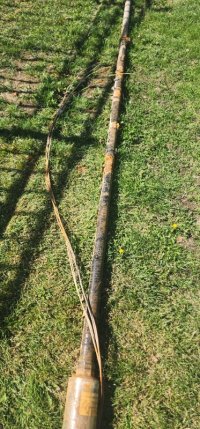
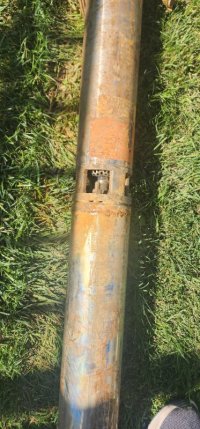
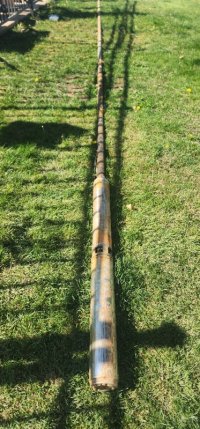
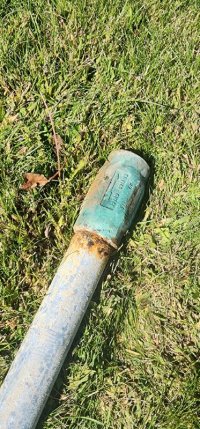
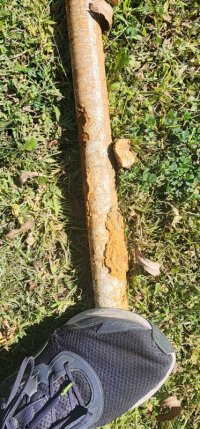
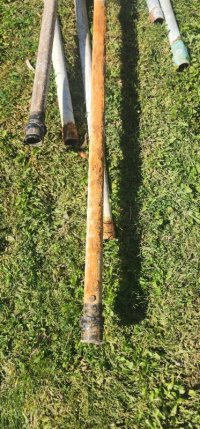
I did end up swapping the pump out. The galvanized pipe had rusted holes in the bottom stick. It took about 3 hours to assemble my extractor and then probably 4 hours to get all 14 and a half sticks of galvanized pipe out.

I got to go visit family an hour away and they had a supply shop that carried 1.5" pvc so I was able to get it.

I feel like a real chump for asking questions and not following the guidance here, but I chickened out. The place I got the supplies from does well pump installations as well and them plus the 2 people I got quote from told me they'd put in 3 check valves since its 300ft deep. Maybe they just like selling parts or they like doing services after the systems fail early because of the parts they install, but I ended up having to their advice. I wasnt planning on using the torque arrestor or any dope on the threaded pvc connections based on what ive found on these forms but man they again convinced me that tight connections with the dope they sold wont come undone. So I followed them there as well.

Before the install i dropped a bobber, weight and sting down to check the static level and it was ~216ft, which lines up with my neighbors well seeing 222ft static 5 years ago.

I thought the install was gonna be faster than the removal but that didnt pan out. It was probably 6 hours to install the 15 sticks including the splice and taping the crap outta the wiring guards on the first stick. The wiring was single conductor #8AWG wire and it was sleeved in 3/4" poly tube the entire run so that was pretty cool. I also ran a 1/8" stainless safety wire attached to the pump. . I tested the fist stick in the pool before dropping it into the well and then on the last stick I ran it and flushed it out OK the ground before dropping the pitless back on. It was a long day but at about 9pm I was able to slip the pitless on and get water back in the house. I think it was 10 days of not having running water in the house haha. RV trailer kept us shower with water from my friends house.

~$2k for the piping and associated materials
$2k for the pump shipped
$2k Rounding up on other tools, winch, brackets and wood (orange pipe clamp tool was $450 with 2 day shipping).

So for less than $6k I was able to do it myself with friends. Didnt get new wire but mine was in great shape given the poly encasement. Pretty good compared to $10k and $15k estimates i was given. In hindsight I agree with you guys I could have went with a smaller pump and saved probably $2k.
 

Attachments

  • 20260905_165340.jpg
    20260905_165340.jpg
    67.5 KB · Views: 0
  • 20260903_133915.jpg
    20260903_133915.jpg
    91.4 KB · Views: 0
  • 20260911_203544.jpg
    20260911_203544.jpg
    47.9 KB · Views: 0
  • 20260910_205228.jpg
    20260910_205228.jpg
    65 KB · Views: 0
  • 20260912_120311.jpg
    20260912_120311.jpg
    76.2 KB · Views: 0
  • 20260912_191543.jpg
    20260912_191543.jpg
    71.7 KB · Views: 0
  • 20260913_165834.jpg
    20260913_165834.jpg
    87.7 KB · Views: 0
  • 20260913_165837.jpg
    20260913_165837.jpg
    102.2 KB · Views: 0
  • 20260913_165841.jpg
    20260913_165841.jpg
    100.2 KB · Views: 0
  • 20260913_190424.jpg
    20260913_190424.jpg
    32 KB · Views: 0
Im curious why it seems odd to you just for my own education. I have no experience dealing with this stuff so im just genuinely curious.

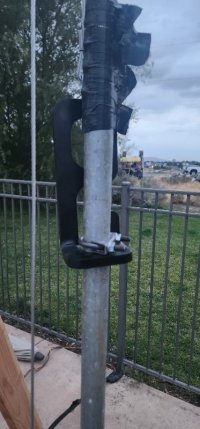
More pictures of the pipe I pulled out. I attached those two exhaust clamps in the middle of the pipe since my tower wasnt tall enough to pull up coupler to coupler. There was also some electrical tape on the inlet to the pump that im sure wasnt helping it out. They put tape over the couplers that were deeper which made it a little harder to grab with the pipe wrenchs but im guessing that was to help prevent them from coming loose. I didnt do that on my new pipe.
 

Attachments

  • 20260920_123404.jpg
    20260920_123404.jpg
    132.1 KB · Views: 0
  • 20260920_123604.jpg
    20260920_123604.jpg
    146.4 KB · Views: 0
  • 20260920_123554.jpg
    20260920_123554.jpg
    146 KB · Views: 0
  • 20260920_123549.jpg
    20260920_123549.jpg
    152.2 KB · Views: 0
  • 20260920_123537.jpg
    20260920_123537.jpg
    99.9 KB · Views: 0
  • 20260920_123533.jpg
    20260920_123533.jpg
    111.7 KB · Views: 0
  • 20260920_123525.jpg
    20260920_123525.jpg
    134.2 KB · Views: 0
  • 20260920_123511.jpg
    20260920_123511.jpg
    165.7 KB · Views: 0
  • 20260920_123443.jpg
    20260920_123443.jpg
    149.1 KB · Views: 0
  • 20260920_123410.jpg
    20260920_123410.jpg
    151.3 KB · Views: 0
That is a monster pump that I have seen used in commercial applications. The wells were near farm operations, aerial applicators and oilfield locations and never near a swimming pool. In my area that well would have a galvanized steel pressure tank 10' tall and 500 gallons in size.
 
Amazing job! Thanks for the pictures. A smaller pump would not cycle as much, but the two huge pressure tanks will help. A Cycle Stop Valve would make it even better. The three check valves will most likely cause water hammer problems, but usually not when they are new. Plastic pipe will have some torque to it compared to the galvanized, so I hope it doesn't chaff the single conductor wire against the poly covering. Torque arrestors don't help, get stiff over time, and make it hard to pull the pump. Wiring guards can also be a problem. Too much tape on things can also be a problem. If that 1/8" SS cable comes loose, it will act like a wedge and keep the pump from ever being pulled again. But you did good and probably better than what you would have gotten if you had it done and paid top dollar.
 
Thank you for the feedback. I really appreciate all the information on this forum.

I did look at that cycle valve for a little bit since I seen you mentioned it before. Like you said about the two tanks, gemini suggested those should help and I was ready to be done with the project haha but that might be on my next list of to-do.

The wiring was submersible rated so hopefully it holds up. The bottom section that I could see looked good as did the top that wasnt under water but I did forget to megger it.

The torque arrestor kept me up for a few nights going back and forth on it. Hopefully I dont have to touch it for another 25 years but if that time comes maybe ill be more financially stable (doubt it lol) and just pay someone to deal with it.

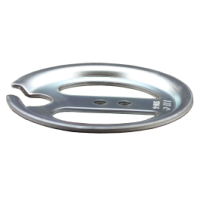
Working with the safety wire was interesting. I'm not happy with how ive got it attached at the top so I ordered on of these well rope hangers. Ill see how i like that.

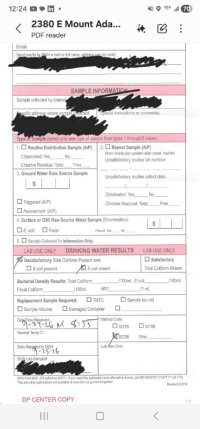
I went and got a water test and they detected coliform but no e coli so now I gotta sanitizer it. So back to the RV again for 24hrs while the bleach sits in the system.
 

Attachments

  • 5b89a294528e083df0ec55f4cdfad81012b320f3_strh_6-2.png
    5b89a294528e083df0ec55f4cdfad81012b320f3_strh_6-2.png
    38.5 KB · Views: 0
  • Screenshot_20260925_204258_Gallery.jpg
    Screenshot_20260925_204258_Gallery.jpg
    56.2 KB · Views: 0
https://terrylove.com/forums/index....izing-extra-attention-to-4-inch-casing.65845/ is my writeup on disinfecting the well and plumbing.

It may be overkill, and it is definitely more rigorous than the usual.

If you are looking for a negative coliform test, you have to use care in sampling, including heat or disinfectant at the faucet to kill bacteria where you take the sample. Search for sampling procedures.
 
I appreciate the feedback. Youtube, forums, and service manuals have brought me from not knowing how to change my oil in my car to doing full engine rebuilds. Gotta start somewhere :)
i had a windshield kit repair and i was browsing all the youtube guide videos till i gave up and finally contacted professional... after 2 years i learned how to fix small cracks, so yeah you are right, gotta start somewhere!
insurance auto glass replacement Murrieta
 
Nice work doing this yourself, the well report and pictures are more than most people bring to a job like this. On the drop pipe, going from 1.25 galvanized to 1.5 sch 120 PVC is the right call at 305 ft. That old galv is rough inside and at 3HP flows the friction loss is real, so the same pump will hold better pressure upstairs with the bigger pipe.
Valveman is right about three check valves being water hammer waiting to happen. One at the pump is enough, the extra ones just give the column somewhere to slam.
If you add a cycle stop valve later, put it ahead of the pressure tanks and keep the switch spread wide, the two 86 gallon tanks will handle the rest. Post the ohm readings off the control box before you pull the old pump too.
 
Back
Top