Stripping Romex Sheathing

Verdeboy

In the Trades
Messages
2,041
Reaction score
6
Points
0
I thought I had a decent wire stripper, but I can't find a way to use it to strip the sheathing from Romex cable. I end up using a pocket knife to score it and carefully peal it back. That seems too labor intensive.

Can someone recommend a better stripping tool or a better approach?

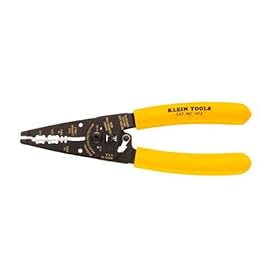
Here's a pic of my Calterm stripper. (made in China).
 

Attachments

  • Wire Stripper.jpg
    Wire Stripper.jpg
    66.5 KB · Views: 2,512
Thanks.

I'll definitely pick one of those up. What do you think of the Klein dual or single cable strippers?

Also, is there something out there that will work on tray cable? One of my customers bought an entire spool of it at a rummage sale and wants to use it to makes some runs. He can't find anyone who wants to work with that stuff.

The colors are different as well: Black, blue, and red instead of black white, and bare copper.
 
Verdeboy said:
Also, is there something out there that will work on tray cable? One of my customers bought an entire spool of it at a rummage sale and wants to use it to makes some runs. He can't find anyone who wants to work with that stuff.

The colors are different as well: Black, blue, and red instead of black white, and bare copper.

Tray Cable (Type TC) is not permitted outside a raceway or cable tray system. NEC 336.12. I suppose if you wanted to run it in conduit it would be ok, but that would be a real pain in a residence.

The 3 colors indicate that it is intended for 3-phase service without an Equipment Grounding Conductor. Metal cable trays are sometimes used as the EGC, or a separate EGC is run in the tray.
 
Bought a Croc's

The guy at the electrical supply place talked me into buying a $30.00 Croc's NM Stripper. It's supposed to strip 14/2 Romex on one side and 12/2 on the other, but I haven't figured out how to do it yet. It does strip the insulation off 12 gauge wire easier than any other stripper I've ever used. I just need a lesson in stripping the Romex sheathing I guess.

BTW, I told the customer that I wouldn't touch the Tray Cable. I'm sure that when it's time to sell their house, the building inspector will not like all the work that he already did using that stuff.
 
i know the cdn code (table ??) states you cant use cable tray any where but tray but why?
There is a thicker casing on tray cable then there is on NM so whats the reason, any idea???
 
hj said:
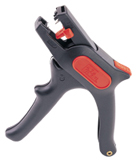
Why not spend a little more and get a "real" stripper. The "squeeze and pop" type.

No one else has mentioned that type. Who makes it?
 
Everybody I know uses a razor knife.

Slice both sides and slip off the sheath.
 
hj said:
Why not spend a little more and get a "real" stripper. The "squeeze and pop" type.
"Real" in who's eyes???? Any "real" electrician will tell you that would be wither a razor knife or the ones in Chris' picture.

If you mean these then you have no clue what is used in the real world. Maybe unless you are doing car stereo installs all day.
sjgreatdeals101_1968_68832091
 
Speedy Petey said:
"Real" in who's eyes???? Any "real" electrician will tell you that would be wither a razor knife or the ones in Chris' picture.

If you mean these then you have no clue what is used in the real world. Maybe unless you are doing car stereo installs all day.
sjgreatdeals101_1968_68832091


I find these things useless!
To big to fit into the tight places.
 
The "squeeze and pop" type are very nice for stranded and small wire, and they save time if you are doing a lot of terminations in one place. I don't carry mine if I am doing general wiring with solid wire.
 
This is what I bought. It's very similar to the Klein in Chris' picture. It strips and loops wire beautifully, but l still can't get it to strip the sheathing without nicking up or completely removing the insulation on the conductors.

I don't even understand how it could work. I've got two different 12/2 cables, one by Essex, and the other by Winkler/Jorge. The Winkler/Jorge cable is flat (has all 3 wires on the same plane), while the Essex has the ground wire elevated above the other 2, so the sheathing is more triangular in shape. It seems to do a bit better job on the triangular one, but no nicks are acceptable.
 

Attachments

  • crocs_photo.jpg
    crocs_photo.jpg
    8.5 KB · Views: 1,136
I went back to the place I bought the Croc's stripper from, and the salesman admitted that no NM stripper will strip the sheathing from UF-B Romex cable. So, I got out the razor knife again.

I'm getting pretty good with the razor knife, so I'll give up my quest for the perfect NM stripper for now.
 
I have found that the best way to strip UF is to slice it along the ground wire with a sharp knife, using the ground wire as a guide. Start it at the end and just run the blade along the wire, like you would carve a shaving off a stick, splitting the cable. Then pull the ground wire free of the cable.

Then you can put a little scoring cut in the groove of the jacket where it was exposed by removal of the ground wire, grab the conductor with your lineman pliers, and yank the wires out of the jacket, one at a time. Cut off the wasted jacket and you are in business.
 
Back
Top