Does this dishwasher drainline need to be changed?

AdrianMariano

New Member
Messages
79
Reaction score
0
Points
0
Location
Massachusetts
So as far as I can tell, the dishwasher works OK. But the drain line is kind of screwy. The dishwasher drains into the disposal but the pipes go through the basement and then come back up into the kitchen. In the basement I can see first a white corrugated plastic pipe which then transitions to 1/2 inch copper which transitions to 3/4 inch copper which transitions to 7/8" rubber. I assume this must have arisen through some series of incremental changes to existing stuff since obviously nobody would put in something like this.

Now I'm about to redo the kitchen sink, so if it needs to change, now's the time. On the other hand, if there's really nothing wrong with this setup, why mess with it. So the question: is there anything wrong with this setup?

Here are pictures. First the overview picture:

overview.jpg


Next close ups showing left the left side:

left.jpg


middle:

middle.jpg


and right side where it goes back up into the kitchen:

right.jpg
 
First, I will assume from this lashup you have no airgap, so there is always a risk that dirty sink water will overflow back to the DW. Second, that big dip will always hold dirty water, and is a smell and health hazard.
 
The problem I see, other than the obvious, is that a dishwashe drain line is required to go up at least 20" before connecting to its termination.
Is there a way to run this line through the back of a cabinet somewhere?

The big box stores carry a heavy rubber type hose sold as "dishwasher drain hose".It might be a good idea to make this drain all one piece as well.
 
I think it's just 50 years of incremental changes, no need to invoke Rube Goldberg.

The problem I see, other than the obvious, is that a dishwashe drain line is required to go up at least 20" before connecting to its termination.
Is there a way to run this line through the back of a cabinet somewhere?

When you say the drain line must go up 20" before connecting to its termination...well, doesn't it do that? I mean, it goes up into the kitchen cabinet all the way to the top of the cabinet before connecting to the disposal.

I think that, depending on where the drain line starts, it would be possible but difficult to run this line through the back of a cabinet. The line would have to make a sharp 90 degree bend.

I'm not sure if I can put in an air gap because I already have the sink (18 gauge stainless) and it doesn't have a hole for the air gap. I seem to recall reading that it was very difficult to make a hole in a stainless sink.
 
Last edited:
Hold on there for a second....

"I'm not sure if I can put in an air gap because I already have the sink (18 gauge stainless) and it doesn't have a hole for the air gap. I seem to recall reading that it was very difficult to make a hole in a stainless sink."

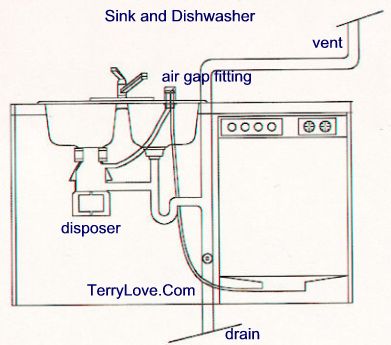
The air gap is nothing more than running the diswasher drain line up higher than the spot it actually drains into to, so if it drains into the disposal, part of the drain needs to be run typically in a upside down U shape higher than the disposal.....
 
sink_dw.jpg


I thought an air gap was a little device a couple inches high that sits on the sink which the dishwasher drain connects to.

From what I have seen, people refer to looping the drain hose up above the disposal as a "high loop" and it is not as good as an air gap. Right now my dishwasher drain features such a loop.
 
Last edited by a moderator:
oh, well ignore my post then, i've not heard of an air gap you set on your sink. Sorry! But could you not mount said device underneath sink?
 
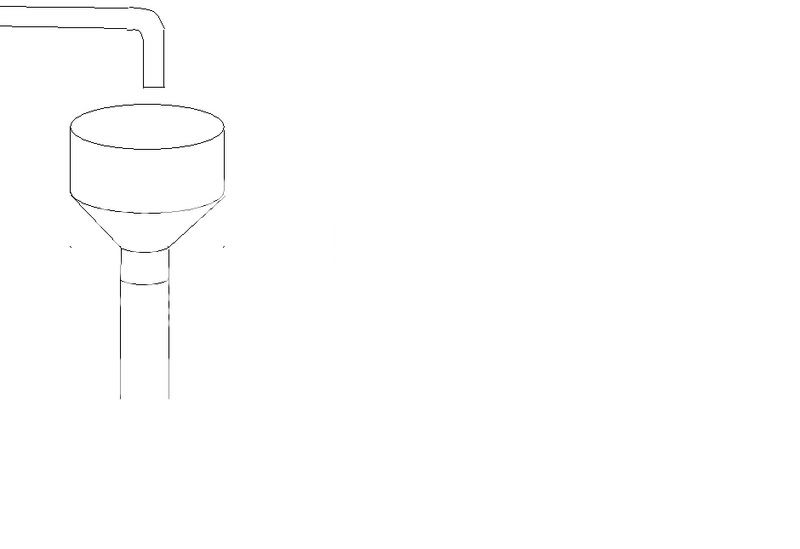
I had a guy try to get me to install an air admittance valve where the top of the loop would be... he referred to it as an "air gap".. twisted my brain on that one. I backed out and he did it all himself. He was trying to figure out how to mount it and I was trying to figure out why he needed it... said the "instructions" showed that he needed one. My idea of an air gap is where a drain terminates about 1" above a cup or funnel looking thingy, usually a 3" or 4" PVC increaser/reducer to a 2" pvc drain pipe.

airgap.jpg
 
Last edited:
The air gap and high loop are two different things. The air gap is code in some places, and not a bad idea anywhere - it provides positive protection from getting overflow crap back into the DW, a high loop usually does the same thing, but not always.

Making a nice clean hole in SS sinks shouldn't be too bad. A bi-metal hole saw will work, but a punch is better. The punch will cost more, but you might be able to rent one. The punch is a two part device, with a cutter on one side, and a cup on the other. The cup is sized so that the cutter just fits into it when you tighten the bolt. You drill a hole for the bolt, assemble the cutter on one side, the cup on the other, and then tighten the bolt. It makes a nice clean hole fairly quickly.
 
WHen I moved my DW, I used pvc with a brass barbed hose connector at each end to connect to the GD at one end and the DW at the other. The inspector accepted it, and it has been working for a few years without problems. My kitchen is a small U, with the DW directly across from the sink - with the door open, it is basically right next to the sink.
 
adrianmariano said:
I think it's just 50 years of incremental changes, no need to invoke Rube Goldberg.

Sorry, but I've not seen such an unusual drain for a dishwasher before.

Usually, the dishwasher sits right next to the sink it drains into, and it's a short run with a dishwasher drain hose into some sort of air gap and then into the drain.

There are two kinds of air-gaps: The kind that sits on top of your sink and the "high-loop" kind that is under the sink. There has been such heated debate in this forum on which one is better that I won't even recommend one over the other, except to tell you that you do need an air gap of some kind. As far as drilling through stainless steel, it takes about 20 seconds with a good bimetal hole saw.
 
Verdeboy said:
As far as drilling through stainless steel, it takes about 20 seconds with a good bimetal hole saw.
I agree with this however...
Go slowly and use a lubricant/oil to keep the blade cool - other than that, have fun...LOL
 
Randyj said:
I had a guy try to get me to install an air admittance valve where the top of the loop would be... he referred to it as an "air gap".. twisted my brain on that one. I backed out and he did it all himself. He was trying to figure out how to mount it and I was trying to figure out why he needed it... said the "instructions" showed that he needed one. My idea of an air gap is where a drain terminates about 1" above a cup or funnel looking thingy, usually a 3" or 4" PVC increaser/reducer to a 2" pvc drain pipe.

That's the kind of arrangement I used for the drain for my water softener.
 
Last edited by a moderator:
My dishwasher is separated from the kitchen sink cabinet by a fairly large corner cabinet. There is no room in my kitchen to have the two side by side. So running through the cabinets would mean going through the back of that corner cabinet.

So is the high loop adequate, or should I really put in an air gap on top of the sink? (Current installation has a high loop.)
 
High-Loop: If your sink backs up above the level of the high-loop, dirty water will drain into your dishwasher. The high loop comes to within an inch or so of the rim of the sink, so the backup would have to come up to the rim of the sink and beyond for this to happen.

Mounted Air-Gap: Dirty water will never back into your dishwasher. However, if the inlet into your garbage disposal gets plugged with debris, water will spew out of the air-gap onto your counter and onto the floor.

You decide. Also, check the code in your state if you can.
 
Disposer: with or without?

Adrian, have you mentioned somewhere above whether or not you will have a disposer?

Without a garbage disposal, you can eliminate the device known as an air gap, but you can still have an air gap! If the sink's P trap is several inches below the sink, just Tee your dishwasher drain in under the sink, several inches above its P trap. That is enough air space to do the job. The air is in the 1 1/2" drain pipe above the P trap.

That is what I have. The "T" has a slight slope to it. It's copper or brass. From there, a rubber hose loops high (from the Tee) and then down to the dishwasher.

When the dishwasher drains, I can hear it in the kitchen sink. Occasionally a few drops of rinse water splash upwards too. The noise is loud; my machine is 24 years old.

I wonder if modern dishwasher make the same amount of noise when they drain. Nobody here talks about noise as being a problem... but it sure IS a problem in an open space kitchen. Even the fridge is too noisy, at night when everything else is quiet.

David
 
Last edited:
Seems to me this subject has been beat to death! Yes, the drain needs to be totally redone. The fact that the DW is some distance from the sink is really irrelevant. You just run a hose through the back of the cabinets to the sink. I see no reason why the hose could not be under the floor. There are 2 choices to prevent a clogged sink drain from backing up into the DW. The simplest is to loop the hose and fasten it under the countertop and then into either the garbage disposal or, if no disposal is used, into a special tee with a stub for the hose installed in the sink drain above the trap. The other way is to install an air gap on top of the sink. The pros and cons of these have been discussed, but in fact either will work. For what it's worth, I've use a loop on my DWs for 35 years and have yet to have a problem. Main thing with using the loop is to attach it to the underside of the counter in such a way that it can not kink. Pick a way that will work best for you.
 
safer with

ok, i have now read a bit about "a possible cross connection or a possible back flow" when no air gap is used, with a disposer. There were 6 threads in the last two years relevant to air-gaps. I didn't see clearly whether or not there was a risk of a possible cross connection or a possible back flow when there is no disposal.... so I am still unclear about that.

Master Plumbers have responsibility and public health to deal with, so safety dictates including an air gap with a garbage disposal. I did see that "plumbers" are divided over this issue; and codes too.

david
 
Back
Top