
You are using an out of date browser. It may not display this or other websites correctly.
You should upgrade or use an alternative browser.
You should upgrade or use an alternative browser.
instead of a p-trap ----
- Thread starter fsteyer
- Start date


hj
Master Plumber
- Messages
- 33,613
- Reaction score
- 1,057
- Points
- 113
- Location
- Cave Creek, Arizona
- Website
- www.terrylove.com
siphon
No to both questions, and we would have to see more than that picture to tell if they are even effective, or desirable.
No to both questions, and we would have to see more than that picture to tell if they are even effective, or desirable.

Sponsor
Paid Advertisement


Mikey
Aspiring Old Fart, EE, computer & networking geek
I doubt any of these would pass code, which is not to say they aren't any good. US regulatory agencies are generally not the most flexible, forward-looking, innovative, etc., organizations in the world. For example, when I imported a European car a while back, I had to remove the yellow turn signals, since the US required red. Now, of course, the US requires yellow, and I don't want to talk about headlights. If you were to sneak one of those fancy traps into the US in your luggage, it would probably work great, and (eventually) pass code. Of course, if you got caught, you'd probably wind up with an all-expenses-paid vacation in lovely Gitmo.
Mikey ... I hear you. Many times (any) code approval which is supposed to be in place for the consumer has nothing to do with that. Many times unions stand in the way of progress, especially when it comes to time saving innovations. Some locations won't even allow PEX just because of the unions objections. I don't mean to offend anyone here, but being a contractor, in my opinion the building trade in the US is so far behind that it's almost comical when compared to other countries. Crimp copper connections have been used forever but just make their way here, same with electrical wire nuts vs. snap on connects, on demand water heaters with small water tanks ... the list is endless and spans all trades. Now I'm not saying you can't find these items .... I am talking about current general practices.
If you don't agree ... no hatemail please .....
If you don't agree ... no hatemail please .....
hj
Master Plumber
- Messages
- 33,613
- Reaction score
- 1,057
- Points
- 113
- Location
- Cave Creek, Arizona
- Website
- www.terrylove.com
traps
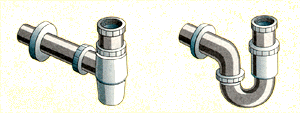
The two left ones are bottle traps and the chrome one is sold by many pedestal sink distributors. Technically they are illegal because they depend on internal baffles for the sealing, and those baffles cannot be easily tested or checked for failure or poor manufacture. The design also limits the area of the water flow passage. The right one on the inlet to the trap must just act as a flow restrictor since I cannot see any other purpose for it. But in all three cases it is not a substitute for a "P" trap, it is either a different version of a "P" trap, or an addition to one. Do not go "Continental" on us and start thinking that just because it comes from Germany or elsewhere over there, that is it far superior to what we have. If we turned the codes over to the contractors and engineers, we would probably have those things also, and a lot of other questionable shortcuts to save construction costs.
The two left ones are bottle traps and the chrome one is sold by many pedestal sink distributors. Technically they are illegal because they depend on internal baffles for the sealing, and those baffles cannot be easily tested or checked for failure or poor manufacture. The design also limits the area of the water flow passage. The right one on the inlet to the trap must just act as a flow restrictor since I cannot see any other purpose for it. But in all three cases it is not a substitute for a "P" trap, it is either a different version of a "P" trap, or an addition to one. Do not go "Continental" on us and start thinking that just because it comes from Germany or elsewhere over there, that is it far superior to what we have. If we turned the codes over to the contractors and engineers, we would probably have those things also, and a lot of other questionable shortcuts to save construction costs.
Mikey
Aspiring Old Fart, EE, computer & networking geek
Didn't mean to imply that just because something was foreign it was by definition good, but the code writers, whoever they are, do move slowly, with sometimes humorous results.a lot of other questionable shortcuts to save construction costs
I can't see what the chrome jobby on the right has that the $1.59 plastic traps I use don't have. I hate chrome for many reasons. Is there some kind of magic in the white barrel-like piece in the input arm?


hj
Master Plumber
- Messages
- 33,613
- Reaction score
- 1,057
- Points
- 113
- Location
- Cave Creek, Arizona
- Website
- www.terrylove.com
trap
The only problem you might have with getting a 2" trap in a 2x6 bay, using these, would be that they probably only come in 1 1/4" and 1 1/2" patterns.
The only problem you might have with getting a 2" trap in a 2x6 bay, using these, would be that they probably only come in 1 1/4" and 1 1/2" patterns.

Bill Arden
Computer Programmer
The water flow in the top square one would be turbulent and would be more likely to plug up with hair and other objects.
I think the P-trap is still much better even if you use smaller pipe. Why use large pipe in the trap section if the popup sink drain only has an effective pipe size of 3/4 inch?
The P-trap is also better when you are trying to unclog it.
I think the P-trap is still much better even if you use smaller pipe. Why use large pipe in the trap section if the popup sink drain only has an effective pipe size of 3/4 inch?
The P-trap is also better when you are trying to unclog it.
Similar threads
- Replies
- 0
- Views
- 364

- Replies
- 4
- Views
- 517

- Replies
- 0
- Views
- 175

- Replies
- 8
- Views
- 3K

