Copper Pipe repair for a newbie

HA217

New Member
Messages
5
Reaction score
0
Points
0
Location
New York
Hello All,

Last winter a pipe in an outer wall first floor bathroom busted due to the freezing cold and there being no central heat on in the house for a few days.

I finally found the break in the line after ripping up a section of that bathroom floor and crawling under the bathroom (I have an older home and I'm pretty sure that bathroom was a later addition).

Now that I have the break in front of me, I'm not totally sure how to proceed.
I don't know what type of repair would be best. I'm not afraid to solder and have capped and sealed a pipe before with a torch and solder.
However, it's such a clean break, I don't know if I should just try to butt the pipe back up to the T-joint and solder or, try to use a sleeve, or what.
The pipe is not in a place that's very accessible so, I want to make sure I do it right the first time.

Any suggestions?

Thanks, in advance!

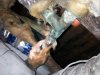
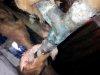
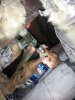
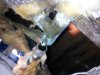
Here's the pics of the pipe-


20130614_123041.jpg20130614_123048.jpg20130614_123056.jpg20130614_123118.jpg20130614_123123.jpg
 
I would say you need to cut the tee out ( about 8" ). You can get couplings without a 'stop' - so you won't need a union.

If the tubing has expaned because of freezing - anneal it (by heating and letting it cool slowly) - you can use a flare block to bring it back to size.
 
I would say you need to cut the tee out ( about 8" ). You can get couplings without a 'stop' - so you won't need a union.

If the tubing has expaned because of freezing - anneal it (by heating and letting it cool slowly) - you can use a flare block to bring it back to size.
 
Thanks for that information.
When you say cut the tee out about 8", are you saying 8' back down from it's source (stem of the T)?
Then I'd be repairing the new cut, I just made, down the base of where the T was and attaching the two connections of the tee back on (One where it's currently broken, and the opposite side of it)?
I'm trying to picture this.
 
What I was suggesting is to cut the tubing (from each branch of the Tee) about 8" back (if you have the room), and replace the tubing and Tee.

In order to solder to the Tee you will have to heat up the entire Tee - Heating up that old fitting may prove problematic.
 
If you have enough movement to remove the T, I'd just remove it and replace it. This is assuming it is the T that has cracked. If it is a section of pipe, then you do need to cut out that section and replace it. A repair coupling, as mentioned, does not have a stop in the middle and would be used if you can't move the pipe enough to slip the one with a stop in there. I'd rather solder one fitting than four (a repair coupling on each leg and the T if I could help it. You do not need to remove the existing solder on the pipe ends IF you can flux it and still push it into a new fitting. If it's too tight, then clean it off enough so it will fit in. It's actually easier to solder to the new fitting when it already has a nice coat of solder on it.
 
Initially, I was thinking it looked like that could be done but, it seemed to simple; which made me think twice.
Also, the pipe looks like it mates at the same size to the coupling so, I'd probably have to reheat it to re-size it as DougB suggest.
 
Heat the pipe, take a natural fiber cloth (cotton works) and wipe the outside of it to remove most of the solder. Then, see if it will push back in. You don't want to use something like a polyester or nylon cloth since it will melt, leaving a mess.
 
OK, I was able to slide the pipe back in although, after cleaning it back to its shiny finish I realize I was unable to get the pipe as far in as it previously was.
I solder it, to the best of my ability, turned the water on and , of course water shot out of it.
I'm thinking my solder didn't get to the top of the pipe, because I can't see up there.
I kept putting the solder up there, even wrapped it around the joint and heated the pipe up from below.
Is there a trick to this?
 
leak

Once it leaks water, you will NEVER be able to resolder it without taking it apart and cleaning it again. be sure to flux both sides properly before puting them togehther.
 
I already took it back apart. I cleaned it again with steel wool and will be going over it again with the flux.
I'm just wondering how to handle that angle? Is there a tool or trick for this. If it comes down to it, I can cut out the wood flooring above the spot but, I'm thinking there's got to be an easier way.
 
I already took it back apart. I cleaned it again with steel wool and will be going over it again with the flux.
I'm just wondering how to handle that angle? Is there a tool or trick for this. If it comes down to it, I can cut out the wood flooring above the spot but, I'm thinking there's got to be an easier way.

I've got to ask the obvious!

You are cleaning the inside of the fitting, also?

If the pipe is clean and the inside of the fitting is clean, flux on both, heat applied to the correct area, then the solder should be sucked up and around for a water tight joint.

Adding more solder after the initial amount is a waste of time and solder.

If it was at an angle before then you should be able to re-assemble it the same way.
 
Solder flows towards the hotter surface so if you don't heat around the whole pipe, while conduction will work to an extent, you may not get great flow. But, if you got a decent coat of flux on things and it was clean going in, if the solder melted, it should be okay. I will say that if you don't solder frequently, some of the fluxes out there are a real pain. I like the one that has ground up solder in it, often called a tinning flux. Some of the newer water based fluxes are a pain to use until you get the hang of them, and a DIY'er may not! Overheating the joint will burn out all of the flux, and can create a bad joint. Try to get the torch around as much of the fitting as you can, then remove it - touch the solder to the joint, and if it's hot enough, it will suck in the solder. Keep the flame on it, and you're more likely to overheat it. Another thing that can create a bad joint is if the pipe gets hot enough and there's some moisture in there that turns to steam...it can force a hole through the solder joint while it is still molten. Open up a faucet on that line to provide a path for it to go.
 
Solder flows towards the hotter surface so if you don't heat around the whole pipe, while conduction will work to an extent, you may not get great flow. But, if you got a decent coat of flux on things and it was clean going in, if the solder melted, it should be okay. I will say that if you don't solder frequently, some of the fluxes out there are a real pain. I like the one that has ground up solder in it, often called a tinning flux. Some of the newer water based fluxes are a pain to use until you get the hang of them, and a DIY'er may not! Overheating the joint will burn out all of the flux, and can create a bad joint. Try to get the torch around as much of the fitting as you can, then remove it - touch the solder to the joint, and if it's hot enough, it will suck in the solder. Keep the flame on it, and you're more likely to overheat it. Another thing that can create a bad joint is if the pipe gets hot enough and there's some moisture in there that turns to steam...it can force a hole through the solder joint while it is still molten. Open up a faucet on that line to provide a path for it to go.

Hey, you turned my synopsis into a tome!

All good info.

I was taught by the pros and measure, cut, debur, shine, flux, heat, solder still stays with me.

I was getting real proud of myself until the inevitable happened.

They felt sorry for me and then I learned all the "tricks of the trade".

And since I'm old, I forgot and can't pass them along;)
 
I was taught to use the same length of solder as the diameter of the pipe. In other words, if you are using 3/4 pipe, put a bend in the end of the solder about 3/4" from the end. That should be all the solder you need to sweat the joint.
 
Back
Top