Toilet flange over tile floor

Mar3232

Member
Messages
246
Reaction score
2
Points
18
Location
Indiana
I've put down my hardiboard and ready for tile -- also know where I want to mount the toilet flange and have already cut the circular opening through the hardiboard and subfloor.

Is it possible to just lay the tile so the outside of the the toilet is resting on the tile but the flange is mounted to the hardiboard? I'm guessing because of the thickness of the flange itself, almost 1/4", like the tile that it would be ok.

Of course, that way I don't have to try and cut a circle in the tile.

In other words -- flange would be seated on the cement board, not the tile.
 
It is proper to install the flange on top of the finished floor.

A diamond blade in a 4" grinder works good for shaping curves and large holes in tile. It is messy and best done outside.
 
ok thanks -- thought that may be the case. I do have some 1/4" HDPE plastic (same thickness of tile) certainly easier to work with for the circle -- maybe I can build up the area around the drain then put flange on top? me and tile don't get along.
 
You could do that. In finishing, no matter how you fill the gap, you will want the flange screws to go all the way through so the assembly is mounted solidly to the subfloor.
 
right -- using machine screws and nuts with thread lock.

you don't have to caulk around the toilet where it meets the floor do you?
 
Once you have installed the toilet, it is good practice to "caulk" around the base of the toilet. This is important for a variety of reasons, among them that when you wash the floor, water won't run under the toilet and create a smelly mess in there, ants and roaches won't congregate in there, etc.

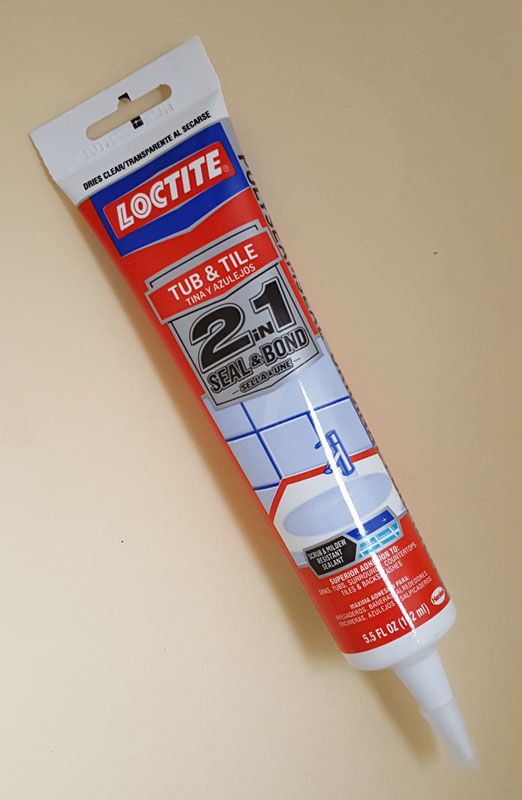
Terry uses and recommends Polyseamseal instead of caulk. The reason is, among other things, that it is easy to remove and removes cleanly when you later want to take up the toilet, either to replace it or to get into the pipe or pull a GI Joe from the toilet trap (one of my favorite pictures that Terry has posted on the sources of toilet clogs that he has found). You can get it in a little tube, or a cartridge suitable for your caulk gun.

In many jurisdictions, code requires that the toilet be sealed with caulk or the like. In some places, you seal all the way around but leave the back open. In others, you seal the entire thing.

For the DIY-er, it's kind of like putting a little icing design on the cake. I find it kind of fun to put down the bead and use the little tool to make it look nice.

One tip: use your Dremel or hacksaw to cut the toilet bolts to the right height BEFORE you do the caulk. Otherwise, you will get dirty-looking metal dust in the caulk.

loctite-tub-tile.jpg


Last edited by a moderator:
I like to use #12 stainless steel screws to secure the flange to the sub floor. Stainless steel maybe a bit overkill, but for a few pennies more you know they will never rust out. Caulking around the toilet is required in most areas. Some want it 100%, others want the rear end of the base left open. The "little tool" (As seen on TV) is a handy dandy and will make a nice small bead. However, you can get a good looking finish if you use a wet finger to smooth it out. A cup of water and a rag to keep the excess caulk cleaned off the finger and keep the bead spreading smoothly works well too.
 
I like to use #12 stainless steel screws to secure the flange to the sub floor. Stainless steel maybe a bit overkill, but for a few pennies more you know they will never rust out. Caulking around the toilet is required in most areas. Some want it 100%, others want the rear end of the base left open. The "little tool" (As seen on TV) is a handy dandy and will make a nice small bead. However, you can get a good looking finish if you use a wet finger to smooth it out. A cup of water and a rag to keep the excess caulk cleaned off the finger and keep the bead spreading smoothly works well too.
If you can use water to smooth out your caulking, your not using 100% silicon as you should. Denatured alcohol works on 100% silicon caulking.
 
I use water when smoothing silicone caulk all the time. The purpose of the water is to reduce the friction and keep the caulk from sticking to your finger.

I don't like to use silicone caulk on toilets, because it has a strong adhesive bond, which makes it very hard to remove if the toilet needs to be re-set at some future date.
 
I use water when smoothing silicone caulk all the time. The purpose of the water is to reduce the friction and keep the caulk from sticking to your finger.

I don't like to use silicone caulk on toilets, because it has a strong adhesive bond, which makes it very hard to remove if the toilet needs to be re-set at some future date.
I'll repeat that again, if water works, your not using a 100% silicon caulk. If you choose not to use it for other reasons, hard to work with, etc. that's something else. I used 100% silicon on a bathroom sink install for the first time thinking that water worked as before with caulk. Boy was I ever wrong, what a mess, it sticks to everything! I looked it up later in a plumbing forum where they stated to use denatured alcohol. I had some right there at the time too!

I was all ready on my toilet install and using denatured alcohol works just like water does on other types of caulking. Surprised that you guys don't know this. I guess that you don't use 100% silicon on anything?
 
Bill, silicon and silicone are 2 different things, but I think you are simply spelling it wrong.

I think the difference between your experience and mine is the technique we are using to smooth the caulk, but I can promise you that my technique works with either. The silicone just requires a little more finesse.
 
Bill, silicon and silicone are 2 different things, but I think you are simply spelling it wrong.

I think the difference between your experience and mine is the technique we are using to smooth the caulk, but I can promise you that my technique works with either. The silicone just requires a little more finesse.
Excuse my spelling error. Silicone caulking and 100% silicone caulking are two different things. Whatever your calling silicone has "some" silicone in it but not enough to be a problem. If you lay a bead of 100% silicone, dip your finger in water, touch it and it sticks to your finger. In order to be able to smooth it out, you have to use denatured alcohol. It's much thicker and doesn't flow.
 
Back
Top