4 Gang Switch Box Wiring diagram

ChrisNJ

New Member
Messages
22
Reaction score
0
Points
0
Location
NJ
Hey all. Other than my poor artistic skills, spelling and use of scrap paper does this plan look acceptable? This is a dedicated 15 amp circuit on a GFCI breaker (it's gonna be in a bathroom) straight from the panel using 14-2 NM. Black is hot, blue neutral, green ground.


For the three 5 wire connections in the switch box, I was going to use Ideal 452 Wing Nuts in red for hot and neutral wires but I'm not sure if I can use those for the ground wire.

As an alternative, can "rabbit ear" connections still be used rather than the 452 nut? Any suggestions or criticisms will be most appreciated. Thanks!
 
Ground wire (EGC) connections are no different than any other wire connections. Never heard of "rabbit ears", but if its a listed wire splicing device,
and has the capacity for the number and size of wires,
it should be fine. You need to ensure the switch device yokes are grounded, which may possibly require connection to the EGC.
 
Ground wire (EGC) connections are no different than any other wire connections. Never heard of "rabbit ears", but if its a listed wire splicing device,
and has the capacity for the number and size of wires,
it should be fine. You need to ensure the switch device yokes are grounded, which may possibly require connection to the EGC.

Thanks! Is it acceptable to pigtail the EGC to the 4 switches as long as I don't exceed each individual splice's capacity? For example:


How's that look? Or do you have a suggestion? I'm all ears.
 
It's not only acceptable, it's required if you're using a plastic box. There are many ways to physically attach the wires, what you show looks fine.
 
The color of a "wire nut" is a function of its size and capacity. I have a feeling that you are going to run out of "box capacity" very quickly if you make ALL those spices you show.
 
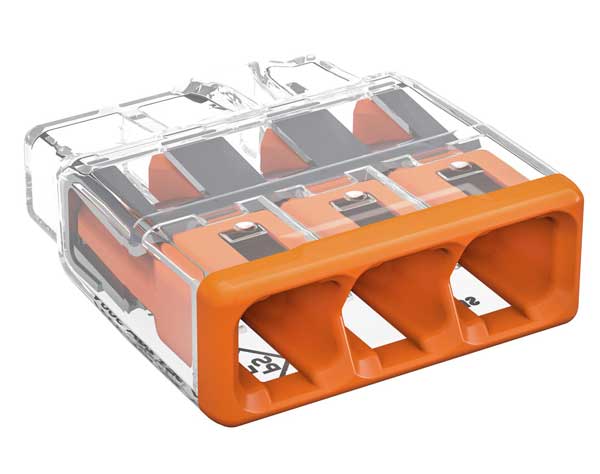
Push-in (Wago-style) connectors are handy for making those pesky ground connections; you can get 'em with up to 8 holes.

wago.jpg
 
Last edited by a moderator:
You can cut down on the number of wires in the switch box by going with 14-3 to one device box with two switched hots and then continuing on with 14-2 to another.

Hope that makes sense...
 
You can cut down on the number of wires in the switch box by going with 14-3 to one device box with two switched hots and then continuing on with 14-2 to another. Hope that makes sense...

It does. That will save a ton of box space. Thanks.
 
Push-in (Wago-style) connectors are handy for making those pesky ground connections; you can get 'em with up to 8 holes.

Gonna grab some of those too since all the stuff I'm connecting doesn't draw too many amps.
 
Last edited:
Gonna grab some of those too since all the stuff I'm connecting doesn't draw too many amps.

You can also save lots of wire by daisy-chaining the common hot and the ground. One wire long enough to go from one switch to the next, with enough insulation removed to wrap around a screw. Not cut, continuous across the screw to the next switch.

Very much a pain with 12 ga, but everything is a pain with 12 ga. Happily you are using 14 ga, which makes all this much easier.
 
Gonna grab some of those too since all the stuff I'm connecting doesn't draw too many amps.

You can also save lots of space by daisy-chaining the common hot and the ground. One wire long enough to go from one switch to the next, with enough insulation removed to wrap around a screw. Not cut, continuous across the screw to the next switch. Don't damage the conductor.

Very much a pain with 12 ga, but everything is a pain with 12 ga. Happily you are using 14 ga, which makes all this much easier.
 
You can also save lots of space by daisy-chaining the common hot and the ground. One wire long enough to go from one switch to the next, with enough insulation removed to wrap around a screw. Not cut, continuous across the screw to the next switch. Don't damage the conductor.

Will that pass inspection?
 
Will that pass inspection?
I did that here and it passed -- but the inspector didn't look that closely in every box. Here they seem to be looking for things that stick out like wires cut really short or a box crammed full of wires (or a single gang duplex box with four or five NM cables going into it).

The other thing here (may work there or not) is that when I'm not 100% sure about something I point it out and ask before the inspector discovers it -- if I did something minor wrong, he says how it should be (before the next inspection) and then signs it off.
 
quote; 14-3 to one device box with two switched hots and then continuing on with 14-2 to another.

That assumes the two "switched hots" have a common path.
 
Back
Top