
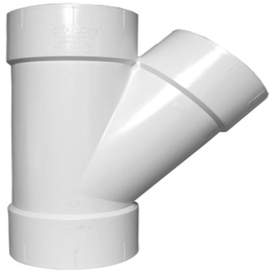
I'm prepping a new tub and plan to solvent weld all all the fittings. The trap will be directly under the overflow pipe. I think I can fit a wye in the overflow such that it will end up in the bathroom wall where I will leave an access panel. It seems like this may make cleaning out the trap easier in the future. Assuming it will fit, are there any problems with doing this?

You are using an out of date browser. It may not display this or other websites correctly.
You should upgrade or use an alternative browser.
You should upgrade or use an alternative browser.
Wye in bathtub overflow
- Thread starter _mike_
- Start date

JohnjH2o1
Plumbing Contractor for 49 years
Why would you need a Y for a clean out in the overflow? Just remove the overflow plate and snake the line from there. It's been done like that for as long as I can remember. Which is a very long time.
John
John

Sponsor
Paid Advertisement

hj
Master Plumber
- Messages
- 33,613
- Reaction score
- 1,057
- Points
- 113
- Location
- Cave Creek, Arizona
- Website
- www.terrylove.com
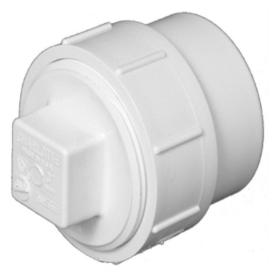
If you go to the trouble of putting a "cleanout" in the overflow, why bother with an access door? Just put a plug and cleanout cover like we do with other cleanouts inside the wall.
Why would you need a Y for a clean out in the overflow? Just remove the overflow plate and snake the line from there. It's been done like that for as long as I can remember. Which is a very long time.
Everything is open and it's not much work. I recall the old tub being a pain to snake so I'm trying to make life easier.
If you go to the trouble of putting a "cleanout" in the overflow, why bother with an access door? Just put a plug and cleanout cover like we do with other cleanouts inside the wall.
I can do this. I was going to cap the Wye with a threaded plug. It looks like, at least in some cases, that the cleanout covers attach to the cleanout plug. Most of those seem to be for 90 degree holes as opposed to the angle of a Y. Am I finding the right items (cover that attaches to plug)?

LLigetfa
DIYer, not in the trades
Personally, I would be more inclined to put a cleanout after the trap to facilitate snaking the line. That way I can snake through the overflow to just past the trap and use the cleanout for beyond the trap.

Cacher_Chick
Test, Don't Guess!
Does someone make a tub waste and overflow assembly that is sized to cut a schedule 40 wye into the overflow pipe? I was under the impression that most were thinwall tubular units, which would not fit into a hub and spigot type connection.
Personally, I would be more inclined to put a cleanout after the trap to facilitate snaking the line. That way I can snake through the overflow to just past the trap and use the cleanout for beyond the trap.
The trap goes to to a T that has straight shot to the basement. In the old setup the vent was connected to a 90 on top of the T. I'm going to use another T instead of the 90 and put a cap there too.
I'm trying to make snaking a fast and easy job because the kids that use the bathroom have perfected getting plugs of hair into tub and shower traps. Cleaning them out is at least a 2x per year exercise. I'm amazed that they have any hair left on their heads.
Does someone make a tub waste and overflow assembly that is sized to cut a schedule 40 wye into the overflow pipe? I was under the impression that most were thinwall tubular units, which would not fit into a hub and spigot type connection.
All the parts are schedule 40, solvent welded. I'm hoping that using the schedule 40 will provide a better service life than the slip joint fittings with the gasket. There are fewer failure points (gasket, nut, the thinner tubing, etc.) with the only downside that I can see being you can't take it apart to clean it out and you need to be precise in in the initial assembly.
Does someone make a tub waste and overflow assembly that is sized to cut a schedule 40 wye into the overflow pipe? I was under the impression that most were thinwall tubular units, which would not fit into a hub and spigot type connection.
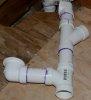
Here's a photo:

Kreemoweet
In the Trades
Better service life? I've encountered numerous slip-joint tub w&o assemblies that have given good service for 50 years or more. Quality fittings
are still available, just not at BigBox. If you have an access panel, standard slip-joint is the way to go.
are still available, just not at BigBox. If you have an access panel, standard slip-joint is the way to go.
Cacher_Chick
Test, Don't Guess!
I've only replaced one tub drain, and used a brass/bronze waste and overflow.
hj
Master Plumber
- Messages
- 33,613
- Reaction score
- 1,057
- Points
- 113
- Location
- Cave Creek, Arizona
- Website
- www.terrylove.com
quote; the only downside that I can see being you can't take it apart to clean it out and you need to be precise in in the initial assembly.
1. We NEVER take the drain assembly apart to clean it.
2. Actually, with sch 40 pipe and fittings you have MORE latitude, since there are fittings to make 'offsets", etc., that you CANNOT do with the tubular drains.
3. It has been "decades" since I have used a tubular waste and overflow, and those were furnished by the customer.
1. We NEVER take the drain assembly apart to clean it.
2. Actually, with sch 40 pipe and fittings you have MORE latitude, since there are fittings to make 'offsets", etc., that you CANNOT do with the tubular drains.
3. It has been "decades" since I have used a tubular waste and overflow, and those were furnished by the customer.
Similar threads

- Replies
- 3
- Views
- 532

- Replies
- 0
- Views
- 838
- Replies
- 1
- Views
- 219

