It's the low-temp end of the curve that has the biggest effect on cycling, not the high end. When the water temps are low the radiation puts out less heat, and when the water temp is low enough that the radiation can't put out the min-fire output of the boiler the thing cycles. If you can program the hysteresis around the setpoint, increasing that will lengthen the burns by "exercising" the thermal mass of the system a bit more.
The minimum output of the thing in condensing mode is about 28,000BTU/hr, which is a significant amount of heat- could be more than half your actual heat load at design temp if that 70K heat load is a Manual-J type heat loss calc rather than calculated from fuel use. (The
99% heating design temp for Ithaca is 0F, 28K is more than 80% of the heat load of my house at 0F.) The minimum burn time depends on the thermal mass of your smallest zone (most of which is the water in the tubing), and the programmed temperature hysteresis. If you have say 1000' of half inch PEX in the smallest zone, that's about 85 lbs of water. Now 28,000BTU/hr is roughly 470BTU/minute, so at low temp when the floor isn't emitting much heat into the rooms, at min-fire that water heats up at (470/85=) 5.5F per minute. With the hysteresis is set to 10F you're looking at 2 minute burns, but if it can be bumped to 25F you'd hit 5 minutes. Whatever the boiler's controls allow for hysteresis, max it out.
Do the lipstick-on-napkin-math of your actual system, assuming you know the tubing layout. In very rough terms you're looking at 8.5lbs of water-equivalent thermal mass for every 100' of half-inch PEX, 8.5lbs for every 50' of 3/4" PEX. The boiler itself has about 20 lbs of water-mass. Add up each zone separately, since they can all call for heat separately. The key is find the water temp and hysteresis to get the min-burn on your smallest zone up to the 5 minute range.
If there's a programmable hard low-limit to the boiler to block the reset curve from taking it any lower, start by setting it to 120F, then see what happens- time the burns when it's just maintaining (not a cold-startup). If you get 5+ minute burns out of it serving only your smallest zone, drop the temp 5F at a time until you drop below the 5 minute threshold and go no further.
The actual whole-house heat load could be calculated from mid-winter fuel usage measured against degree-day data for the billing period, and from there the water temp requirements estimated from the square footage of radiant floor, the type of heat transfer plates, subflooring, and finish flooring. But since you know it keeps up with 140F, starting with 140F @ 0F is a good place to start on the high-temp end of the reset curve, and you can work down from there. The output is roughly linear with temperature above 70F, and from the fuel-use numbers we can calculate the heat load at any arbitrary outdoor temp. But if it needs 140F at 0F outdoor temps it will only need 85-90F water at +35F, and the hysteresis of the thermal mass of the smallest zone becomes critical. If you run the experiments and time the burns you'll know where to set the hard-bottom of the curve.


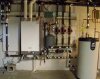 Just hooked up outdoor reset on our Triangle Tube Prestige 110 boiler. I'd appreciate recommendations regarding the Prestige's internal circulator speed setting. Specifically I'd like to know whether running it on low speed would provide adequate flow through the boiler. I realize there are factors to take into consideration. All near boiler piping (1") is according to the TT manual with Primary Secondary. Three radiant zones each use their own 3 speed Grundfos circulator and manifolds to monitor flow. Loop lengths are within spec using predominantly subfloor pex in plates. The 110 boiler is oversized for our heat loss of 70K BTU, but it supplies a Smart 40 gal. indirect tank also. I ask about reducing the internal pump speed because the boiler cycles slightly more than I prefer in the fringe season (currently 40's) if not all zones are calling for heat. I thought that a low internal pump speed would permit the secondary zone pumps to pull the heat from the boiler to reduce short cycling. I'd rather not increase the secondary pump speeds in order to preserve electricity costs. My biggest concern is harming the boiler or reducing it's longevity.


