Toilet Drain/Joist Clearance

DIYdude

Member
Messages
79
Reaction score
0
Points
6
Location
Seattle,WA
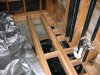
Is there a minimum clearance requirement between a joist and a toilet drain opening? I read something about, I think, 3" from the center of the drain to a joist. I'd like to sister the bad joist in the attached pic. If my calculations are correct, doing this will leave me about 1/2" from the edge of a properly-centered 5" drain hole in the subfloor to the new sister.

Thanks.
 

Attachments

  • toilet drain and joist2.jpg
    toilet drain and joist2.jpg
    46.5 KB · Views: 1,987
From a practical viewpoint, most toilet flanges are a cone, so they flare out from the pipe. Thus, if the joist was right next to the pipe, you may not be able to slide the flange on while gluing it in place - at least you may not be able to slide it all the way in. Now, this is often more of an issue with a 3" pipe than a 4" pipe where you could use an internal flange.

Don't know if there's an actual code issue here, but more of a practical issue on what will fit.
 
I don't see much joist left in that photo, I hope it wasn't you who went crazy with a sawzall.
 
I would pull the shutoffs at this time and stub out copper.

You should go with a new pressure balance valve for the tub there.
There is a drain for one in the corner, right?
You will need space for the waste and overflow that will be lower than the floor there. Looks kind of tight right now. Normally the drain is about 10" from the wall at the end.

I will say the framing looks new and solid.
 
I don't know about your jurisdiction, but here they would require EITHER some of the foam "gasket" material between the new joists and the concrete (or block) wall, OR have the new joists rest on a pressure-treated plate. It's generally frowned upon to have non-pressure treated wood in direct contact with concrete.
 
I don't know about your jurisdiction, but here they would require EITHER some of the foam "gasket" material between the new joists and the concrete (or block) wall, OR have the new joists rest on a pressure-treated plate. It's generally frowned upon to have non-pressure treated wood in direct contact with concrete.

I have building paper under the joists; it's not easy to see in the picture. I confirmed with the city that this is ok.
 
I would say that "triple" joists are an "overkill".

Thanks :) Seriously, I wanted to flatten the floor from below before I attached the subfloor, so I added a second sister to the second joist from the wall to make the joist heights even across the floor. The first joist nearest the wall was an absolute mess, so I patched it and sistered on both sides.

I don't know about your jurisdiction, but here they would require EITHER some of the foam "gasket" material between the new joists and the concrete (or block) wall, OR have the new joists rest on a pressure-treated plate. It's generally frowned upon to have non-pressure treated wood in direct contact with concrete.

I have building paper under the joists now. I confirmed with the city that this is ok. I got a lecture about that when I took some pictures to City Hall to ask about boxing in the drain. Is that a newer code standard? Most or all of the floor joists on the first floor are resting on the foundation. The house was built in 1976.

I would pull the shutoffs at this time and stub out copper.

You should go with a new pressure balance valve for the tub there.
There is a drain for one in the corner, right?
You will need space for the waste and overflow that will be lower than the floor there. Looks kind of tight right now. Normally the drain is about 10" from the wall at the end.

I will say the framing looks new and solid.

Sorry, the picture doesn't show that I'm actually boxing in the tub drain. I'll have to read up on pressure balance valves. Thanks for the suggestion.
 
Last edited:
For a number of years, ALL legal shower valves sold in the USA have anti-scald technology. The most common way to do this is with a pressure balance valve although some thermostatically controlled valves are fast reacting enough to qualify without some additional internal controls. Some places still sell valves that do not meet this requirement, but that doesn't mean they are legal to use (seems like they'd be required to only sell legal, code-compliant devices, but that isn't the case). The most common ones are a single handle that does not have a volume control...they're either all on or all off. There are some that still have a volume control, if that is important to you, but none I'm aware of still have separate hot and cold valves you control separately, only temperature control.
 
For a number of years, ALL legal shower valves sold in the USA have anti-scald technology. The most common way to do this is with a pressure balance valve although some thermostatically controlled valves are fast reacting enough to qualify without some additional internal controls. Some places still sell valves that do not meet this requirement, but that doesn't mean they are legal to use (seems like they'd be required to only sell legal, code-compliant devices, but that isn't the case). The most common ones are a single handle that does not have a volume control...they're either all on or all off. There are some that still have a volume control, if that is important to you, but none I'm aware of still have separate hot and cold valves you control separately, only temperature control.

Ah, those valves. Ok, thanks.
 
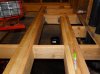
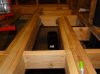
When I was looking to remove the subfloor, I took a semi-crude route for removing the outside-fitting flange; used a drill, screwdriver, and mini-hacksaw. This left the collar of the flange still attached to the pipe, and the ABS cement is solid as a rock (the pipe is not damaged). Now that I have the floor open and I have a much better view, I want to clean up the sewer pipe before I reinstall the subfloor. I thought about cutting the pipe after the elbow when I initially looked at removing the flange, but there isn't much pipe after the elbow. Now, I was thinking of replacing the elbow and adding a section of pipe for the new flange if I can't somehow remove the remaining portion of the existing flange. Thoughts?
 

Attachments

  • DSC01142.jpg
    DSC01142.jpg
    54.9 KB · Views: 1,441
  • DSC01143.jpg
    DSC01143.jpg
    40.8 KB · Views: 1,370
Last edited:
Quit your thinking so much. :)
Run down and pick up either a long turn 90, or a medium and a coupling.
Wack off what you have and start over. (with a saw or cutter)

You could also drill out the pipe from the fitting, but it's cheaper and quicker to just pick up new fittings.
 
Quit your thinking so much. :)
Run down and pick up either a long turn 90, or a medium and a coupling.
Wack off what you have and start over. (with a saw or cutter)

You could also drill out the pipe from the fitting, but it's cheaper and quicker to just pick up new fittings.

Thanks, Terry - needed that :) Moving on now...
 
Ok, I got the new 90 installed, but it's a little of level and puts the center of the drain at about 12 3/4" from the rough wall. Should I be concerned about this? I was thinking about cutting a slight angle on the end of the pipe that will sit in the top of the 90 to correct it.

DSC01149.jpg

DSC01150.jpg
 
Take two - started over: The elbow is now fairly close to plumb, and the center is at 12 1/2" from the rough wall.
 
Last edited:
Back
Top