Drain question: new utility sink + washing machine drain

brownetowne

New Member
Messages
4
Reaction score
0
Points
0
Location
madison, WI
I am replacing a utility sink in my basement near the washer / dryer. The old setup had the washer drain line empty into the utility sink basin. As part of the project, I would like to plumb the washer drain directly into the plumbing. Two questions:

1. *What's my best drain option for both the utility sink and the washer?

2. *Something I liked about draining into the sink was the additional lint catch wire mesh sock that I could dispose of 2-3 times per year. If I plumb into the line, is there something that would allow an interchangeable lint filter?

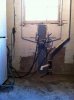
The existing setup is fairly simple —*a single trap that drains into a main stack. I'd upload the photo, but I seem to be having problems with that feature of this forum...
 
The sink may be connected to a 1-½" drain line. This is not adequate for a washing machine directly draining, and is not up to most codes
 
There challenges are that the washer will require a 2" drain and the traps from the washer and sink must be vented through the roof.

Assuming you will need to run a new drain line into the building sewer, you will need to get a plumbing permit from the city and have the work inspected by the local plumbing inspector when it is ready.

You can post a photo it's easiest to have it hosted on another web site and use their url.
 
browntowne1.jpg

Plumbing in basement
 
Last edited by a moderator:
thanks all for the replies.

this is the current setup.

I know I need to install new valves for the utility, but I have no idea where to start on the washer drain —*can it just be an addition to the sink drain after the trap?

thanks!
 
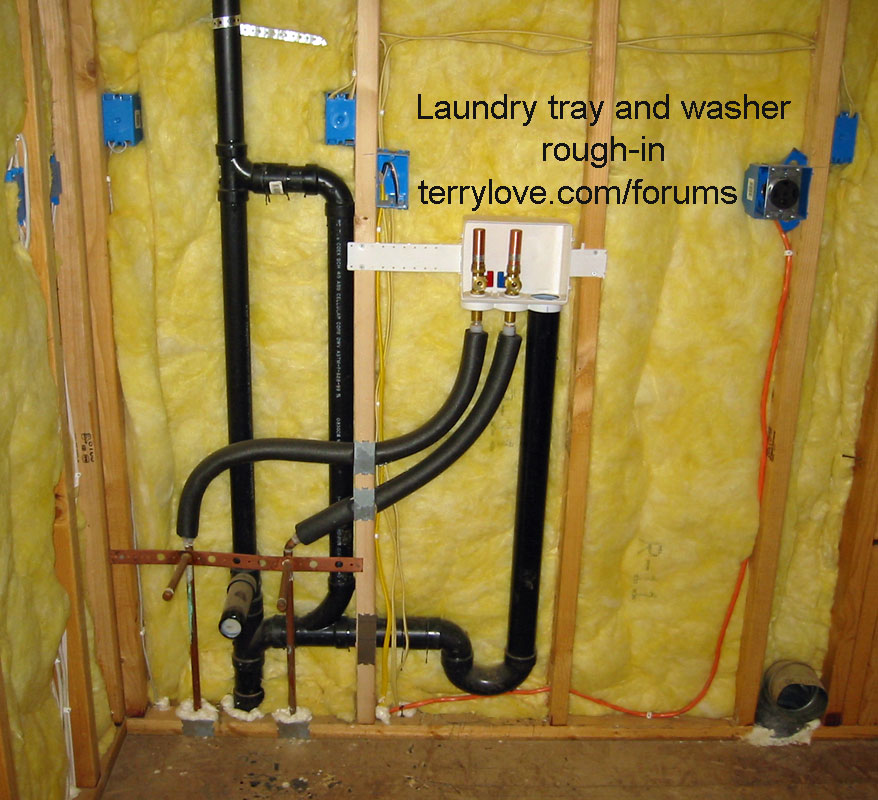
Terry's is a perfect example of how it can be done.

Luckily, it appears that you have an existing vent.

You must have a separate sanitary tee in the drain stack for each of the 2 fixtures, with the sink tee directly above the laundry tee.
The sink and the laundry standpipe must each have their own individual trap.
 
Brownetowne,

Is there a kitchen sink above this? If so, check and see if the kitchen sink drains into the pipe going to the sink drain in the basement. If so, let us know as that will change our recommendations a bit, OK?

Back to you...
 
Thanks for the recommendations, all.

I made some headway last night after realizing I should re-route the water lines to one side of the basement window. Not ready to post and show quite yet, because that phase of the project isn't done yet.

More to come tonight though.

I'll post a picture with my idea of what needs to go where.

Thanks!
 
Can someone explain if there is any specific height to where the washer drain vent connects to the main vertical vent in this photo (near all the blue outlet boxes)? I am building a half-wall laundry area and would like to keep the wall as low as possible, hence hiding the connection in the wall. Thanks
 
By code, if I'm understanding your question, the re-vent must be 42" or 6" above the flood plane, whichever is higher. The flood plane would be the top of the stand pipe, since if there was a clog below, it could rise to the top of that. Also note, that once a vent, always a vent, or once a drain, always a drain. IOW, you can't vent into a drain unless you re-vent it properly.
 
Washer Wall box

It would look something like this

washer_rough_b.jpg
I know this is a somewhat of an older topic, but is there a code requirement for how far up the wall box has to be? I've got a window at 40.5 and I was hoping to attach the wall box under the window.
 
There is a code requirement on the min/max length of the standpipe (the vertical above the trap). Then, you have the depth of the trap, which is really your limiting factor (well, you have to have enough room to install the sanitary T on the drain line, too). I don't remember the exact numbers (and it may change based on which set of codes you use where you live).
 
ive installed this setup, and the wife doesn't like the way it looks so, she would like it all hidden behind the washer. my question is how low can i put the box and standpipe so the operation is still correct? it's about 43 inches up now.i would like it at about 30 inches or so. thanks
 
It would look something like this

washer_rough_b.jpg

Sorry to bump this old thread, but for my own DIY plumber education why is it necessary to construct the washer vent like that? Can't the vertical stack just be a wet vent for the washer? Could it if it were 2" instead of 1.5"?
 
Sorry to bump this old thread, but for my own DIY plumber education why is it necessary to construct the washer vent like that? Can't the vertical stack just be a wet vent for the washer? Could it if it were 2" instead of 1.5"?

If you want to pass a plumbing inspection, then it should be done to code. Or explain to the next buyer of the home why the extra $10 in pipe and fittings were just too much for the budget.

UPC code allows wet venting of "bathroom" fixtures on the same floor.
Neither the laundry tray or the washer are in that category.

My preference is to give advice that works all of the time, and not for those times when someone with authority isn't looking.
 
That is a good explanation of why it isn't UPC complaint. I was also confused because I assumed for some reason the vertical stack above the laundry tray was a wet vent also (e.g. a drain for something above) but of course it isn't, which means that extra plumbing is providing a true dry vent for the washer which it didn't have before. Thank you!
 
Brownetowne,

Is there a kitchen sink above this? If so, check and see if the kitchen sink drains into the pipe going to the sink drain in the basement. If so, let us know as that will change our recommendations a bit, OK?

Back to you...
I have a situation like this…. upstairs shower, downstairs sink + washer drain. All one stack… 60 year old galvanized & cast iron. Looking to redo it in ABS & was planning on using Terry’s pic as a basic go-by.

Hoping to hear what the modified approach would be (plumber2011 alluded to), to account for the upstairs drain, or other venting alignment.
 
Last edited:
Back
Top