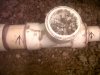
Toilet drain pipe issue

Fantom

New Member
Messages
6
Reaction score
0
Points
0
Location
NVA
There are two pictures here of a toilet drain pipe. I need to replace the tee joint - it is cracked. Is the best place to cut it where I mark the arrows? Should the riser pipe going up to the toilet flange be 3 or 4 inches? If it is 4" the flange fits inside the pipe instead of being pushed down on the outside and blocked by cured concrete or should i leave room for this and use 3" riser again? The previous toilet flange was never fastened to the floor. Whenever the toilet moved however little - the riser pipe and everything else moved also. IMG00050-20120316-1729.jpgIMG00049-20120316-1728.jpg

 
Last edited:
With 4" sch 40 pvc I always install the flange on the inside of the pipe.

Wye or a combo would be the proper fitting.
 
quote; With 4" sch 40 pvc I always install the flange on the inside of the pipe.

If I were going to use an "inside" flange, I might as well use a 3" riser and put the flange on the outside. BUT, since I NEVER do that, I always slide the 4" flange over the pipe. In this case, however, AA=it would be impossible to use a "Y", but there might be enough elevation to use a combo on its back with a "spigot" flange into the hub.
 
Last edited:
quote; With 4" sch 40 pvc I always install the flange on the inside of the pipe.

If I were going to use an "inside" flange, I might as well use a 3" riser and put the flange on the outside..

Whats the logic behind that? LOL
 
I use 4" inside flanges for several reasons. I can stub up with 4" pipe and the finished floor can be laid against the pipe.....when its time to set the flange after the finished floor is installed I can just cut the riser off and set the flange. The height is always perfect this way and no bother of tile or concrete in the way of my flange install.

Also if the finished floor is changed to a different height a 4" inside flange is easier to remove.

I do not use spanner flanges or extension flanges. I always anchor the flange to the subfloor. Never any problems.......NEVER
 
The opening in an "inside the pipe" flange is only slightly larger than a 3" riser, (in fact most of those flanges are really a 3" hub with the outside o.d. about equal to the i.d. of a 4" pipe), so if the flange fits over the 3" it will create almost the same opening. If the finished floor "moves", the all you have to do is cut the outside the pipe flange off flush with the floor, then you CAN insert a new one inside the pipe. Much faster than cutting out the inside flange.
 
Last edited:
The opening in an "inside the pipe" flange is only slightly larger than a 3" riser, (in fact most of those flanges are really a 3" hub with the outside o.d. about equal to the i.d. of a 4" pipe), so if the flange fits over the 3" it will create almost the same opening. If the finished floor "moves", the all you have to do is cut the outside the pipe flange off flush with the floor, then you CAN insert a new one inside the pipe. Much faster than cutting out the inside flange.

Right so why would you use a 3" over the pipe flange instead of a 4" in the pipe flange. Read the first sentence of your post #5. I dont understand that logic.
 
quote; Right so why would you use a 3" over the pipe flange instead of a 4" in the pipe flange

You are misunderstanding. I would NOT do it either way, I was referencing YOUR statement about how YOU do it, and how it does not make a lot of sense to go to the expense of a 4" riser, and then reduce it down to about the same as a 3" riser.
 
Last edited:
quote; Right so why would you use a 3" over the pipe flange instead of a 4" in the pipe flange

You are misunderstanding. I would NOT do it either way, I was referencing YOUR statement about how YOU do it.

Yeah I use inside 4" pipe flanges. Its easier because I do not have to bother with tile or concrete being in the way of sliding a flange over the pipe. The tile and concrete can butt right up to the pipe.

Your the one who brought up the use of over the pipe 3" flanges...not me.

ADD> I just saw your edit....... "the expense of a 4" riser only to reduce it to about the same as a 3" riser"

Quit while your behind.........your not really making any sense. The cost is not a factor and neither is the reduction in size.
 
Last edited:
When people use over the pipe flanges they usually wrap some kinda crap around the exterior of the pipe so the concrete doesn't fill that space so it makes room for the flange to solvent weld over the pipe.

Then you have to dig that out when its time to set the flange. Most of the time too much of whatever was used so the gap is larger than it needs to be. This can cause a problem with anchoring the flange because the concrete is not strong enough because the screw etc is too close to the edge of the concrete to have enough holding power.

My way the concrete is full thickness all the way around the pipe and holds the pipe steady and gives me plenty of concrete to get the flange anchored properly.......then and in the future if replacement is needed.

I can remove an inside the pipe flange in about 3 to 4 minutes. I'll make a video of it one day.

But I realize I'm an expert and not everyone realizes these problems.
 
I can remove an inside the pipe flange in about 3 to 4 minutes. I'll make a video of it one day.

Oh man you're gonna get Hackney goin on videos again. I still remember his videos from about 2 months ago where he soldered caps on a dry 12" piece of 1/2" copper, proving soldering on a closed system, then he had a buddy pressurize to failure.

What Hackney says above does make sense though using a 4" inside flanges.
 
I guess you have to be a "old time real plumber", when the ONLY way to install a cast iron flange was over the pipe, to have learned it that way.

I've installed plenty of those also...they dont have to be anchored to the slab. But we are not talking about cast iron. I learned ALL ways.
 
venting question

I am reviving this thread because I'd like to learn more about venting a toilet when it is on a slab. The picture that the OP posted caught my eye because it looks like this line is vented by what appears to be a 2 inch line heading off to the right of the San T. Is this how a toilet on a slab is usually vented? Wouldn't this constitute a flat vent and wouldn't it be vulnerable to getting plugged up? I can't imagine how else a toilet would be vented in this circumstance, but I thought I'd inquire. Curious to hear what the pros have to say. Thanks in advance.
 
I am reviving this thread because I'd like to learn more about venting a toilet when it is on a slab. The picture that the OP posted caught my eye because it looks like this line is vented by what appears to be a 2 inch line heading off to the right of the San T. Is this how a toilet on a slab is usually vented? Wouldn't this constitute a flat vent and wouldn't it be vulnerable to getting plugged up? I can't imagine how else a toilet would be vented in this circumstance, but I thought I'd inquire. Curious to hear what the pros have to say. Thanks in advance.

If the vent is washed by another fixture its fine.
 
still curious

Thank you, Hackney. I'm still curious, though. If there isn't an opportunity to wash a vent such as the one depicted in the photo... then what? Would that installation fail an inspection? Would it require a clean out? Is there another configuration of how this might be vented that would be better? I'm wondering if what is seen in the photo might be unusual in that the installation wasn't dug deep enough to allow a vent to rise up, rolling off the drain line somehow at a 45 degree angle. Wondering what a really good installation would look like under a slab. Thanks again.
 
Back
Top