Which toilet flange repair ring to use?

MOV

New Member
Messages
26
Reaction score
0
Points
1
Location
Indiana
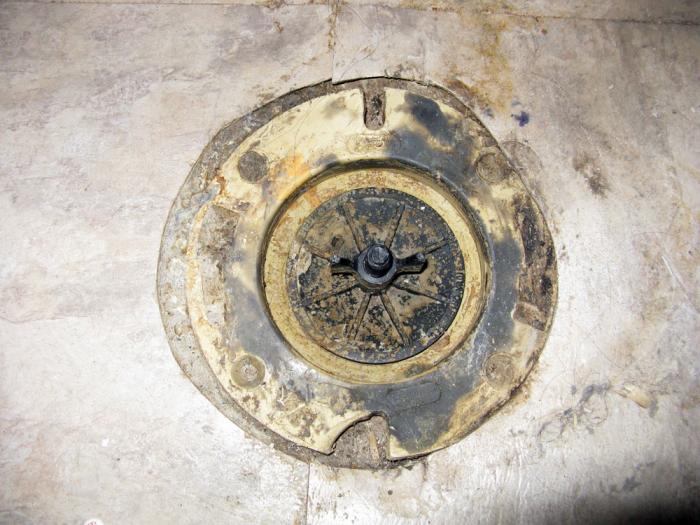
So our old toilet was knocked loose surprisingly easily, and we removed it to find this:
Drain-003.jpg


The flange is embedded in the concrete. And the bolts were NOT in the proper slots on the left & right; rather, they were in the warped/broken notches on the top and bottom (where the concrete was carved out below the notches). Yet another surprise from the previous owners of this house. :mad:

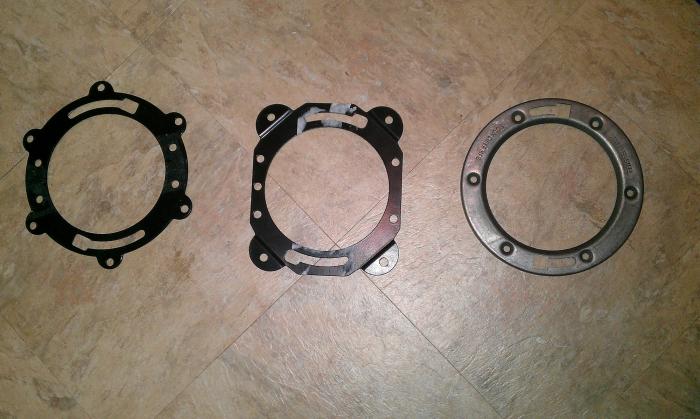
Rather than an expensive job of digging up the concrete and installing a new flange -- something I am not skilled/qualified to do, and can't afford right now to hire someone -- I have read about people successfully using repair rings. So I cut out the warped parts of the flange and used some Quikrete to fill in the holes and level the concrete around the embedded flange. I'm thinking this should be solid enough to use a repair ring, as I won't be drilling into the Quikrete. I picked up some 1-1/4" long Tapcons and found a few different rings. Any thoughts on which would be best?
Rings.jpg


The first two are Superior Tools Super Rings (original model -- and some new differently shaped one; not sure if there's a benefit), and the second one is a stainless steel Sioux Chief Repair Ring . If anyone has any thoughts on or experience with any of these, your advice is much appreciated. Thanks! :)
 
Do yourself a favor and replace the flange with on that has a stainless steel ring. This can be done without cutting up the floor by using inside cutters to remove the old flange.

John
 
1. The "notches" that the bolts were installed in WERE the best way to mount the toilet. Using the slots usually insures that the flange will break.
2. You did NOT do yourself any favors by removing the broken section.
3. You could, and should, have used crescent shaped "spanners" under the cracked piece.
4. Personally, since none of those flanges attach to the drain pipe, I would not use any of them.
 
I used the one on the left and the middle.

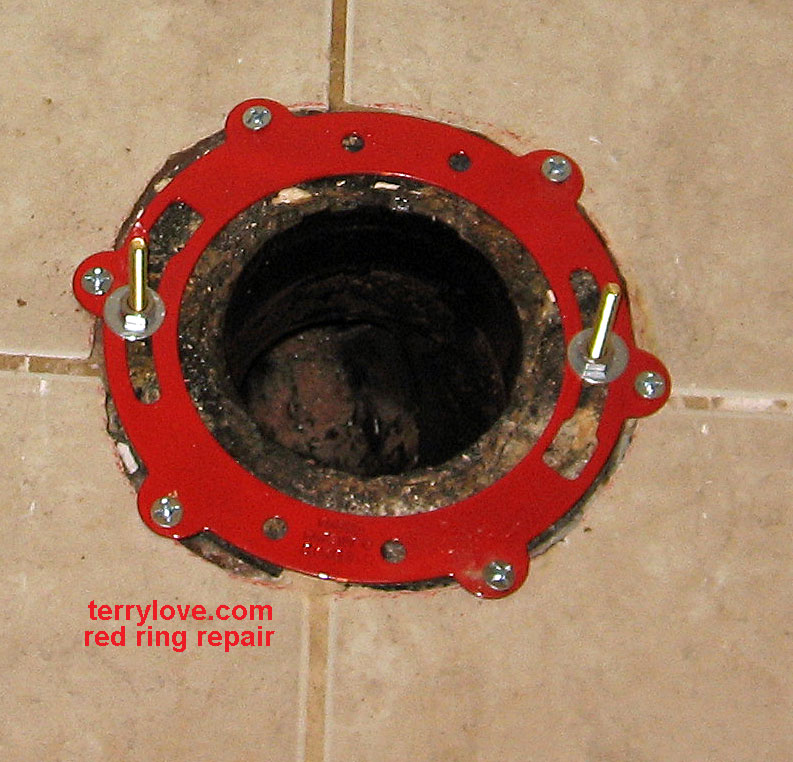
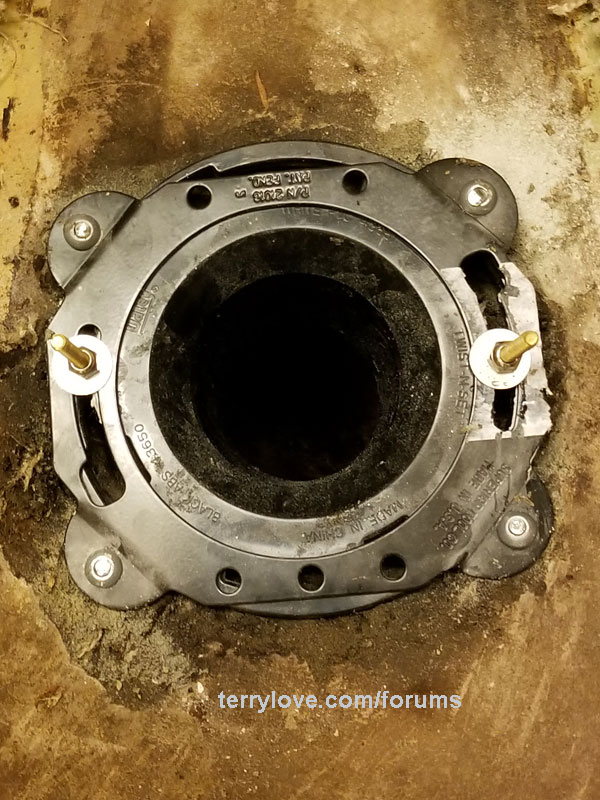
Your flange where the wax sits is still there. The repair ring is only for holding the closet bolts.
It works.

red_ring_repair_2.jpg


red-ring-repair-love-2.jpg
 
Last edited:
Thanks for the replies.

Do yourself a favor and replace the flange with on that has a stainless steel ring. This can be done without cutting up the floor by using inside cutters to remove the old flange.
I think this is still probably outside of my skill set. :o And the ones I've seen which go down into the pipe wouldn't fit inside this one, as it looks like it narrows from 4" to 3" right at the top. Unless I'm missing something, of course... But without taking out that whole piece of pipe and replacing it, is there any "easy" way (for a non-plumber DIY'er like myself) to replace that flange?

1. The "notches" that the bolts were installed in WERE the best way to mount the toilet. Using the slots usually insures that the flange will break.
2. You did NOT do yourself any favors by removing the broken section.
3. You could, and should, have used crescent shaped "spanners" under the cracked piece.
4. Personally, since none of those flanges attach to the drain pipe, I would not use any of them.
1. Sure, but using those notches DID cause the flange to break. :eek: Are the slots not for the closet bolts? I've seen it both ways, but never by carving out a 1/2" of concrete floor underneath the notches. Those bolts completely pulled up and warped the PVC.
2. I should note that the picture was taken BEFORE I removed anything. That bottom notch was already destroyed, and the top notch was bent upward a good inch.
3. I considered the crescent repair piece, but there was no way to get it to "cradle" the flange, attach to it, or to fit under it... because the whole thing is embedded IN the concrete floor rather than being above it. It may not be obvious from the overhead camera angle, but that whole flange is actually BELOW ground level (the top of the flange is level with the floor, rather than the usual 1/4" above it).
4. That is a good point, but aside from replacing the whole flange + pipe, I may have little choice. I'd like to think as long as I use a good sealant between the ring and the flange/pipe, and a wax ring with the black "funnel" attached, I'll get a good seal.

I use the one on the left.

Your flange where the wax sits is still there. The repair ring is only for holding the closet bolts.
It works.
Thanks Terry. Does it matter that the flange where the wax sits is recessed into the ground? Really, with the tile around it, it's technically about 1/8" LOWER than the floor itself. Do I need any sort of stacker/spacer (to raise it up) before using the Super Ring? Or is it okay being that low?

Thanks again for the replies guys!
 
Last edited:
If the wax compresses to seal both the floor and the bowl, that is all that is needed. You should feel compression when setting the bowl.
If not, you will need to double ring it.
I don't like stacking spacers. If stackers are used, they need to be installed with Silicone to seal them, or that becomes an obvious place to leak.
I have much better success with wax.
The repair ring is outside of the wax seal area.
 
The narrow notch IS much stonger than the wider slot. But, the bigger issue is that most plumbers will not use an all plastic flange for just the reason you saw...the plastic is just that plastic...under load, it bends and bend it too far and it breaks.

Especially on a tiled floor, it is important to caulk the toilet since the tiny closet bolts shouldn't be too tight, and there's not much friction between the tile and the porcelain. The caulk helps to anchor the toilet, prevents dribbles and misses from getting beneath, and is required by code most places anyway.
 
Actually, in addition to that Fernco wax-free seal I linked to above, here's something else someone recommended to me:

Here's the key part about how this works --


To a non-plumber, DIY-er, both of these products look good and simple, and SEEM like they'd work.... but any thoughts by you professionals before I do anything? :cool:

Thanks again everyone!
 
Last edited by a moderator:
No one has any thoughts on the Fernco wax-free seal or the Set-Rite kit (compared to using regular wax or extended or stacked wax rings)?
 
IMO all flange repairs are stop gaps between proper replacement. Start with a flat solid floor and have the flange bottom sitting on the finished floor and anchor the flange.

Use one regular waxseal and some brass bolts. Finish by caulking it to the floor with 100% silicone.

You do that and your problems will be gone forever.
 
IMO all flange repairs are stop gaps between proper replacement. Start with a flat solid floor and have the flange bottom sitting on the finished floor and anchor the flange.

Use one regular waxseal and some brass bolts. Finish by caulking it to the floor with 100% silicone.

You do that and your problems will be gone forever.

I know, replacing the whole flange would be ideal... but it's just not in my skillset or budget right now. So the repair ring is going to have to get the job done for me. :) It's just a matter of using the traditional wax (and/or extended or stacked wax rings) versus the Fernco wax-free seal.

Feedback on the Set-Rite is hard to come by, and it looks like overkill for what I need. But I just wondered if the Fernco wax-free seal would work better to seal that extra gap than stacked wax. I'll grab one this weekend so I can finish this job. I did patch the concrete and have a nice level surface now.
 
The waxless seals work quite well. I've never used the Fernco brand, but the Fluidmaster is about the same. One thing about the waxless seals is to disregard the instructions (at least on the Fluidmaster) and place the seal on the toilet first. Then into the flange. The cardboard collapsing frame is joke. A couple of advantages the waxless offer is being able to remove and replace the toilet without changing seals, and you don't have the wax mess to deal with. If you decide to go with wax, avoid the ones that have the plastic funnel on the flange end. They don't really help and they can cause clogs.
 
Back
Top