
Corrosion in newly installed water heater

rick112

New Member
Messages
11
Reaction score
0
Points
0
Location
Virginia
water_heater.jpgwater_heater-2.jpgwater_heater-3.jpg

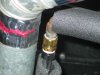
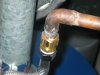
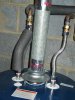
A couple of months ago I installed a Whirlpool Gas 40 gal. water heater and I'm getting some corrosion on both the hot and cold lines where the new brass compression fitting meet the old copper pipe. I checked with my multimeter, and both lines are firmly grounded. As you can see from the pictures there is much more corrosion on the hot line. I used the dielectric unions that came with the install kit I bought and tried my best to do everything right. What am I missing?

-rick
 
I don't know about the corrosion aspect, but one thing you're missing is the clearance from flammables between the vent stack and the (oh-so-flammable) closed cell pipe insulation.

I doubt the adhesive on the FSK tape is rated for vent pipe temps too. If you want to seam-seal the stack joints use a water-glass type furnace-cement or automotive muffler-sealer, not tape.

I assume you cleaned off all the flux when you soldered the potable ells?
 
How does brass corrode?

With flex connectors, I don't wrap the threads with tape. The connectors come with nice new rubber washers.
 
I don't know about the corrosion aspect, but one thing you're missing is the clearance from flammables between the vent stack and the (oh-so-flammable) closed cell pipe insulation.

Yep, that's exactly what I noticed when I saw the image. I actually tested a similar set up on mine (note that it was a test, I was expecting trouble and don't advise anyone else to try it.) It worked okay for a few weeks when I checked it, but eventually the section immediately adjacent the vent stack opening began to shrink/melt--it was getting too hot at times. So I pulled the insulation and went to a local distributor to get some non-flammable material. I tested this latter material with flame before installing it. I've checked it periodically since and it remains in "as new" condition. My runs are straight so this was easy to do.
 
Wow, thank you for pointing that out. I will replace with non-flammable insulation and appropriate sealer. The ells are part of the original plumbing. I chopped it and sanded back to shiny copper before installing the compression fitting.
 
Do you think I should re-do the flex connectors without the tape? Any thoughts on the corrosion? If it looks like that in 2 months, I'm wondering what it's going to look like in 2 years.
 
Is it corroding or is that leakage? It looks like the result of a slow seep to me. A small amount of water over time will evaporate and leave behind the inorganic salts. Sometimes they will seal themselves off if the leak is really small. I've seen this more with pipe unions installed by professionals in the plant or at home...so I avoid pipe unions when I can. That's just a layman's observation.
 
After the install there were a few drops that oozed from that join over a period of a couple days and then stopped. I specifically remember thinking I was going to have to redo the cold line if I saw and more water, but then is stopped on its own.
 
If it doesn't leak now, leave the tape.
There is no seal on the threads; it works like a garden hose with a swivel nut and a rubber washer.
The tape can prevent those type of threads from going down far enough, and if a strand of tape lands on the rubber washer, it can lift it up and create a path for the water.
However, the tape won't hurt the fitting either. So if it stopped, I would leave it.
 
I say your brass compression joints may weeping water somtimes. Probably due to expansion and contraction. They may not be quite tight enough,then again you may have over-tightened them. I dunno. You could take them apart and add some pipe dope and reassemble.
 
FWIW, no connection should be considered good if you get some weeping of any kind. The fact that it stopped on its own isn't necessarily an indication that it couldn't restart on its own at a later time. there had to be a reason it leaked, and unless you did something to make it stop (i.e., tightened the nut), you shouldn't consider it fixed. now, it might not leak again, but corrosion as already noted, may really be mineral deposits from maybe one drop or two a day, depending on your water hardness levels.
 
With that type of compression fitting do you just keep tightening until the dripping stops? Hackney mentioned over tightening. Is is just a matter of feel?
 
IT is pretty difficult to overtighten a 3/4" compression fitting, but then again, it is also difficult to align and tighten them adequately. I avoid them like the plague for just that reason.
 
Back
Top