Urgent: lav & tub single 1/2" or dpkit from 3/4"

DavidTu

Member
Messages
261
Reaction score
1
Points
18
Location
Seattle, WA
For second floor bath we will have single lav and tub/shower. We can either run single shared 1/2" pipe or a shared 3/4" pipe and split at bath to 1/2" to each fixture. Which is preferred? With 1/2" shared concerned about lav affecting shower temp. With split 3/4" worried about having to wait long time to get hot water thru to lav. what's best option?

Note wc is on totally separate line.
 
The shower and lav on one 1/2" line is fine.
The shower and lav are restricted flow. The supply lines on the faucet are only 3/8"
You are also using a pressure balanced shower faucet.
 
If filling the tub, you might notice it takes longer. If that's an issue, you might want a 3/4" valve, as it would likely fill the tub faster, but for a shower, not a big deal. A single 1/2" line generally can't support more than about 6gpm, or the velocity gets too high and you can create problems. A tub/shower valve might reach more than that since it is usually a combination of both some hot and some cold, but generally most are spec'ed at the 6-8gpm range. A 3/4" tub/shower valve might reach 12-18gpm and not exceed the maximum recommended velocity. For an average tub, the 1/2" valve and supply are likely fine.
 
A Delta R10000 can flow 9 GPM @ 80psi to the tub filler with a 17t cartridge.

The cartridge is the limiting factor for the most part but the flow rates are still high for the tub fillers or showerheads that have been modified one way or the other.

The 1400 series cartridge will flow 8 GPM @ 80 PSI using the R10000 naturally.

Delta also offers an R1000HF......HF is for high flow. I'm not sure what that one flows at.

So if you are filling the bathtub in the middle of winter(or your on a well) and your using 70% hot water running at 80psi thats 5.6 GPM of hot water running to the tub. MAX EVER at that given thermostat setting of the water heater.

Ok then you have a lavatory. Lets say its flowing at 3.0 GPM @ 80psi. I may run straight hot at the lavatory.....so thats 3.0 GPM.

That gives you a flow of basically 9 GPM a minute in a very unlikey situation.

Its a small bath.....typically one user. Unless they filled the tub and ran the hot water full blast in the lavatory at the same time these flow rates would never occur.

I would like to add thats assuming the cartridge would allow the hot water to flow at 70% of the max rate......I doubt it would. I would need to do some test to find out exactly what the flow would be. It may be around 4 gpm max flow of hot......plus the 3.0 max for the lav. So arounf 7 GPM max flow.
 
Last edited:
With 1/2" diameter pipe flowing 7GPM your velocity is 11.5 FPS (feet per second)

That means if the pipe was 23 ft long it would take 2 seconds at that flow rate to get from a to b

With 3/4" diameter pipe flowing 7GPM your velocity is 5 ft per second. Thats about 2.5 seconds longer than with the 1/2". BUT the 1/2" is flowing at too high of a velocity.

Purging a water hot water line of cold is not that cut and dry. Hot water is more viscous......it will stratify in an upsized pipe with a low volume flowing. It will mix the hot and cold together at points in the pipe with turbulence. This is more noticable with long straight runs of pipe. The water will get warm but will not get hot for an extended amount of time unporportional to the relative pipe sizes.

For example if you had a lavatory that flowed 2 gpm of hot but it was fed off a 1" hot water branch that was 60' long it would take longer to get near thermostat temp hot water than the typical flow velocity calculators are compensating for. The hot and cold water have different viscosities which make a difference on your wait for hot water.

I calculated the flow velocity of a 3/4" pipe that is flowing 1.5 GPM and its about 1 FPS (feet per second). At 3 GPM 3/4" pipe your velocity will be around 2.4 FPS.

This gives you an idea how long it takes water to travel at different flow rates in different diameter pipes. These numbers again do not hold true when purging cold water from a hot water line. The larger the line and the lower the flow will have a compounding effect on the wait for hot water at the faucet.
 
Last edited:
For plumbers that haven't figured out how to plumb a home the answer is yes.

You can and do run a 1/2" pipe for a bathroom set on the hot side. I've never seen anybody waste a 3/4" line on two fixtures like that. That would be a tub/shower and a lav.

I have run 3/4" hot to a Grohe roman tub valve with 3/4" inlet and outlets. It wasn't a pressure balanced tub/shower valve though and was needed for a extremely fast fill. Most Roman tub faucets are 1/2"


And when have you ever seen a 3 gallon aerator on a modern lav faucet?
Industry standard is 2.2 gpm and Watersense is 1.5 gpm

taylor-great-shot-drinking.jpg
 
Last edited:
For plumbers that haven't figured out how to plumb a home the answer is yes.

You can and do run a 1/2" pipe for a bathroom set on the hot side. I've never seen anybody waste a 3/4" line on two fixtures like that. That would be a tub/shower and a lav.

I have run 3/4" hot to a Grohe roman tub valve with 3/4" inlet and outlets. It wasn't a pressure balanced tub/shower valve though and was needed for a extremely fast fill. Most Roman tub faucets are 1/2"


And when have you ever seen a 3 gallon aerator on a modern lav faucet?
Industry standard is 2.2 gpm and Watersense is 1.5 gpm


Most aerators are rated at a lower pressure than 80 psi. In a different thread he says he will have 80 psi at the water heater. So I was figuring a bit higher flow with the higher pressure.
 
And in actual practice, does anyone run their lav faucets full force? I will if I'm trying to run water down the drain to keep it clear, but I don't if I'm washing hands.

I've plumbed very large office buildings before, and my inspections were perfect.

But he's plumbing a home in Seattle, so that's how I'm answering the question.
He's not running a dairy and washing down cows. I bet the biggest critter he has is a dog.

becu_frt.jpg


https://terrylove.com/becu2.htm

becu_800.jpg
 
Last edited:
For plumbers that haven't figured out how to plumb a home the answer is yes.

You can and do run a 1/2" pipe for a bathroom set on the hot side. I've never seen anybody waste a 3/4" line on two fixtures like that. That would be a tub/shower and a lav.

I have run 3/4" hot to a Grohe roman tub valve with 3/4" inlet and outlets. It wasn't a pressure balanced tub/shower valve though and was needed for a extremely fast fill. Most Roman tub faucets are 1/2"


And when have you ever seen a 3 gallon aerator on a modern lav faucet?
Industry standard is 2.2 gpm and Watersense is 1.5 gpm

Terry all that wouldn't matter in a large house that wasn't busy. The flow velocities are really no big deal in a situation like that because it simply isn't used enough USUALLY.

If this were a commercial type project with high expected use there is no way I would use 1/2".

I enjoy discussing the why and how.....the more its discussed the clear things become.

I usually run mine full on hot and there is no restrictor. Helps keep my drain nice and fresh! Melts the toothpaste and shaving cream away. We have a high cold water temp usually so hot water heating is not a big issue for me. Two of us with a 50 gal tank set at 130. In the summer we have cold water temps from the meter at 80+ degrees some days. The pipes are shallow here because the frost line is like 1 or 2".
 
Last edited:
Even the water chart for "public" use figures the lav as one fixture unit and the tub/shower as 4, making a total of five fixture units.
At eighty feet and over 60 PSI you can run 7 fixture units, in both private and public.

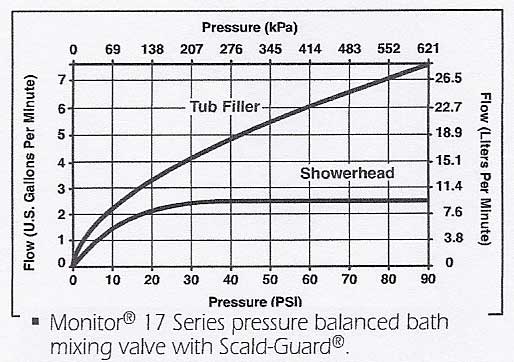
monitor_17_flow_chart.jpg
 
Last edited:
Even the water chart for "public" use figures the lav as one fixture unit and the tub/shower as 4, making a total of five fixture units.
At eighty feet and over 60 PSI you can run 7 fixture units, in both private and public.

Well at 80 psi the Delta will flow 9 GPM. If you plug 4.0 GPM for the tub and 1.0 for the lav. into the formula with .5" pipe it spits out a flow velocity of 8.17 fps.

I don't dispute what your saying. I'm just doing the math and the velocity is high.

I'm reading that PEX can have a max velocity of 12 fps????? That doesn't seem good for the insert fitting. What say you? Thanks for having the discussion!
 
Last edited:
Thanks to your quick replies. We ended up running it 1/2". My concern was to do with a shower not the tub. When someone is showering I was concerned turning on lav full hot or cold would affect the shower temp momentarily causing freezing or scalding experience in shower. Sounds like that won't happen though.
 
quote; I've never seen anybody waste a 3/4" line on two fixtures like that.

That's because we have never actually "met". I basically only use 1/2" for the final run to an individual faucet or opening.
 
Even the water chart for "public" use figures the lav as one fixture unit and the tub/shower as 4, making a total of five fixture units.
At eighty feet and over 60 PSI you can run 7 fixture units, in both private and public.

monitor_17_flow_chart.jpg

Your flow chart seems to be lower than mine. Looks like they are cheating you out of about 1 gallon a minute. My chart for the 17T showed 9 gpm at 80 psi and the typical 13/14 series flowing 8 gpm at 80psi.

Thats a conflict from Delta Unless the specs have changed.
 
All I did was go to the Delta site and download a spec sheet for the Monitor 17.

But thanks for thinking I'm that awesome at making up graphs in my spare time.
They sure do a good job at restricting the shower heads. I would have thought that with more pressure that number would go up too.
 
The federal regulation of showerheads restricts flow to a max of 2.5gpm at any normal household pressure. Codes generally restrict that max to be 80psi, so it doesn't surprise me that it peaks at the 2.5gpm. Now, getting it flat like that across that large of a range takes some good engineering or lots of trial and error.
 
All I did was go to the Delta site and download a spec sheet for the Monitor 17.

But thanks for thinking I'm that awesome at making up graphs in my spare time.
They sure do a good job at restricting the shower heads. I would have thought that with more pressure that number would go up too.

I never thought you made anything up.......note that I said......"its a conflict from Delta unless the specs have changed"

I would be willing to bet the shower head would flow more at 90 psi than at 40 psi.....despite what they claim on the chart.

Click on the specifications for this delta 1400 series tub/shower faucet. After that look at the graph in the lower right hand corner,......It says the valve runs 8gpm at 80 psi.


Ok now here is the 17T. Look at the graph......At 80 psi its flowing 9 gpm


Looks like different models have different flow rates. I swear I didn't make the graph either.....
 
Last edited by a moderator:
Back
Top