Basement stairs issue

lmei007

Member
Messages
183
Reaction score
0
Points
16
Location
Maryland
I am finishing my basement (1950's house). I want to put insulation on the wall and then frame it. It looks like there is no enough space at the lower end of the stairs (refer to the photos please).

I have 3 choices, I think. They are followed:

1. no insulation or less insulation in that area;
2. make the turnning area even smaller; But it may be too small by cutting another 5.5" from that small area.
3. make that 90 degree turn one step early (when you go down). That means there will be 3 steps (now is 2 steps) to the basement ground after the 90 degree turn.

Which way you think is better? do you have a better solution?

thanks,
 

Attachments

  • IMG_4005.jpg
    IMG_4005.jpg
    23.6 KB · Views: 1,141
  • IMG_4007.jpg
    IMG_4007.jpg
    22.5 KB · Views: 1,349
  • IMG_4008.jpg
    IMG_4008.jpg
    24.5 KB · Views: 1,202
Use 2" of spray foam for more value in less depth.
I will use 1.5" or 2" foam board. But i have to frame it. So the total will be at least 5.5". Use spray foam will not save much space but more expensive, right? Are you saying the frame is not necessary in this area, and use furring to hold the board? That will will save some space.
 
You cannot take out a step unless you can re-space all steps without making the riser height greater than 7-3/4". (IRC)

What you have there now appears to be bead board over furring strips. You could switch to 2" EPS foam board with furring strips topped by drywall, making the wall less than 2" thicker overall.

For such a small job, the EPS makes the most sense to me.
 
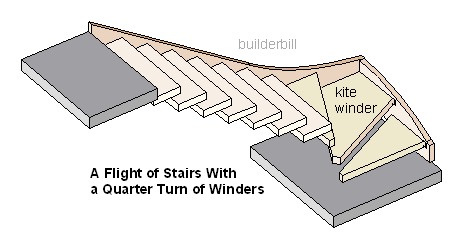
Are winders allowed in your area? You could replace the landing and the step above it with three winders if you have the headroom.
 
My question would be that since the basement is probably entirely below grade, why are you even insulating it?

To reduce/avoid condensation in the summer and heat loss in the winter, I think
 
My question would be that since the basement is probably entirely below grade, why are you even insulating it?

Surely you're joking?

The average subsoil temps in MA are 45-50F, and the design frost line in eastern MA is 48", and heating design temps are around 0F +/- 5F. (It's slightly warmer for locations 5 miles from salt water, but still only single digits F.) To make it even more fun, eastern MA is a swamp, with a lot of development in areas with high water tables and wet highly-conductive soil. At ~R0.8 a poured concrete foundation represents a HUGE heat loss into that cold-wet/frozen soil. R10 foam insulation for a conditioned basement is easily cost effective here, even R20 has a positive net-present value in a 25 year analysis most of the time.

But in lower-altitude warmer parts of AZ with design temps well into positive double digits Farenheit, and subsoil temps north of 60F, that would be a valid question.

If this house has any history of moisture problems in the basement, either wetting of the slab at the base of the wall, or efflorescence on foundation walls, etc. it's better to use more vapor permeable 2" EPS rather than 2" XPS to allow the foundation to dry into the basement. Otherwise the now-higher moisture content of the concrete can wick to top and rot out the foundation sill. Yes, its' a 20% hit in thermal performance, (but still WAY better than the uninsulated wall), but unless you have a metal or membrane capillary break between the concrete & sill, or 4' of exposed above grade wall and 2' overhangs on the eaves for minimal wetting from the exterior, it's better to play it safe. XPS at 2" would be pretty much the limit even in homes without ground moisture issues.
 
Last edited:
Back
Top