Moving kitchen sink, want to get it right..

Spaceball1

New Member
Messages
18
Reaction score
0
Points
1
Location
Twin Cities, Minnesota
We're remodeling the kitchen in our townhome and have removed all of our cabinets. We're working on the design for the new cabinets, and I came across a couple of questions.

The old sink was in the middle of a wall, so that's where my drain & supply lines are at. We're hoping to move the sink about 6'-6" to the end of the wall in a corner sink basin cabinet.

I'm thinking that I'd install the P-Trap and disposal connections all be there under the sink, and then I'd route new lines in the back of the cabinets (sloped & supported) over to the existing drain connection in the wall.

Any problems with this?

The biggest obstacle that I see is that the dishwasher would be between the sink and the wall connection. Will a drain line fit behind a dishwasher?

I can sketch up what I have in mind if that helps.

Also, the kitchen is on the 2nd level and everything is torn out so I do have access to the subfloors. I suppose that I could run stuff beneath the floor, but that would require punching holes in floor joists. I'd like to avoid that if possible (right?)?

Thanks!
 
Last edited:
Two issues to overcome.

1 - minimum slope is 1/2 inch per foot
2 - if you are moving it 6' you are going to need to vent the trap
 
No,
That does not work.

The trap arm can only be 3'6" at the longest.
The drain will not fit behind the dishwasher.

You will need to run a 2" line over to the new cabinet space, in the wall, and then run a 1.5" vent back, unless you vent with an AAV.
Regardless, you will need a 2" drain, which is 2.5" OD
 
Last edited:
Ok, glad I asked.

Can I route the new drain line under the floor instead of in the wall?

I'm pretty sure this is a load bearing wall and it's shared with a neighbor, so I'd rather not take the hole saw after it.
 
Maybe...you still need to maintain the slope. Depends somewhat on which way the joists run and how deep they are and where you can make the connection. It still needs to be vented which may become an issue, depending on where and how the existing one is run. Sounds like there's unlikely to be a window over the sink location, so you can run the vent up in the wall between studs. The vent doesn't need to be as big as the drain line, so it's easier to get through the wall and if you have an attic above, you could run it up into there.
 
It seems as though an AAV is probably going to be your only vent option here.
 
No window above the sink, however, it's a shared wall so I'd rather stay out of it if possible.

I'll have to take a closer look at things, but I'm pretty sure I can go under the floor with no issues. For one thing, I'm replacing the ceilings in the lower level, and some of the subfloors in the kitchen. So I have all the access I need right now. Secondly, the existing sink is directly over the unfinished laundry/utility room where my stack is. With the 6 foot move, I might have to punch through one or two joists to get into the unfinished room, but after that I have plenty of options. I would rather do that than go through 5 or 6 2x4's in a shared wall.

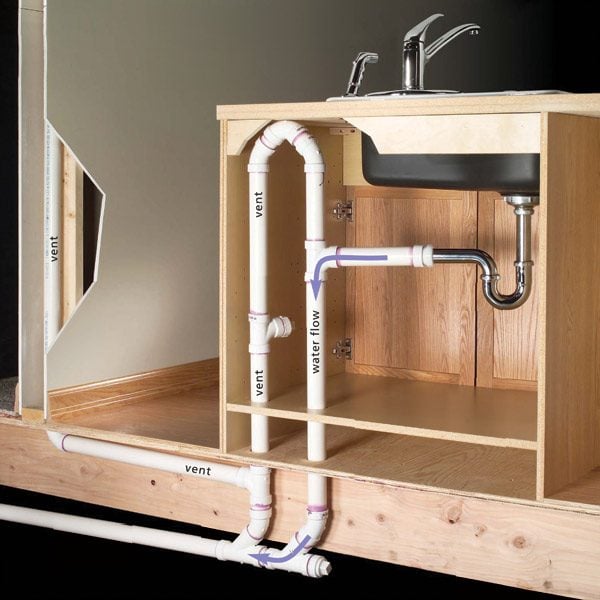
As far as venting goes.. An AAV seems to make sense for me. However, since I have access to the floors, would something like this be better?
FH03OCT_ISLANSI_01.JPG
 
Your first problem is the wall, since it is a party wall shared with a neighbor and SHOULD be a fire rated wall. IF so, then that creates many problems for your installation, and you might be better served calling a plumber to get it right.
 
venting concepts

I have a question of a conceptual nature regarding the picture in post #7. As I understand it, it's against the rules to have a vent take a horizontal trajectory unless you're at least 6 inches above the flood rim or (if I recall) 42 inches above the floor. This is to prevent the vent pipes from becoming clogged with debris in the event of a backup. In other words, you'll get back up in your sink before your vent lines get fouled. But in the picture of the island loop, there seems to be plenty of opportunity for backup in the vent lines without a person even knowing it. There is even a horizontal vent line running under the floor and despite the presence of clean outs, it would appear difficult to clear. Does having an island loop somehow relieve the system of the usual requirements? Thanks in advance for the education!
 
There should be a clean out on that horizontal line but the big issue with a loop vent is that if the vent does plug up, nobody is going to know it's plugged up unless the trap starts siphoning.
 
If you put the sink in the corner, you might be able to run the vent right up the corner and then cover it with a panel.
 
I talked the concept over with a pro, and he seemed to think that going through the wall would be no problem at all. He also told me that the vent can just live there inside the wall space, so that helps. Additionally, he was pretty sure that the shared wall is actually two walls (one is mine, one is my neighbor's) with an air gap in between. He's putting together a bid for me, but said that it's contingent on me getting approval of the plan from the city inspector.

All of that being said, I've come up with an alternate design for the kitchen which keeps the sink within 24" of the original location. Would I be able to use the existing drain location if I only moved the sink 24"?
 
Back
Top