Apparent leak under slab

SuperMatttheHero

New Member
Messages
78
Reaction score
3
Points
0
Location
virginia
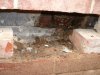
This wall on my rear patio area has been "moist" the last 2 days. This is a brick veneer wall, where real brick is used in front of sheathing, studs, etc. Inside area of the home corresponding to this section (corner of my kitchen) is dry.

My house sits about 16 inches above grade, so technically, the wet spot corresponds to beneath the slab floor inside of the home.

What would you do?
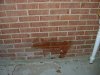

DSCF0074.jpg
 
I'm confused, not hard to do!
Is there a crawl space?
Seems like to opposing statements. Slab and 16" above grade...

If there is a crawl space send a young kid down with a flashlight to see what is to be seen.

If there is not a crawl space then most likely will need to open up the wall under the kitchen cabnets.
Michael
 
I think I understand what you have. One thing that is in your favor is the leak is pretty well pinpointed. Often slab leaks really are a bitch to find because they don't show up like this. It will still be a PITA to break concrete and make a repair though.
 
What do you suppose the chances are that I could just cut out a few bricks and find the leak not too far from the wall? Just put granite in the kitchen, so I really don't want to rip it out less than a week later. :(
 
Check under the kitchen sink, check the shutoffs, the supply lines and the drain pipes.
Check the icemaker line to the fridge, and lastly remove the bottom panel near the floor on the dish washer and shine a light in there.
 
How old is the house? What type drain lines do you have. If it's copper or galvanized it could be the waste arm. This is a common problem. Before removing any brick check under the dishwasher and sink.

John
 
House is from 1955. Drain lines are galvanized steel which go into cast iron at the floor level. Dishwasher and sink area is dry. HOWEVER, I did notice when hooking up the sink plumbing that the galvanized waste arm was "rotating." I assume (like every where else in the house that I've seen), the galvanized pipe goes into a lead/oakum joint right at the floor. If this joint is rotating when twisted, could that cause this? It would correspond almost exactly with where the moist spot is outside.
 
What you more then likely have is a sanitary tee where the horizontal line turns down to the drain and up to the vent. In order for the line to rotate at the caulked joint the vent would also have to move. I would say you have a bad waste arm. Your next step should be to call a licensed plumber to make this repair as it is not a DIY job.

John
 
John,

I do not know for sure that the vent is rotating (haven't checked, but home is a single story, so there are no other connections above. There is a square hole cut out in the cabinet where waste arm exits the wall, and I can see the galvanized tee in there.

I suppose it is possible that it may not be rotating in the lead/oakum joint, but rather only the tee is rotating.

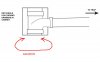
To show with a picture, this is what I have...
plumbingprob.jpg
 
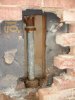
And we're back again with an update. Busted out a few bricks to see what the matter was, and found the cast iron drain hub pretty soaked. Not leaking at the joint as far as I can tell, but water runs down the galvanized pipe when I turn the sink on. It must be leaking somewhere near the galvanized tee.

DSCF0075.jpg
 
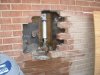
Turns out the bottom-most threaded portion of the galvanized tee is where it is leaking. How would you pros repair this? Cut off the galvanized pipe, couple to a mission coupling and then run PVC upward? Would you remove the lead-oakum joint and install a rubber donut? Cut off the cast iron hub and install a coupling there?

If these lead-oakum joints are known to last, then I would rather not try to dig that out, since I know it's a lot of work. I can't say for sure it's not leaking, but I assume I would only notice that it was in the event of a backup downstream.DSCF0076.jpg
 
Last edited:
Back
Top