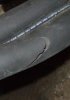
Does a torn wire jacket violate California electric code?

I suggest you double check what we are talking about. The wire you showdoes not look line " house wiring ". It looks like low voltage wire, and all of the mini split A/C that I am familiar with do NOT send line voltage to the inside. Line voltage ( 120 or 240) feeds the outside unit, and low voltage control wires, including 34 VDC to run the inside fan, go in on 18 ga. thermostat wire.

I think the same thing jimbo.

It is good quality wire with the pull string reinforcement build into the wire.

But its gauge makes it about the size you would use for long runs, when used as a control wire.

I do not think it is a big issue, But I don't live in California, and the rules differ.

Enjoy your afternoon.

DonL
 
I suggest you double check what we are talking about. The wire you showdoes not look line " house wiring ". It looks like low voltage wire, and all of the mini split A/C that I am familiar with do NOT send line voltage to the inside. Line voltage ( 120 or 240) feeds the outside unit, and low voltage control wires, including 34 VDC to run the inside fan, go in on 18 ga. thermostat wire.
That's funny, I realize you are a plumber and probably install these systems all the time, but every one I have ever wired (and that is a lot of 'em) has sent line voltage between the units.
 
Also, if you look closely, it says "600V" on that cable in the picture. That is definitely line voltage cable.
Actually it looks more like cord, which means it is unlikely that that is an actual image of the cable used.
 
I am familiar with LG and Friedrich. In poking around on line, I did find that Mitsubushi and Sanyo do feed line voltage from out to in...
I am still curious about that cable he showed in the pic. Does it look like 14 or 12 ga? or smaller?
 
Guys,

The pic is not of his wire. He just grabbed a pic off the web. Here is what he said:

I've attached a web image that will give you an idea what this cable looks like, but mine looks like it has another black jacket underneath the one that's torn.

It would be best to get a pic of the real install. It may need a new wire ran or the problem area may be able to be placed in a junction box and ran from there (assuming it would be accessible).
 
It may need a new wire ran or the problem area may be able to be placed in a junction box and ran from there (assuming it would be accessible).
Or, since there is just a small 1.5" tear in just the cable jacket, it CAN be repaired with electrical tape.
 
Sorry guys didnt mean to start a war!
Actually after taking a closeup of the cable it's apparent that the installers used the wrong cable. The cable they used says SJEW E54864 (UL) 300V 90*C CSA LL39753 SJTW(TPE). The install manual calls for 600V insulation on the cable. BTW its a Mitsubishi. Power-Cable-Closeup.jpg
 
What war??? All I see is a discussion.


Why would they call for 600V cable? the only difference between 300V and 600V cable is the jacket thickness. 600V cable like that is for hard usage.
 
Now we have another problem

400.8 Uses Not Permitted. Unless specifically permitted in 400.7, flexible cords and cables shall not be used for the following:
(1) As a substitute for the fixed wiring of a structure
(2) Where run through holes in walls, structural ceilings, suspended ceilings, dropped ceilings, or floors
(3) Where run through doorways, windows, or similar openings
(4) Where attached to building surfaces
Exception to (4): Flexible cord and cable shall be permitted to be attached to building surfaces in accordance with the provisions of 368.56(B)
(5) Where concealed by walls, floors, or ceilings or located above suspended or dropped ceilings
(6) Where installed in raceways, except as otherwise permitted in this Code
(7) Where subject to physical damage
 
Does the manufacturer specify a temperature rating as well? 90C may not be high enough when running through a hot attic.
 
All wire is Flexible, so what makes a wire flexible enough to be under the 400.8 code,
and what is the 400.7.

These numbers mean nothing to the original poster, and helps none for the problem.

Please Post the Code Info , not the numbers, If you really want to help.

A lot of these codes are not meant in all States, and you can do what you want in your own home in most States in the USA.

Call BR549 For a good time, Most know that code, but not 368.56(B)


DonL


P.S. At the least post the link to the code , most DIY people are not as smart as you. They want help, not BS.
10-4 ?
 
Last edited:
All wire is Flexible, so what makes a wire flexible enough to be under the 400.8 code, and what is the 400.7.
These numbers mean nothing to the original poster, and helps none for the problem.
Please Post the Code Info , not the numbers, If you really want to help.

Pay attention to what is being posted my friend.
First it was 400.8 not 400.7
Second the code section was posted in clear English

It is the marking on the cord or cable that mandates how the cord or cable is to be installed.
SJEW is a rubber cord not a cable and is not allowed as part of the premises wiring and not allowed to pass through holes in walls which this installation violates both.

A lot of these codes are not meant in all States, and you can do what you want in your own home in most States in the USA.
This is the most incorrect statement I have ever read on the internet. The first word in the book’s title in National. This means it goes over the entire nation.
No you cannot do as you please in your own home. There are cases where homeowner’s insurance companies have filed suit in court against homeowners who did unpermitted work in their own homes.
When adopted by your state the NEC becomes law. Are you saying I can break the law as long as I am inside my own home? You need to let all the drug dealers that are in prison know this so they can get out.

Call BR549 For a good time, Most know that code, but not 368.56(B)
What does busways have to do with the original post?

P.S. At the least post the link to the code , most DIY people are not as smart as you. They want help, not BS.
10-4 ?
One again you are not paying attention to the post. I posted the code section that relates to the problem.
Anyone undertaking a do-it-yourself project should already be familiar with the codes involved in the project or they should leave it alone. In a lot of areas in the US the permit office will require the homeowner to take a test on the codes involved before issuing a permit and let’s hope no one would undertake a project such as installing a AC unit without a permit.
Should something go wrong and there was no inspection the door would be wide open for legal action.

As far as to being help to the original poster try reading post number 11. It looks like all I did was confuse this poor old fellow to the point of suicide, or then again maybe it was you that was confused.

I would strongly suggest that if you don’t understand something that you speak up but don’t start posting about someone else that might be confused, let them do that their self. Don’t start taking for granted the ignorance of others as they might be as smart as or even smarter than you seem to be giving them credit for. To make the statement, “not everyone is as smart as you†is very insulting to everyone but I do appreciate you praise of my knowledge.

Now if I can get my hat on this big head you have given me I shall go forth to meet my day.

 
JW,

If people knew all the codes then they would not be posting, That is why they ask people like yourself that know.

But if you reference to something, It would be nice to know what that reference is.

I hope you have a great Day.


DonL


P.S. I am sorry if I insulted anyone, that was not my intent. I will be the first to admit that I do not know everything. Life is a learning curve for everyone.

Flexible cords and cables information;
http://www.mhprofessional.com/downloads/products/0071546529/NECch4.pdf
 
Last edited:
LCroft,

It does look like the wire that they used, may not fit the installation, If it is not a control wire.

I am not sure why the manufacture would spec a wire that would not meet code.

That unit is UL listed and the code to my understanding states "Must be installed per manufacture instructions"

It gets rather confusing when looking at the NEC rules. But the Manufacture would not go against code.

The cable number indicates that it should be a 600V PVC cased wire, but it says 300 Volts.

It is rated for Temporary and not for permanent installations under the NEC, so I guess it depends what "Temporary" Means.

It would be best to replace it, if you are worried about code.

Like I said before, It depends on the inspector. Around here inspectors don't like to go into the hot attic, If it works it passes.


Enjoy Your day.


DonL


P.S. What is the model number of your unit ? I still think that it may be a control wire, or the manufacture would be out of business.
 
Last edited:
The lower-cost Chinese made mini-splits DO include a length of type SJ cord to interconnect the outside and inside units. Generally the power is to the outside unit and from there to the inside unit. The four-conductor interconnect may be at full line voltage or some lower voltage.

Bottom line, this is without a doubt contrary to the NEC but it may be (barely) acceptable because it IS in accordance with the manufacturer's instructions. I personally do not think it is a big hazard and would just tape the outer jacket. However, if the insulation on any of the individual conductors has been compromised then either replacement of the cable/cord or a proper splice in an approved and accessible box is required.
 
Back
Top