Wire gauge for new double-oven?

Artie

New Member
Messages
46
Reaction score
0
Points
0
Location
Jacksonville, Fl
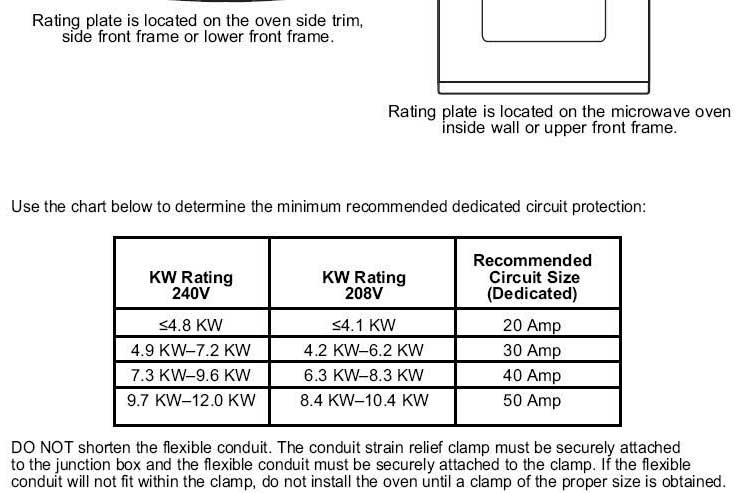
Hi all. I asked this question once before, but it was for a single oven. My wife decided she wanted the double, so I need to ask again. Some of the gauge-to-amperage ratings are confusing, so let me ask straight out: for an oven thats 6.9kw @ 240V, with approximately a 40' run from the breaker panel, what gauge wire would you use?

Its basically this model: GE 30" double oven. We have last years' model, but otherwise, its virtually identical.
 
And with 80' of a #10 AWG copper conductor and a 6900 W/240 V = 29 A draw, if you see more than a 2.3 volt drop in the 240 vac measured at the oven when you turn it on there is a bad connection somewhere.
 
The spec sheet and the install instructions call for 40 amps. I hope the OP gets a second opinion, rather than jump on the first electrical help he got from the PLUMBERS forum!!!!!!!
 
I always check these forums for several days, (sometimes weeks), before I make a move.

Going with a 40 amp breaker opens a new can of worms. The original oven was an older Lady Kenmore double oven, and it used a dual-30A breaker. I was hoping to reuse that one. This is an old Federal Pacific breaker panel, which doesn't have a very good reputation. If I need to replace that breaker, then I really need to replace the whole panel.

But if I must, I must.
 
I always check these forums for several days, (sometimes weeks), before I make a move.

Going with a 40 amp breaker opens a new can of worms. The original oven was an older Lady Kenmore double oven, and it used a dual-30A breaker. I was hoping to reuse that one. This is an old Federal Pacific breaker panel, which doesn't have a very good reputation. If I need to replace that breaker, then I really need to replace the whole panel.

But if I must, I must.

What you said before was that this was a:
for an oven thats 6.9kw @ 240V, Its basically this model: GE 30" double oven. We have last years' model, but otherwise, its virtually identical.

When I go to the site you posted it tells me that for the oven you posted all that is needed is the 30 amp circuit.
Unless you bypass all the controls on this oven you will never get the full load draw on this oven therefore voltage drop would not be an issue.

ovenrating.jpg


Connect this oven to the same circuit that the old one was connected to and go to bed.
 
Last edited by a moderator:
It is my understanding that the wire size is determined by maximum draw. But, when inspected, it must ALSO abide by the manufacturer's instructions. So, if they call for a 40A breaker, depending on your inspector, he may require one, too. That would require the appropriately sized wiring to it. Resistance heaters momentarily draw more current when they are energized than their steady state. Their resistance changes as they heat up to limit the operating load. So, for a short period of time, they could exceed the 30A supply (say you turn both ovens on at the same time to preheat them). It probably wouldn't trip the breaker since it happens fairly fast, but it could be an issue. From a safety issue, it probably isn't one, but if it trips, it could ruin your supper! Also, keep in mind that if the voltage drops in a brownout, you draw more amps, and your safety margin gets much smaller.
 
I would take this as a great motivation to change the Federal Pacific panel. Those things are scary, and have history. IMO, nothing to trifle with. Plus, most of the breakers you can get for them at this point - since they are long since out of business - are rebuilt. Even the new ones had a reputation for not tripping under overloads. In adition to the busbar issues. Of course if you go that route, you can increase the breaker size if needed.
 
The double oven at the link he posted specifies: 240v=6.9 kv; 240v= 30 amps. If he has a different oven then there is no way we can comment on that without the new model number's specifications. Or if he HAS the new oven, then the rating plate will give the proper amperage. I have done almost as much electrical work as plumbing. In fact, I have done trouble shooting FOR electricians.
 
Back
Top