Soldering / brazing troubles for tub spout

Chris4x4Gill2

New Member
Messages
10
Reaction score
0
Points
0
Location
Alabama
I am trying to install a new tub fauct (spicket?) The old trim piece was held in place to the smooth copper pipe using a set screw. The new trim piece requires a threaded end and needs to be about 2" longer.

I am trying to braze (solder?) connector - short piece of pipe - threaded end onto the existing pipe where it comes out of the wall but so far I have been unable to get it to hold the solder doesnt want to penetrate, it builds up at the joint.

Any tips or ideas what I am doing wrong?
 
You are doing it completely wrong and from your description, you need a plumber who KNOWS how to do it correctly. You cannot solder a "threaded pipe" onto the copper. It will either be the wrong size or material to make a proper joint.
 
You wouldn't solder a "short piece of pipe" to the copper, but you could solder a copper male threaded adapter. You are much better off getting a slip on spout, or best spout around is the Delta, where you have to solder the Delta adapter onto your copper.

Soldering can be learned by homeowners, but you are going off the cliff without a parachute.
 
What would the proper way be then?

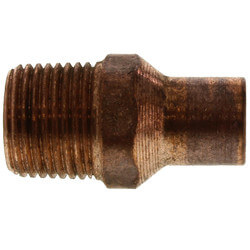
I am not soldering a threaded pipe, but a male threaded end onto the smooth pipe. Like this:

wp4-2-08-2.jpg
 
I guess I didnt explain myself well in the first post.

I have aprox 2 1/2" of smooth copper pipe sticking out of the wall. I need it to stick out 4" from the wall and be threaded on the end. To achieve this, I was trying to attach a coupler to the current piper, then a short (1 1/2") piece of pipe into the other end of the couple, then the threaded adapter onto the 1 1/2" pipe.

I am familiar with soldering, but am by no means an expert at it. I am applying a paste like flux to each connection, heating it using a propane torch and then applying my solder. The Solder is not holding though and I dont know what I need to do differently.
 
Could the exisitng piece be something other than copper?
The more I think about it (I was just dropping by to browse) the more I would lean towards the product I mentioned.
Solder is good but even my plumber uses Sharkbite and also PEX with some frequency.
 
No its copper. I was thinking aobut the sharkbite setup but I am worried I dont have enough room. I'm going to look into that though and see what the dimensions look like. I can only be 4" total from the wall so thats what I have to work with.


I think my trouble is too many joints so close together. I think that the flux is burning up before the joints are hot enough to solder if I do them all at the same time. If i try to do them individually, it seems like heating the next joint melts the solder on the first joint.
 
Last edited:
To make a good solder joint, there are a few rules that have to be followed. First, There can be zero water present in the pipe. Second, the pipe ends and the interior of the fittings must be sanded clean. Third, you must apply flux to the pipe and fitting. Fourth, you apply heat to the joint until it is hot enough to cause the solder to flow. The torch is not applied directly to the solder. The way I would approach your job is to solder the threaded adapter to the pipe nipple, then the coupler to the nipple and main pipe at the same time. The solder building up at the joint makes me think your either didn't flux the joint or there is moisture present. Either of those would prevent the solder from drawing into the joint.
 
Thanks for the advice Gary. I did apply Flux to the joints but it is possible there was moisture in the existing line. I will try it again in the order you recommended.
 
Both the outside of the pipe AND the inside of the fitting must be spotlessly clean and then fluxed. To get this, you need to either sand it or use a brush tool designed for it. Also, I've found that some water based fluxes are nearly totally worthless. You may have better luck with a tinned solder flux - this has powdered solder mixed into the flux.

In this situation, do NOT use a Sharkbite...you'd have no way of keeping the tub spout from turning unless you glued it to the wall.
 
You couldn't even tighten the spout to the Sharkbite, since it would start rotating as soon as the thread got snug, nor could you get it off once that happened. We cannot tell you what your problem is because we do not know HOW you are trying to solder the joint. IF you have "cleaned" the copper and fitting, then fluxed them properly, the solder should flow easily. It makes no difference how MANY joints, or how close together they are if you are using the proper procedure. And a tub spout does NOT have moisture in it prevent soldering. BUT, you should really use a "female" adapter right onto your copper pipe, so you can eliminate the coupling and short piece of copper, then just use the proper sized 1/2" brass nipple to attach the spout to it.
 
Last edited:
I'm not sure what you're using now, but soldering became easier for me when I started using MAPP gas instead of propane, tinning flux, and a low-temp solder (like Lenox Sterling).
 
Why not call a plumber and try the soldering lesson on an easier job?
One that doesn't have so many joints as close together and hides inside a wall when completed...
 
What people have said before, drain the whole system, clean the inside and out several times over...then clean it again, hit the fitting with heat until the solder starts to stick. There's plenty of videos on youtube.
 
Thanks for the advice Gary. I did apply Flux to the joints but it is possible there was moisture in the existing line. I will try it again in the order you recommended.

One thing that nobody said is that solder flux WILL go bad, how old is yours?
 
quote; What people have said before, drain the whole system,

Tub SPOUTS do not have to have the "whole system drained". They do not even require that the water be turned off to the building.
 
First off, I was able to get it done over the weekend. I just took my time and went back to the basics. I cut a new piece of pipe, re sanded all of the pieces and made sure everything was cleaned. As suggested by Gary Swart, I attached the threaded male adapter first, then did both sides of the coupleing at the same time. I "think" my probelm at first was that I was trying to do too much at once (3 joints) and by time everything was heated properly, the flux had burned out of the joints. Either that or I was jsut taking too long at getting it hotter than needed.

I thought about the sharkbite suggestion and after looking at it in the store came to the same conclusion as already mentioned, that it would spin when trying to attach the trim piece.

To answer some of the questions....... flux was new (about 3 weeks old) but it is a water based so next time I will buy a higher quality flux.
 
Water based flux is okay, it's just that they are not all created equal! The tinned flux is also water based. Overheating a joint can make it impossible to solder properly.
 
Legally I can only use water based flux.
It works fine.

Normally leaks are more often caused by lack of heat on one side.

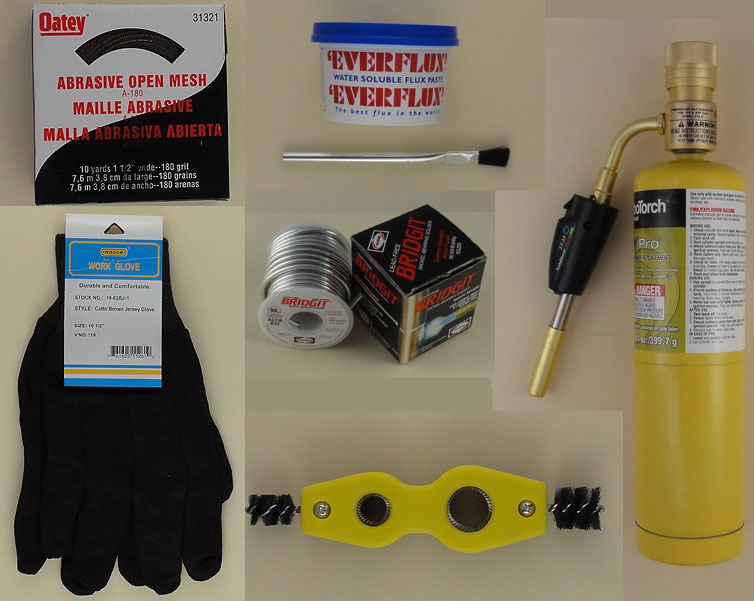
soldering_kit.jpg
 
Last edited:
Back
Top