Sweating a Shower Valve

newmex999

New Member
Messages
27
Reaction score
0
Points
1
Location
nm
Any tips/tricks for sweating in a new shower valve?

I haven't done any sweating in many years, so just want to make sure I have my bases covered.

What are the general sweating procedures?
Does the valve need to be mounted to 2x4, or can it be supported by the 1/2 copper pipe?
When sweating, should the valve be in any particular position- open/closed, to prevent pressure build up?
How far forward do you position the valve to allow for hardieboard and tile installation?

Thank allot!
 
Any tips/tricks for sweating in a new shower valve?

I haven't done any sweating in many years, so just want to make sure I have my bases covered.

What are the general sweating procedures?
Does the valve need to be mounted to 2x4, or can it be supported by the 1/2 copper pipe?
When sweating, should the valve be in any particular position- open/closed, to prevent pressure build up?
How far forward do you position the valve to allow for hardieboard and tile installation?

Thank allot!

If you have a valve with screwed connections you should solder adaptors on pieces of tube and then screw them into the valve.

If you have a sweat valve you should remove the mechanism before you sweat the tube in; if you can't do that wrap some wet rags around it to proctect the valve.

The valve should have come with a plastic spacer that shows where the finish wall should be; YOU HAVE TO ADD THE MEASURMENTS UP.

You are always better off if you use a board to secure your valve.
 
Most plumbers will remove the cartridge while soldering, and reassemble when done.

All fittings need to be open to air during the soldering process.
Otherwise, the hot air will blow a path through the solder and cause a leak.
That's why some "unlucky" plumbers always have a leak on the last joint they solder.
You can't teach these young dogs old tricks.
They just keep messing up their joints by soldering in a closed system.

The nice thing about pulling the cartridge, you can heat the body easier and get the heat even.
A cold spot wont' melt solder.

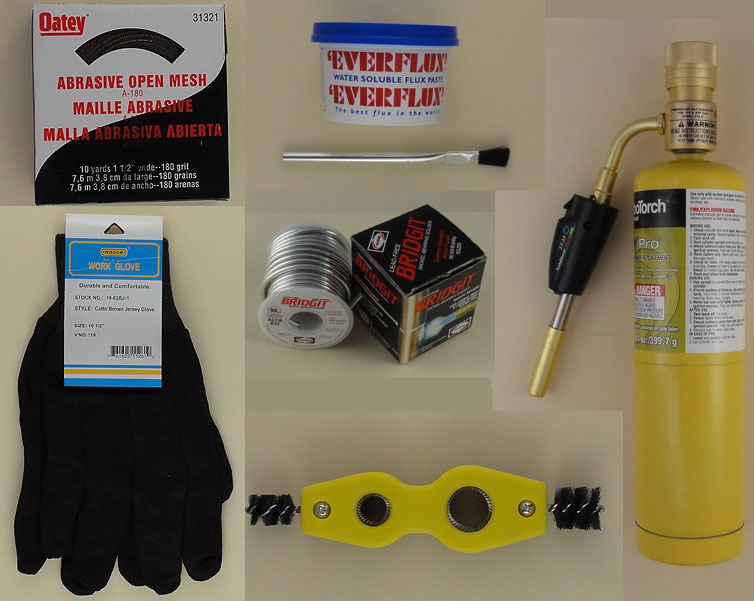
soldering_kit.jpg
 
Last edited:
Should I be using type L or M copper pipe?

That depends on local water.
In Seattle, we use mainly M inside.
Some places require L if the water is corrosive.

In my experience, often if the water is that corrosive, then the fittings go bad too.
But it never hurts to upgrade to L

soldering_kit.jpg
 
Last edited:
Solder & Flux

Are there different types of solder and flux available for use out there?

If so, which ones are recommended?

Thanks much!
 
Lead Free solders are good.
I like Bridgit Lead Free
Oatey Lead Free


Everflux,Water Soluable
Laco 95/5 Flux
Laco Flux-Rite 90 Water Soluable
 
Water and Sweating

How do you pros keep that little bit of water from running down inside the pipe towards the area where you are sweating?

I heard someone talking about rolling a ball of white bread and pushing it into the pipe to keep any water from weakening the solder joint?
 
check your state and local code for pipe schedule. My state ammended the code years back to type L for water supply only.
 
Sorry for posting this again, but never received response

How do you pros keep that little bit of water from running down inside the pipe towards the area where you are sweating?

I heard someone talking about rolling a ball of white bread and pushing it into the pipe to keep any water from weakening the solder joint?
 
I'm no pro, but I've used a product called "plumber's bread" to stop the trickle of water while sweating. It's a pre-cut cornstarch plug that will dissolve when the water is cut back on. It worked pretty well.
 
Yuu can use the white bread, but you are better off not doing that.

When you turn the water off, open ever valve, faucet and shower head you can.
Everywhere.
As long as a valve is turned off, it's like holding a finger on the top of a straw,
The water never drains out.
You need the water to drain, so open everything up.

If the water doesn't stop in 15 minutes, then try the bread.
 
Flux with Tin or Not

I was in the local box store the other day and they have water soluble flux and then there is a flux with "tin" in it.

Which one is preferred?
 
Last edited:
Back
Top