Trouble securing closet flange to concrete floor

sanrico

New Member
Messages
27
Reaction score
0
Points
1
Location
Land of Enchantment
I thought I had finished the hard part of a toilet replacement when I removed the old closet flange piece by piece with a chisel, but I was wrong.

I used PVC cement to replace the flange with a perfect fit. Now I'm trying to secure the flange to the floor and it's driving me nuts. I am using a hammer drill to drill the concrete and planning on using Tapcon screw anchors.

The first hole took a very long time to drill and the screw head snapped off when it was halfway in. So one out of six is useless.

So I moved up to a fatter Tapcon screw (1/4") and drilled the hole using the Tapcon bit. I screwed the screw in and it stripped the concrete in seconds. Two now two holes out of six is useless.

I'm worried now. If this keeps happening, I won't have any way to screw the closet flange into the concrete. What else can I do? Is there some sort of cement adhesive I can use to secure the closet flange to the floor? I can't help but notice the previous flange wasn't secured to the floor. No screw holes.

Any advice? Thanks!
 
Last edited by a moderator:
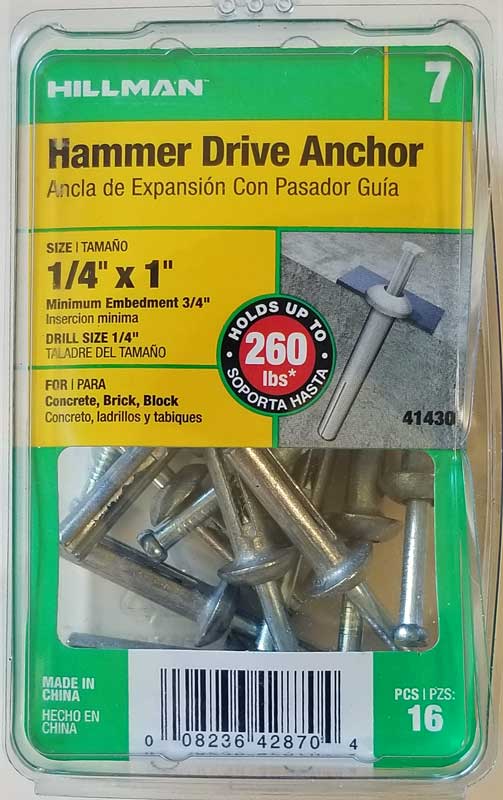
I would say to use some plastic anchors. 1/4" plastic anchors should fit through the existing holes in the flange
 
I bet you tried to use the drill to thread in the Tapcon. I've never had luck doing this and a Tapcon screw is one of the few things I will only secure by hand. I've got many different drills and even my least powerful option can snap a Tapcon.

I'd go back to the first smaller size, and try again but tighten it by hand. I've got an 18v Ridgid dril that will send me for a ride and I know your 18v DeWalt packs some good torque too.
 
I bet you tried to use the drill to thread in the Tapcon. I've never had luck doing this and a Tapcon screw is one of the few things I will only secure by hand. I've got many different drills and even my least powerful option can snap a Tapcon.

I'd go back to the first smaller size, and try again but tighten it by hand. I've got an 18v Ridgid dril that will send me for a ride and I know your 18v DeWalt packs some good torque too.

I did use a drill to thread the Tapcon, but not the DeWalt. I used a very low-power Black and Decker. But you are right. It snapped that head off in seconds.

You are also right that the DeWalt is rattling my soul. The Tapcon drill bit also seems to have become dull after drilling two holes.

I'm pretty worried. I tried a plastic anchor, but it doesn't seem to be grabbing very well.

To top off my concerns, the closet flange seems to be just off the floor and not sitting directly on it. When I rubber malleted it onto the drain pipe, the pipe must have had some give because the flange met the concrete, but came up a tiny amount. I would say it's 1/16" off the concrete. I hope screwing it down (if I ever manage to) will help it to meet the concrete.
 
Here's what I do with 100% success when I want to anchor anything to concrete. I use a SDS Rotary Hammer Drill and drill a 5/16" hole for lead anchor sleeves for #12 screws. The SDS bit drill concrete like a wood bit drills wood. Be sure to go deep enough so the screw will not quite bottom out. I use #12 stainless steel screws either Phillips head or square drive and a drill/driver to run the screws in. Be reasonably careful as a drill driver has more torque than you want to run the screw down with full power. Get close to tight then finish by hand. I have anchored not only flanges with this method, but electrical service panels, outlet boxes, 2/4s, metal plates, shelf brackets, and probably other things I can't remember off the top of my head. It is a bit tricky with the 2x4s, but it can be done. Plastic sleeves may work, but I always use lead. I had similar problems with Tapcons although I know they are a good system, I just find the lead sleeves to be simpler and quicker.

hammer-drive-anchor-01.jpg
 
Back
Top