"Notching" studs vs. holes in studs for copper pipe?

ironspider

Member
Messages
70
Reaction score
0
Points
6
Location
Michigan
Greetings all,

My wife and I are working on a basement remodel and we are planning to add a wetbar up against a wall. Now this wall has both hot and cold supply lines running behind it with joints that are readily accessible. So my plan is going to be to replace those joints with a T joint and then just take the new end of the T to the bar. Simple enough.

My question though is do we want to run these new copper pipes through the studs by way of a bored hole? or by "notching" the 2x4s? Just about every setup I've seen (and, granted, this is mostly from bathroom plumbing work) has the 2x4s "notched" with the pipes in the notch. Is there a reason for this? Or would it be better to run the pipe through a simple drilled hole in the stud (like you would do for running electrical cable through joists0?

Thanks in advance!
 
I'm not a plumber, but notches are more common because is is nearly impossible to 'thread' copper pipe through holes. You would have to make many cuts on the copper and use lots of couplers to get it to work. This is one reason that some people like PEX. With PEX, you can thread it much like you would electrical or other cables.

If you notch, remember the nail protector plates.
 
Notching is not the best of solutions, unless you absolutely have to. Notching leaves you exposed to any nail , screw to be drilled into the pipe. Drilling in the middle or as close to the middle of a 2x4 ensures that the 1 1/4 drywall screw/nail will not penetrate, especially if somebody else is drywalling for you. Notching will also weaken the 2x4, making its strenght as little as a 2x2.

Copper pipe tubing is pretty flexible when fishing it through the 2x4's as long as the holes line up within reason. The tubing doesn't have to be perfectly straight, but you do not want to kink it either. You should be able to fish 12' lengths with a little bit of pre planning.
I know I do.
 
I'm new to the forums as of 5 minutes ago and also am not a plumber. I am finishing my basement, though, and just tried pushing 3/4" copper pipe through 1" holes drilled for wire routing. On 16" centers, it's nearly impossible because of the aspect ratio. My 2006 IRC code book shows 40% notch depth and 60% hole diameter limits, so you could drill up to a 2.1" hole for your 2x4 studs. I would expect you to have to do a bit of bending to make it work. 1/2" or 3/4" copper? Have you ruled out CPVC or PEX? I rerouted my water heater TPR line yesterday using CPVC with 1 3/8" diameter holes drilled in floor joists. The 3/4" CPVC had enough flex to handle the first few holes bending/aligning.

-Adam
 
3/4 copper tubing is a different ball game . A lot less flex in the tubing. Very unlikely to be pushed through 2x4's at 16" centres without damaging its intergrity.
 
I've pushed 3/4" copper pipe through a 2x4 wall with very little problem using a 1" drill bit... what I did was start with the first stud. drill the hole, and push the copper pipe through it until it hits the next stud. spend some time making sure it's level and in line with the wall. make a mark around it with a pencil. find the center and drill. repeat.. I followed this process with a 17' wall.. went right through.. take your time, though. don't get in a hurry..

you can't go wrong with copper...:)
 
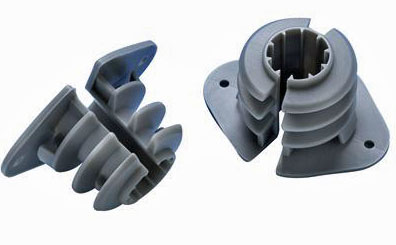
I use a 1-3/8" drill bit for installing water lines. They make plastic pipe insulators that are 1-3/8" OD and work with 5/8" OD pipe, 7/8" OD pipe and 1-1/8" pipe.
One size hole, then if I need to change a pipe size, I'm not constricted.

oatey_pipe_clamps.jpg
 
Last edited:
Ja, it's magnitudes easier if you go with oversized holes. Easier yet if the studs are bare on both sides and there is no blocking so you can flex the first stud out and the one before it in.

You never want copper pipe to be tight in the holes otherwise it will make noises as it expands and contracts.
 
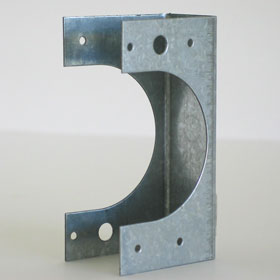
Anyway, if you must notch, they do make special plates that are more than just nail guards and actually restore the strength.

PSS.jpg
 
quote; I rerouted my water heater TPR line yesterday using CPVC

Codewise, CPVC is "undersized" for a 3/4" T&P valve discharge. Those saddle plates are for use on a bearing wall. I have notched hundreds of walls but have only needed the "saddles" when I drilled through a bearing wall for a 2" pipe, and that was the ONE AND ONLY time I have used them in 60+ years.
 
Last edited:
Those saddle plates are for use on a bearing wall...

Not just for load bearing walls... also for tiled walls where deflection is a concern. I am not saying you HAVE TO use them, just that they are available if you WANT TO use them. I have also used 2x6 studs for wet walls.
 
There's flex copper that comes in a roll and then there's stick copper that comes in a stick. The flex copper feeds through the studs much better than the stick copper. No sunday school picnic on the flex, but the stick is impossible without leaving an unacceptable pile of sawdust and weakened studs.
 
I use a 1-3/8" drill bit for installing water lines. They make plastic pipe insulators that are 1-3/8" OD and work with 5/8" OD pipe, 7/8" OD pipe and 1-1/8" pipe.
One size hole, then if I need to change a pipe size, I'm not constricted.

oatey_pipe_clamps.jpg

I don't mean to be a smart as I know that you know your plumbing stuff better than I ever will.....but....... wont 1 3/8 technically violate the hole in stud ratios that are allowed in load bearing walls? Depending on where you are and who you ask, isn't 33-40% the "norm" that is allowed to be drilled through the center of a load bearing stud?

Again, not questioning your knowledge, just asking for your rationale.
 
Couplers are cheap and sweating them is easy. I think what i am going to do is create a feed point by notching one stud then cut 32" pipe sections and couple together. My run is about 20' (load bearing exterior wall) with 3 tees in the hot and 4 tees in the cold. Then repair the notched stud with a stud shoe and some blocking. I will also put stud shoes on all load bearing walls with circular holes.

I also think i will run the cold 12" above the sill plate with a tee looking up at the fixture and the hot 24" above the sill plate with a tee looking down, then 90 these verticals into the cabinet at like 18" above the sill plate
 
Back
Top