2 way switch not working right

Augusta

New Member
Messages
97
Reaction score
0
Points
0
Location
Augusta GA
I have a couple of two way switches that have been working fine for years. A few days ago they started not working right. I can turn on the light from either location, but I can only turn it off from the location where I turned it on. Is this common? Does it mean one is bad? If they both behave the same, how would you know which one to go to first to troubleshoot?

Thanks for any help.
 
Last edited:
Could be either switch bad, or some wiring problems. If no one has worked on this ( to possibly install an incorrect switch or mess with wires) then I would replace both switches and be done with it. BE CAREFUL> the arrangement of the terminals on the new switch will likely be different than the old one. A terminal with a black screw is the common, and the other two are the travelers. Make sure to get the common wire to the right terminal.
 
Thanks. Will do what you said. I just thought it strange that the switches behave the same way. It doesn't seem that they are broken, just both doing exactly the same thing. Can turn on the light from either location, but have to cut it off from the location where I turned it on. Otherwise the switch flip does nothing from the opposite location. I thought that maybe this was a common thing to identify for folks who work on electrical.

No one has been doing any electrical work. I'll buy two new switches, paying attention to the black screw and see what happens. Thanks again.
 
I think you have "3-way switches". I would replace both of them. One switch probably has a bad contact inside the switch, but the other switch is probably about to wear out anyway, so best to replace it too.

3-way switches look like the switch on the right in the following picture. Is this what you have?

image002.gif
 
3 way switch? I thought if you are only switching from 2 locations, then the switches were 2 way switches. I have no clue. I have pictures though. Attached.

By the way, both switches have the black screw. On the second photo, the black screw is on the top right, hidden from view point.
 

Attachments

  • switch1s.jpg
    switch1s.jpg
    46.1 KB · Views: 8,255
  • switch2s.jpg
    switch2s.jpg
    50.8 KB · Views: 8,235
Last edited:
Your pictures are of Three way switches, the black screw is your common terminal. In your first picture you see the wire in the bottom is looped around the black screw. That is your power feed so the black screw on the top of the other picture goes to your light.
 
They are 3 way switches....even though there are only 2
 
Perhaps we will have an electrical historian explain exactly why these are called 3-way. And if you need to control lights from THREE locations, you need a FOUR WAY switch!
 
I'll be the first to admit that I need to take a class in the basics of electricity. Maybe I will soon. Thanks for the help. I'll go buy (2) 3way switches and replace these (2) 3way switches. I don't know if the terminals will match up exactly with the new switches. Meaning, I don't know why the red wire is on the same side of the switch as the side with the black screw on one, but the red wire is on the opposite side of the switch of the black screw on switch two. Guess I'll just try to match up and if that doesn't work, I'll just keep switching wires until I get it right.

Thanks again.

P.S. if it is common for newbies to confuse 2 way switches with 3 way switches, can we put a sticky up explaining the difference?
 
That's a good question as to why they are called 3-way switches!

I found something which explains this...

Following from...
http://www.act-solutions.com/PCC/kingery06.htm
["Have you ever wondered why they are called "3-way circuits" when there are only 2 switches? Well, it has to do with the number of "drop points" and not the number of switches in the circuit. You see back in the early days of electrical wiring, back in the days of Thomas Edison, the vocation of "electrician" was brand new. These new electricians would base their cost estimates partly on the number of "drop points" on each circuit. A drop point could be a switch, a load or any junction point. In a sense a circuit with only 1 switch and 1 load would be a "2-way". I suppose this was because the wires had to go "two different ways". A circuit with 2 switches and 1 load would be "3-way". Incidentally, a circuit with 1 switch and 2 loads would also be a 3-way, but over the years, the label of "3-way" has evolved into meaning any circuit with 2 switches in it."]
 
I always though it had to do with the possible states of the circuit.

2-way circuit has 2 possible states:
- on
- off

3-way circuit has 3 possible states:
- on (through the first traveler)
- on (through the 2nd traveler)
- off

and so on.
 
Hey, thanks for the help fellas. I replaced both 3 way switches today and now the light works like a champ.

I wish I had known to open the box of the new switch before I bought it though. It seems that not all of the new 3 way switches have that slot where you can stick the wire in without using the terminal. For $4.79 each from Home Depot, I would have thought they'd have both the slot and the terminal. Mine didn't. It's just a little difficult to combine both the looped wire with a second wire on the same terminal but I man handled it. Thanks again.
 
Hey, thanks for the help fellas. I replaced both 3 way switches today and now the light works like a champ.

I wish I had known to open the box of the new switch before I bought it though. It seems that not all of the new 3 way switches have that slot where you can stick the wire in without using the terminal. For $4.79 each from Home Depot, I would have thought they'd have both the slot and the terminal. Mine didn't. It's just a little difficult to combine both the looped wire with a second wire on the same terminal but I man handled it. Thanks again.

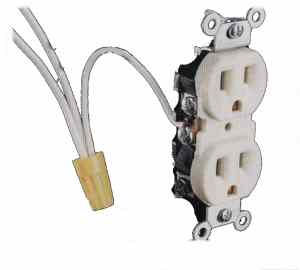
Late now, but... you should combine them under a wire nut, instead, with a third, short length of wire leading to the terminal. It's called a "pigtail". Like so:

2008-02-13_212731_wirenutR.jpg
 
Back
Top