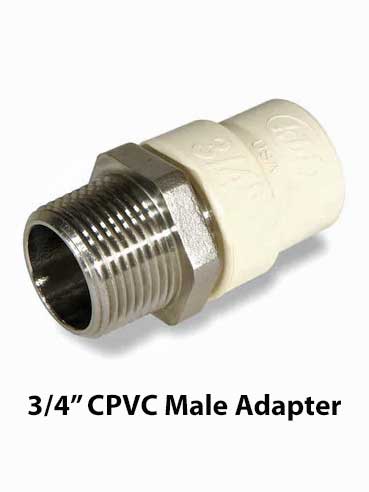
PVC to CPVC Adapters

turkeyvulture

New Member
Messages
25
Reaction score
0
Points
0
Location
California
I stubbed 1/2" PVC cold water pipes up through my slab. Now everyone says I can't run PVC cold water in the house, even though they think it's OK in Florida, Illinois, and maybe other states. I'm in California. So I'm looking for a 1/2" PVC to CPVC adapter, but all I can find is 3/4". Anyone know where to get a 1/2" one? Yes I know I can cobble something ugly together with bushings and couplings, but I'd rather do it clean.
 
I don't know the IPC , or your local codes. Out here, you cannot run PVC inside the dwelling, which is why you don't find a lot of direct adapters. PVC is commonly used underground up to the service entrance valve at the house. So threaded fittings are used on the inlets and outlets. Are you not running any hot water, that you wanted to use only PVC in the house?
 
I don't know the IPC , or your local codes. Out here, you cannot run PVC inside the dwelling, which is why you don't find a lot of direct adapters. PVC is commonly used underground up to the service entrance valve at the house. So threaded fittings are used on the inlets and outlets. Are you not running any hot water, that you wanted to use only PVC in the house?

Same in FL and IPC.
 
Pvc

If you have PVC out of the slab that would imply you have connections under the floor. That violates one section of the code, and PVC inside the house is another violation, and using PVC inside the house, especially under the floor, violates all rules of common sense. You have created the potential for a HUGE headache someday.
 
PVC Controversy

HJ, if not PVC under the slab, then what? There are connections, but all glued PVC. What is the huge headache? The PVC is buried in rock under the slab.

Jimbo, the hot is in PEX.
 
Threaded adapter

Why don't you stick a 1/2" PVC by male adapter on then a threaded ball valve and a 1/2" CPVC by male adapter out of that. That way you'd have a shutoff valve right where the line comes up through the slab. Male & female threads are the same no matter what material you use. Hopefully those glued joints in the ground don't give you trouble with ground settling or pipe movement.

cpvc-male-adapter-terrylove.jpg
 
Last edited by a moderator:
Pvc

quote; There are connections, but all glued PVC. What is the huge headache? The PVC is buried in rock under the slab.

The headaches are the glued joints, which can fail, and the rock which can wear holes in the pipe. NO CODE allows joints under the floor unless they are positive mechanical connections, or fused, such as brazing. In addition, because of the nature of PVC pipe, it is almost universally banned for use within a residence. It is bad enough to repair a cracked PVC connection or fitting outdoors underground, without having to break concrete to do it.
 
Last edited:
Sheeezs! I fork over $120 bucks every 3 years ( with senior discount!) to IAPMO to get the code book, and you got it on the internet!
 
PVC and CPVC and Joints Under Slabs

Thanks garrydaplumber, but this is the stub-up in the wall. I need to come up to a drop ear, then out to an angle stop. So I'm still looking for that 1/2" PVC/CPVC adapter.

HJ, the joints under the slab are glued--doesn't that count as "fused"? I've never seen one come apart that was glued even half right. And, what is so different about PVC vs. CPVC that CPVC is allowed in residences and PVC isn't (except in minor states like Illinois and Florida, according to posts on this site).

The only explanation I've seen is the danger of using PVC for hot water (pretty easy to not do), and some vague hand-wringing about chemical leaching (seems far-fetched and anyway, wouldn't it leach through the CPVC same as the PVC?) And mechanically, the sched. 40 PVC is thicker than the cts CPVC. You can get schedule 40 and 80 CPVC but it costs an arm and a leg.
 
joints

"fused" is melted together, not glued, and if you have never seen a joint come apart, come down here. I had a 1 1/2" elbow come off its riser yesterday, after being in the ground for at least 20 years.
 
Back
Top