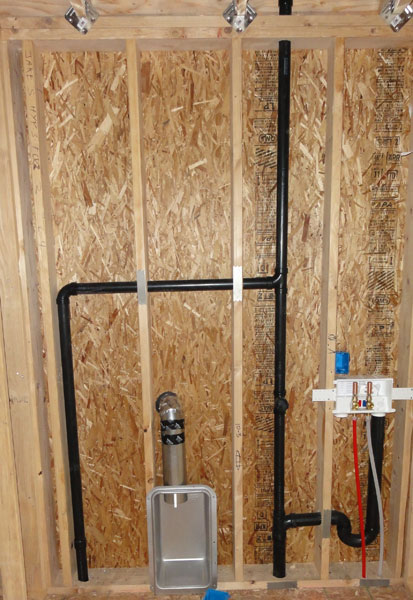
Washing machine outlet box

lottia

DIY Member
Messages
42
Reaction score
0
Points
6
Location
Seattle, Washington
I' m finally getting around to enclosing the dwv project you-all helped with last year, and I want to install a washing machine outlet box for the water supply/shutoff valves. The stand-pipe is separately plumbed.

I can't find any specifications for the required height above the floor for these valves. Any suggestions?

a
 
Last edited:
I normally set the top of the box at 48"
I also pick up the boxes with the hammer arrestors.

washer_rough_1.jpg
 
Last edited:
Problem: A window in the vicinity of the housing requires that the outlet box top out no more than 39" above floor level. This would center the faucet opening at 34" above the floor.

The washing machine inlet connections are centered at 33". I understand why the standpipe for the drain needs to be at a certain elevation, but I'm not clear on why the faucets must be above the inlets on the washer.

Time for Plan B?
 
Last edited:
The faucets can be anywhere.

The only reason I said 48", is it puts the box above the back of the machine, and drywall is at 48", I kill two birds with one stone.

No standpipe receptor for any clotheswasher shall extend more then 30" inches nor less then 18" inches above it's trap.

No trap for any clotheswasher standpipe receptor shall be installed below the floor, but shall be roughed in not less then six inches and not more than eighteen inches above the floor.
 
Thanks, Terry.

All my DWV plumbing is to the inside of the exterior wall (partly below grade, w/ concrete to 31" above floor).

To conceal most of the pipes, I've kept supply and waste plumbing to within 10" of the wall and have begun to build a "housing" topped by a shelf at 39" above the floor [see photos].

I want to install the outlet box in the face of the housing to reduce the clutter in front of the wall. There will still be 3 vertical pipes extending above the shelf, unfortunately.

The position and height of the stand pipe is constrained by the position of existing vent pipes, a tub drain from upstairs (separately vented), and the position of the 3" drain exiting thru the floor [see photos].

Based on good advice from your forum in the past, I think I did the DWV plumbing correctly, but I did not have a digital camera at the time. Would you be willing to look at my Rube Goldberg solution and let me know if it's functional if not to code?

The bottom of the standpipe trap is 15.5" above the floor and the top of the standpipe is presently 24" from the junction with its trap. I plan to strap it to the frame of the housing and cut it so the washer drain line can also go into the face of the housing, rather than thru the shelf.

Please ignore the non-square, non-plumb work--at least it doesn't leak! :o

A
 

Attachments

  • Floor drain and standpipe trap.jpg
    Floor drain and standpipe trap.jpg
    35.2 KB · Views: 16,853
  • Venting and standpipe.jpg
    Venting and standpipe.jpg
    37 KB · Views: 12,055
  • Tub drain.jpg
    Tub drain.jpg
    29.2 KB · Views: 12,925
As near as I can tell from the photo, it should work.

The p-trap is a little deep, but should work.

A plumber would have likely used two 45 bends on the vent, but the medium 90's will work too.
 
Thanks, Ted. I actually have a replacement--flexible aluminum. I haven't worked with rigid vent pipe, but I'm willing to give it a try. I'll return the flex aluminum and buy some rigid material. a

p.s. You won't believe what happened to our original flex aluminum hose. An electrician who installed a vent fan in our bathroom scavenged the dryer hose, rather than providing new material for the installation!


You didn't ask, but---- you really should lose that plastic vent hose from the dryer.

Hard aluminum or galvanized is best. Flexible aluminum marginally acceptable. Flex plastic just adds fuel to any lint fire, and tends to collect a lot of lint in the corrugations.
 
Last edited:
Back
Top