Venting question for a new half bath upstairs...

thefed

New Member
Messages
12
Reaction score
0
Points
0
We have an old bungalow and are adding a half bath upstairs. I had a plumber out who suggested setting it up like this:

Lav drain into floor, horizontal run 2 ft, tied into 3" WC line, then drop vertical to basment with 3", then horizontal run to tie into 4" main line.

He said there is no need for a vent, which I find odd. The total run from lav to main stack is about 25 ft including horizontal and vertical runs.

He also said 3" is fine, but I am unsure how 'fine' it really is.

My guess is that there needs to be a vent...likely Lav drain, then toilet drain, then vent, then drop to basement.

The problem of course is getting access to the roof in this finished room, but I'm sure it can be done.


any input?
 
That sounds like uninspected cabin plumbing.

You flush the toilet, and the lav p-trap siphons dry.

I would like to see his qualifications.

Putting a vent through a roof is better then smelling the septic tank inside your home.

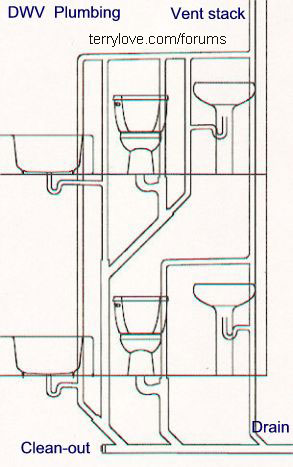
Helpful Plumbing Hints for Residential Construction by Bert Polk Plumbing Inspector Lincoln County

dwv_b2.jpg
 
Last edited:
That sounds like uninspected cabin plumbing.

You flush the toilet, and the lav p-trap siphons dry.

I would like to see his qualifications.

Putting a vent through a roof is better then smelling the septic tank inside your home.

dwv_b2.jpg

Thanks for confirming my suspicions. you diagram actually shows that 2 vents will be needed then...right?
 
That depends on your location and what codes you are under. Down here we could wet vent the toilet off of the lav - single 1 1/2" or 2" vent, some areas require an individual vent for each fixture.
 
vents

The number of vents depends on how the piping is arranged. Some setups only need one vent, while others could require a vent for each fixture. The code specifies that EACH fixture have a vent, it does not tell how the plumber HOW to do that.
 
The cost of venting each fixture is in the $10 range difference.
Unless you understand how to wet vent nearby fixtures correctly and to code, it makes more sense to spend $10, a nice trip to McDonald's and make sure you aren't bugging plumbers later wondering why your traps are siphoning.

The homes I plumb, work like a charm.
 
Terry,

The cost of venting each fixture is in the $10 range difference.

Are you referring to using an AAV at each fixture?

Thanks,
Matt
 
I'm talking hard pipe and fitting.

If you are venting the toilet, then separately venting the lav and reconnecting to the toilet vent means three more fittings and a few feet of pipe.

I would never use AAV's in place of piping.
For me, the pipe is less money then the $22.00 AAV and requires no replacement, or access panel that is vented.
Why would you hack up your bathroom trying to use an access panel with grill and an AAV that needs replacing when you can pipe through the roof and be done with it.

Also, many jurisdictions will fail an AAV
Piping always passes.
 
Here (in central wisconsin) AAV's are allowed. Was asking due to curiosity. Part of our replumb was adding an upstairs bathroom and had the vent for the new lav run to the 2" vent that already goes through the roof from the kitchen sink that was below. The plumbing inspector was the one that told me to use an AAV instead of going through the walls and 8' of pipe to the existing roof vent. The plumber and I both felt the vent through the roof method was the best. Two holes with a 3" hole saw took maybe five minutes - all together the holes & pipe & cutting into old galv pipe took at most an hour. Not a lot of time and do not have to worry about odors or malfunctions, etc.

attachment.php
 
Last edited by a moderator:
Back
Top