
No floor drain available.

wamp73

New Member
Messages
2
Reaction score
0
Points
0
I'm finishing out my basement and have a water heater which is on the main floor, it will be above a finished ceiling when the project is complete.
I want to move it into the basement. My problem is that there is no floor drain in my basement. I want to put the electric water heater in a room that has vent and drain stacks as well as the electric furnace and air handler. Is there an acceptable way to plumb the T/P valve and a drain from a water pan into the drain stacks? Or does anyone have any other suggestions that could solve my problem?
 
I'm finishing out my basement and have a water heater which is on the main floor, it will be above a finished ceiling when the project is complete.
I want to move it into the basement. My problem is that there is no floor drain in my basement. I want to put the electric water heater in a room that has vent and drain stacks as well as the electric furnace and air handler. Is there an acceptable way to plumb the T/P valve and a drain from a water pan into the drain stacks? Or does anyone have any other suggestions that could solve my problem?

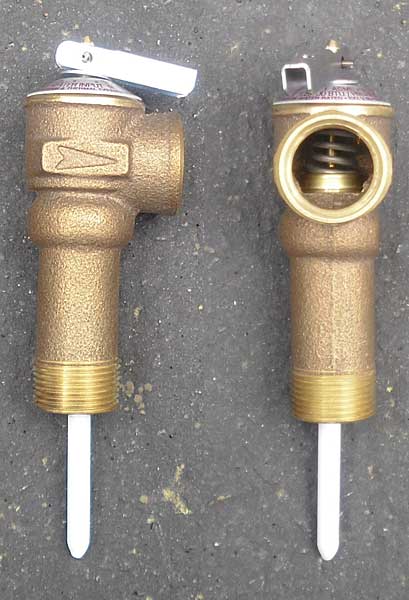
The T&P line usually dumps to the pan or another place that is visible. You need to be able to see if your T&P is dripping.

tp_2.jpg

T&P Valve looking at two sides.
 
Last edited by a moderator:
If I dump the TP to the pan. Is it then ok to plumb the pan into the drain stack as I would a sink with a p-trap?
 
If I dump the TP to the pan. Is it then ok to plumb the pan into the drain stack as I would a sink with a p-trap?

That depends on your local codes. I've seen some places want the pan to discharge outside, I've seen others where it could be tied into sanitary via an indirect connection. An indirect basically means it has to drip into a waste receptor (not directly tied), and of course the receptor needs a trap.
 
drain

The problem with connecting EITHER one of them to the sanitary system with a trap is that the trap will ALWAYS be dry, since neither of them will, or should, replenish the water in the trap when it evaporates. The drain pan is seldom connected to the sewer because it would overflow during a backflow condition.
 
The problem with connecting EITHER one of them to the sanitary system with a trap is that the trap will ALWAYS be dry.

Good point. I was answering between projects, normally IF we run pan to sanitary it is through a primered floordrain or a hub drain that is catching condensate.
 
Back
Top