Steam generator wire size check

50A maximum allowable on #8 THWN. However 9KW isn't 50A or even close to it so I'm a bit confused. I don't think you have to derate for a steam shower as you do for space heating ( I looked in the NEC handbook, but didn't see anything mentioning it). If the manufacturer says use #8 I'd say your fine with #8 unless you need to derate for long distance (voltage drop) or high ambient temperature (unlikely). You can use 8/2 romex unless your local codes say otherwise.

Anybody else?
-rick
 
Last edited:
If it is spec'd at 50a I don't think you can use 8/2 romex. I could be wrong there.

BimmerRacer, I said 6/3 w/g because I just assumed it would be on a gfi breaker. If it is, you need a neutral and a ground. If not, 6/2 w/g would work.
 
Mfg states 50a breaker for this steam shower
This a 240v connection, 2 hots

No GFCI breaker on these per Mfg spec

I used #8 for a 5kw 30a steam shower
Just in case I ever installed a larger size
My installation specified 2 hots & a ground

How far will the electric run be?
 
That's correct on GFCI. From Kohler manual:

NOTICE: Do not install a GFCI to this unit. This will prevent nuisance tripping.
NOTICE: All electrical wiring must be done in accordance with local codes.
Turn off all electricity to the working area at the main breaker panel.
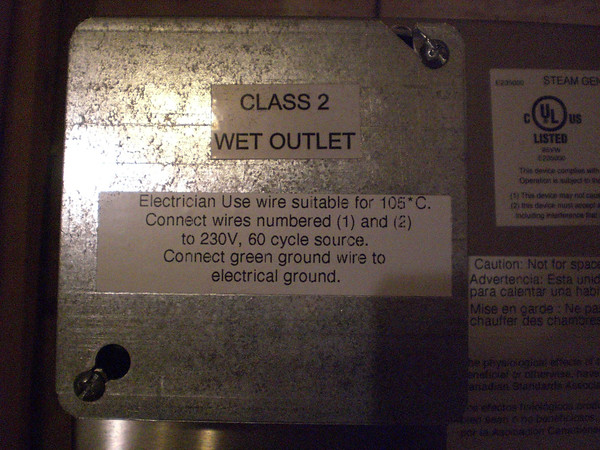
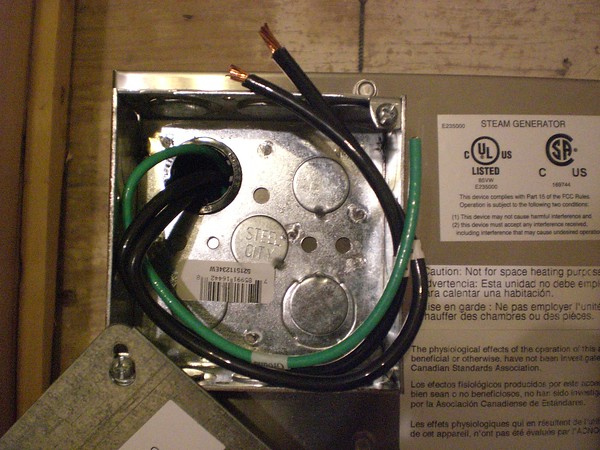
Connect 240 VAC electrical lines to the wires labeled ″1″ and ″2″ coming out of the steam generator.
NOTICE: The steam generator should have a dedicated circuit breaker.

The run will be about 30' to a subpanel.
 
As per the NEC NM Cable has to be rated from the 60 deg. col.
Therefore #8 NM is only good for 40A.
#6 NM is only good for 55A.

Also install by MFG instructions not by a caculation off of the 9kw rating for the heat. Other things are involved in their UL listed rating.
 
Last edited:
S0 either 6 TW/UF or 8 TH*?

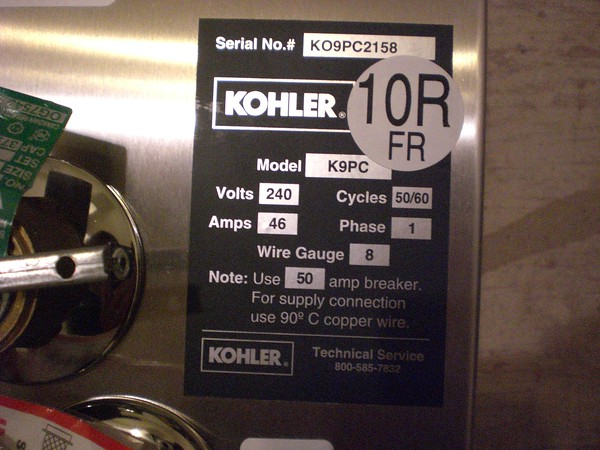
Their instructions do not spec wire, but there's a sticker on the unit says use 8 gauge wire. No mention of type. Is it bad to upsize in this case?
 
The wire must be big enough for the breaker. If they specify a 50A breaker, then you need at least the gauge wire required for that. Don't know what that is, but other than price and the hassle of working with it, larger is okay.
 
Just looked at it again. Sounds like what I need is THW 8/2?

477429623_M5Xqm-M.jpg

477429648_zQUXV-M.jpg

477429598_5SM34-M.jpg
 
As already mentioned, if your going to use NM type cable, then it cannot be smaller than #6 AWG. Personally if I was doing the job thats exactly what you would get, 6-2 NM cable supplied from a 50 amp breaker.
 
What about the 80% rule. Bimmerracer's steam generator seems to have a rating of 46 AMPS. Would it not be code to pout a 55AMP breaker?? even-though the manufacturer calls for a 50AMP?

I will not hijack this thread but the answer will be important since I am in the same predicament with another manufacturer who stated the wire guage, the AMP the generator draws but not the breaker size.

Thx All.
 
I have read on many threads and I believe it is code in some areas that the total connected load should not be more than 80% of the rating of the overcurrent protection devices.

Is this correct? Should it be less of a concern since the steam generator is the only load on this circuit?
 
I have read on many threads and I believe it is code in some areas that the total connected load should not be more than 80% of the rating of the overcurrent protection devices.

Is this correct? Should it be less of a concern since the steam generator is the only load on this circuit?


I have always said to take anything you read on these forums with a grain of salt as most of what you read is the opinion of the poster and carries no merit.

210.19 Conductors — Minimum Ampacity and Size.
(A) Branch Circuits Not More Than 600 Volts.
(1) General. Branch-circuit conductors shall have an ampacity not less than the maximum load to be served. Where a branch circuit supplies continuous loads or any combination of continuous and noncontinuous loads, the minimum branch-circuit conductor size, before the application of any adjustment or correction factors, shall have an allowable ampacity not less than the noncontinuous load plus 125 percent of the continuous load.

If I was doing the calculation of lights in a store then I would do the 125%/80% factor simply due to the fact that the lights in the store would be on for more than three hours.

If I was calculating the number of lights I would add the lights and do 125% of the total.
Example 8 lights with an ampacity of 2 amps each would equal 16 amps. 16 amps times 125% would equal a 20 amp overcurrent device (breaker).

If I had a 20 amp breaker and wanted to know how many continuous amps it would carry I would multiply the 20 by 80% and come up with 16 amps.

When I am installing a piece of equipment that has the amperage on the nameplate then I match the conductor and overcurrent device to the nameplate.
With the nameplate on a motor it is just a little different, see Article 430 for more details.
 
Last edited:
Great. Thx JW

On another note BimmerRacer's steam generator doe not call for GFCI (nuissance trip) the one I bought however calls for one. Why this difference of opinion on something that I would consider a lifesaving device?
 
Great. Thx JW

On another note BimmerRacer's steam generator doe not call for GFCI (nuissance trip) the one I bought however calls for one. Why this difference of opinion on something that I would consider a lifesaving device?

GFCI is greatly misunderstood my many. It would do no harm to install this generator on a GFCI and must be if the manufacture requires it to be done.

I don’t see where GFCI would be considered necessary as this generator does not come into contact with a human being nor does the water contained inside. It just produces steam and the droplets of steam are far enough apart that it will not conduct current.

If a steam generator needed GFCI protection I would think that a water heater would need one also.
 
Back
Top