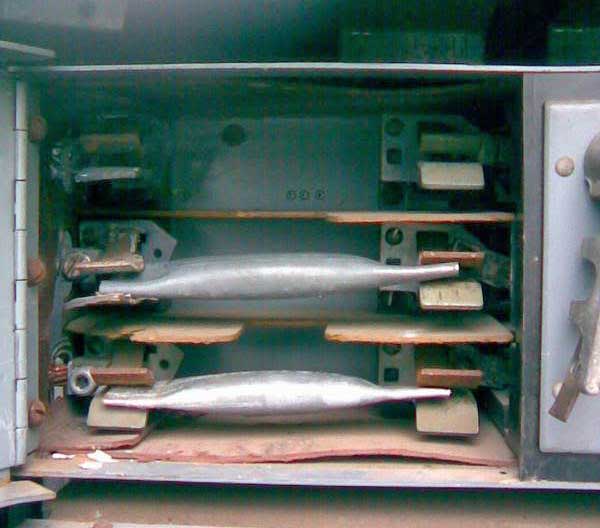
30A Fusible Disconnect Switch w/ Copper Pipe used as fuses

edstevn

New Member
Messages
10
Reaction score
0
Points
0
I found a General Electric 30A/240V single phase fusible disconnect switch that was used as a local service disconnect for a hot water heater. It was fed from a 30A/2P breaker out of a nearby breaker panel. I noticed it had (2) 1/2" pieces of copper pipe installed in place of fuses. I'm sure the National Electric Code book would site this as a code violation. Would they accept dummy fuses ? Do you replace the copper pipe with fuses or replace the switch with a non-fusible type?
 
I don't know if there is such a thing as a dummy fuse. I think it is called "copper pipe"!!

You can most likely use a non-fused disconnect, but I don't see how it would ever be legal to bypass what is intended to be a fuse.
 
non fuse

There have been people here who flatten a copper tube and then put it in the meter socket, after it was pulled for nonpayment of the bill, but I am sure the utility does not consider it a "dummy meter".
 
The current to melt a piece of pipe like this was figured out on another forum. The connecting wires and everything else will melt before this does. I guess that makes it an "anti-fuse."
 
At least they used copper.

Alectrician-06.jpg
 
Last edited by a moderator:
30 A fusible disconnect with CU pipe.

Installing copper pipe in place of proper fuses or fuse blanks is a Code violation of 110-3(B). Use of the disconnect sw with other than a product for which it was tested and listed by the testing laboratory. I will not say I haven't done this in an emergency, but it is a Code violation even though the circuit breaker ahead of the disconnect is rated for the circuit size.
 
And if you want to make it into a slow blow fuse, fill the pipe with water before crimping. That way the water has to boil off before the pipe melts.
All-in-all this is a very versatile circuit element.

Just kidding.
 
fuse

If the tubing is sealed so the water cannot leak out, neither will the steam. So the water will heat to a "superheated" condition, (not steam), until something ruptures and then there will be a 'mini' explosion as the energy is disipated in a matter of microseconds. It probably "looked" like copper when it was installed, but now it looks "silver" probably from being overloaded a few times.
 
Last edited:
Violation NEC 2005 reference standard

110.3(B)
110.9
110.10
210.20(C)
240.6(A)
240.10
240.60(C)
240.61


Take your pick. Remove and replace with the proper sized fuses
 
If the tubing is sealed so the water cannot leak out, neither will the steam. So the water will heat to a "superheated" condition, (not steam), until something ruptures and then there will be a 'mini' explosion as the energy is disipated in a matter of microseconds.

So should I lay off all the employees I have already hired to start building these little gems?
:(
:p
 
I don't know if there is such a thing as a dummy fuse. I think it is called "copper pipe"!!

You can most likely use a non-fused disconnect, but I don't see how it would ever be legal to bypass what is intended to be a fuse.
There are dummy fuses. A person might use one in a 110 v single phase circuit passing through a fused disconnect, no?
 
A dummy fuse is the dummies right finger on the right blade, left finger on the left blade without a pipe.
 
It WAS "golden" before it was overheated, maybe red hot, by overloads many times. Notice the blades are also no longer golden. Remember, in spite of what the title says, that is NOT a "30 amp disconnect", it is something like a 1,000 amp disconnect.
 
Back
Top