Wire Nuts

Cacher_Chick

Test, Don't Guess!
Messages
5,461
Reaction score
214
Points
63
Location
Land of Cheese
Wondering what the general opinion is on the use of wire nuts when splicing wire. I have always stripped the insulation, twisted the wire ends tightly together (clockwise & without damaging the wire), then twisted the wire nut on tight. I normally finish this with a 4-5 turns of tape to prevent the wire nut from coming unscrewed. I see a lot of installations where the wire nuts were put over the straight ends of the wire and twisted. My last home was all soldered and taped (no wire nuts).

Interested in hearing the consensus on wire nuts and wire splicing in general. Lets limit the comments to techniques used on 12 or 14 ga wire, solid and/or stranded.
 
If you use a big enough nut and don't strip the wires too long, I don't see where you need tape. I also find it easier usually to NOT pre-twist the wires. I let the nut do the twisting. This is a plumber talking, so that is my opinion for what it is worth.
 
I am around projects i have done almost everyday,and have used either of connections you speak of ,and have noticed no problems to date. My main critera either pre twisted or not is that the wire nut is not loose fitting on the wires,but this is pretty much uncommon providing the right sized wire nut is used. All the electricians i have seen let the wire nut do the twisting with no tape.
 
Almost all electricians that I have dealt with see tape around a wire nut as a sure sign of a non-electrician that has done the work. All of the instructions for the nuts that I have used don't say to pretwist. Read the instructions for the wire nut, since to be UL listed you need to use or install according to manufacturer's instructions.
 
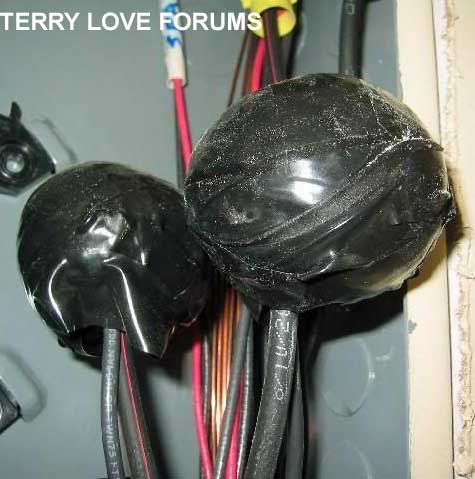
If you gonna to tape them do it right

knuckle.jpg
 
Last edited by a moderator:
As I replyed in a post below, Your splice should be mechanically and electrically secure prior to the application of the wire nut. Twist the bare wires. In my class we have experimented with pre twisting. If you do not twist, the connection is weak especially if you are doing more than two wires. One wire can slide out when you are shoving the wires into the box. Some manufacturers say "no need to twist wires prior to application of the wire nut" on the box--some do not. Are you going to stop and read every box? Also, who will be called back to fix a dead circuit? Conclusion: Refer to the King, Chubby Checker: Come on Baby, Let's do the twist!

One time a co-workers' truck got stuck in the mud. I towed him out with a scrap piece of 12-2 romex. It had a wire nut splice on it that held. I do not think you need tape to hold wire nuts on. If you are concerned about moisture use silicon caulk.
 
If you need tape to hold your nuts, you aint putting them on tight enough.

I'm thinking....2 #12's in a red nut should take about 8 to 10 1/2 twists. It should twist the wires together inside the nut.
 
The wire nut should twist the wires inside, but I have removed a bunch of them that just tightened on straight wires.
For wet locations, I do use a wet splice kit. I am talking about outdoor boxes that get condensation in them, standard splices are OK, but I am trying to upgrade the situation. Some wet location wire nuts come with silicon already in them. At least it looks and smell like silicon,--it could be something else.
 
I am talking about outdoor boxes that get condensation in them, standard splices are OK, but I am trying to upgrade the situation.
What about all the electrical equipment that is installed outside that has no other protection such as the lamp holder of an outside light, the terminals of outside receptacles or panels the list goes on and on.

There is no need in upgrading anything
 
An electrician friend showed me a technique that I (a non electrician!!!) feel confident with:

Strip the ends of the wires to be nutted
Align them
Hold the ends in a set of line pliers.
Hold the wires down 6" from the end with another set of NN pliers.
Twist (this nicely twists the bare wires AND the sheathed portions securely.
(Here's the part I like):
Snip 1/8" off the ends. This gets the wire ends even
Twist on the wire nut
Tape or don't tape

A pro might not need all these steps, but for me, they've been reliable.
 
An electrician friend showed me a technique that I (a non electrician!!!) feel confident with:

Strip the ends of the wires to be nutted
Align them
Hold the ends in a set of line pliers.
Hold the wires down 6" from the end with another set of NN pliers.
Twist (this nicely twists the bare wires AND the sheathed portions securely.
(Here's the part I like):
Snip 1/8" off the ends. This gets the wire ends even
Twist on the wire nut
Tape or don't tape

A pro might not need all these steps, but for me, they've been reliable.
I would add: strip the wires originally to 1" or so. Then trim however much off you need to have the resulting bare part equal to the recommended length for the wirenut being used. This also gets rid of the nasty bent ends of the twist.
 
I don't twist, but do pull on each wire individually after putting on a nut to verify each is caught tightly in the nut.
 
An electrician friend showed me a technique that I (a non electrician!!!) feel confident with:

Strip the ends of the wires to be nutted
Align them
Hold the ends in a set of line pliers.
Hold the wires down 6" from the end with another set of NN pliers.
Twist (this nicely twists the bare wires AND the sheathed portions securely.
(Here's the part I like):
Snip 1/8" off the ends. This gets the wire ends even
Twist on the wire nut
Tape or don't tape

A pro might not need all these steps, but for me, they've been reliable.

I use the same technique except instead of cutting them so long I cut the about 7/16 and instead of the piers I let the wire nut do the twisting.
I save the tape for Sunday afternoons when it might be needed to hold the hood in place.
 
In my class we have experimented with pre twisting. If you do not twist, the connection is weak especially if you are doing more than two wires. One wire can slide out when you are shoving the wires into the box.

I've also seen nice, solid, securely twisted connection, where the nut was loose enough to fall off. The wires were holding, but the connection was shorting against the metal box.

IMHO, not pretwisting & checking for solidity afterwards, ensures that you twisted the nut hard enough.
 
After twisting, if the wire nut does not grab, throw it away. I think the time spent trying to pull out each wire could have been spent twisting. I still say do the twist. .... If you think this is a good discussion, try this: should you torque aluminum connections once and consider the job done, or check the torque the next day and re-torque it? Or this: should you torque all connections with a screwdriver type wrench or larger torque wrench?
 
Back when i was a freshman in votech high school i did 3 days in electrical and the instructor tought us to pretwist but i' don think i've ever seen an electrician on a job do a pretwist .
 
Back
Top