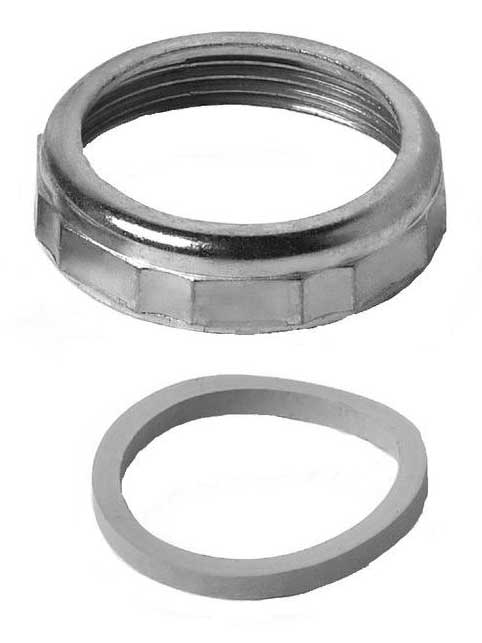
P-trap gaskets all the same?

Plumbob

Member
Messages
30
Reaction score
0
Points
6
I'm getting some leakage at my kitchen P-trap (all steel, double sink, disposer).

I went to Lowes and bought a package of gaskets, but I didn't tell the guy whether they were for a steel or a plastic P-trap. Are they the same?

What I took home were white, tapered plastic gaskets. Will they work on my steel P-trap?

Since its Christmas day I may wait until tomorrow to do this job, as stores are closed...

So, are the P-trap gaskets for 1.5" plastic the same as those used for 1.5" steel?
 
Some of the newer "metal" 1.5" traps use the same seals, but some of the older ones use rubber seals.

You might want to buy new plastic parts for you trap, crossover, tailpiece, and extensions. When you take apart the old pipes if they have any age to them they will be rotten. I would take a picture and take it with you to the supply house and get all new, if you don't need it you can return it. Make sure you have time to work on it, it can be easy, but it can turn into a job.

slip-joint-nut-washer.jpg
 
Last edited by a moderator:
I find that, regardless of the tubing material - the hard plastic ones work better than the rubber ones.

I keep extra plastic ones on hand, and just throw out the rubber ones that come with fittings.
 
I find that, regardless of the tubing material - the hard plastic ones work better than the rubber ones.

I keep extra plastic ones on hand, and just throw out the rubber ones that come with fittings.

The plastic seals won't work on the older metal pipe. The nuts are too short. If the P-trap is leaking, it is possible it is rotten, if so change to plastic buy good stuff. Many new metal traps and sink pipes come with plastic rings, but they have deeper nuts.
 
Last edited:
The plastic seals won't work on the older metal pipe. The nuts are too short. If the P-trap is leaking, it is possible it is rotten, if so change to plastic buy good stuff. Many new metal traps and sink pipes come with plastic rings, but they have deeper nuts.

I concurr!
 
Thanks for all the replies.

I haven't fixed the leak yet, but I have pinpointed it. Its not the P-trap, but instead the drain T-fitting where the disposal is connected.

A plastic piece exits the disposal, turning straight down into the top of the T-fitting. The leak occurs where the plastic piece enters the T-fitting. It only leaks when the disposal is rather full and running.

The other sink is connected to the side of the T-fitting, and the P-trap is connected to the bottom of the T-fitting. Everything is metal except the one little piece coming from the disposal.

So it looks like I should buy that plastic piece, in case its broken...
 
I would buy all the "pieces" just in case. Once you take it apart you might need them. Do the entire drain assembly in good plastic. Metal is harder to keep from leaking. Make sure you buy the correct crossover, the pipe connecting the two sinks, they have middle out let and end outlet. The T has a baffle in it accordingly.
 
I agree with using plastic desanco washers, when the slip nut allows it.
Also, quick side note, if I'm working with a 1-1/2" to 1-1/4" reducing desanco, I don't use those plastic reducing washers, I use a reducing fitting with a 1-1/4" desanco on it.
Those washers take more compression to work and on plastic the slip nut can break.
 
I'm not wild about the move toward making the nut and ring all one piece.

I never have a problem with the reducing ring on a trap adapter, desanco, unless they use the really cheap thin nuts. I like the good heavy plastic assemblies.
 
I must be weak in this area - I have never heard the term "desanco" before. I'm familiar with different codes that require different things for that, and I'm trying to recall what the older type of fitting was called - same thing, made of brass, with a lead washer or compression washer to hook up the tubular. Been over 35 years since I've needed them. (Though I think there are a couple out in the shop . . .)

It'll probably come to me in the middle of the night.

For myself, I think that a flat surface requires a rubber washer, a tapered connection requires a tapered poly washer. Code likes only one "slip-joint' washer on a p-trap, at its terminus. Trying to mix combinations of washers on metal and plastic piping just doesn't work well.
 
Construct30 said:
I'm not wild about the move toward making the nut and ring all one piece.

I like 'em because you can shove an assembled adapter onto a p-trap without losing the washer.
 
OK, I'm just going to replace all the metal parts with plastic. Doesn't seem like that big of a job.

Now, as far as buying "good heavy plastic assemblies," does that rule out Lowe's and Home Depot? Should I go to a plumbing supply outlet instead?

Thanks.
 
If you want to get technical about it, a desanco is a brass fitting or trap adapter to go from the copper or lead to the compression trap and sink assemblies.

The plastic ones are just called pvc or abs trap adapters, but those of us used to calling them desancos still call them that even though it is an old term. When I go into a box store and ask about a desanco they look at me like I'm a nut, then I remember and say trap adapter and all becomes right in the plumbing aisle again..
 
Back
Top