

Anton Derson
New Member
Ive been trying to manage this leak with my lack of plumbing knowledge. And I dont think its from the diverter. I've taken off the valve covers and removed/examined and tightened the escutcheon. I've taken pictures of my shower, and the leaky spots. I've tinkered with the water pressure with no luck.
The leak only occurs when the shower is actuated. Both hot and cold sides leak.
My shower setup: valve stems w/ diverter in spout to push water up shower arm:
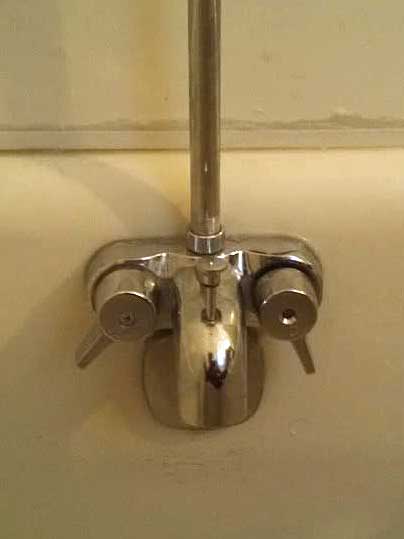
(yes, the cold valve screw is not in place, picture taken during my trouble-shooting)
The leak, behind the faucet assembly
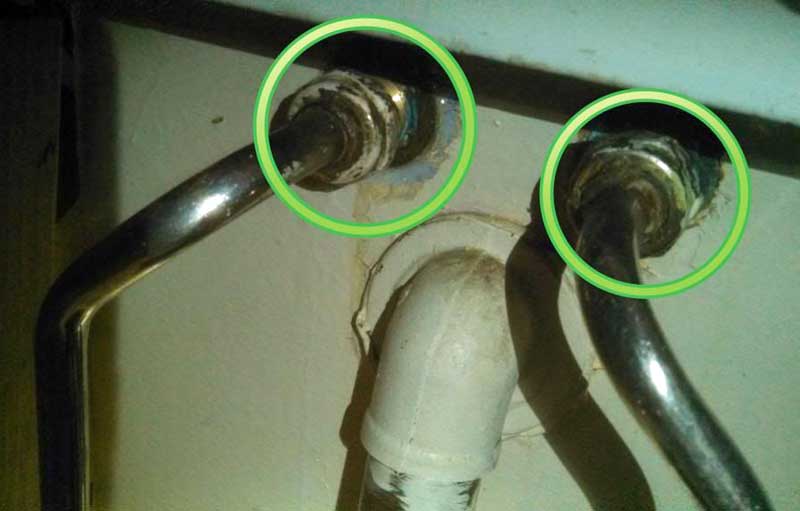
Notice the stripped paint and water stain running down wall
Unnecessary:
The nuts w/ blue hold the faucet assembly to the wall, it appears.
Edit: upon further tinkering i noticed the washered nuts w/ blue mineral deposits are loose, started to tighten but space restrictions are hindering me. To get behind the wall I must lean over very far over access wall, so far that my feet are hanging and I'm upside-down. My shoulders barley fit into the access hole, maybe just bigger than a 2'x3' hole.
Basically what you have a chromed copper lav supplies with the ball ends on them. If you snug the nuts that should stop the leak.
Terry Love
The leak only occurs when the shower is actuated. Both hot and cold sides leak.
My shower setup: valve stems w/ diverter in spout to push water up shower arm:
(yes, the cold valve screw is not in place, picture taken during my trouble-shooting)
The leak, behind the faucet assembly
Notice the stripped paint and water stain running down wall
Unnecessary:
I'm thinking I need to replace the nuts behind the faucet, my faucet assembly is fine?
To do this I should?:
Turn off water
Remove escutcheon and valve stems
Loosen the house piping from the faucet piping
Loosen/remove/replace nut , probably just tighten?
Reassemble
Correct?
The nuts w/ blue hold the faucet assembly to the wall, it appears.
Edit: upon further tinkering i noticed the washered nuts w/ blue mineral deposits are loose, started to tighten but space restrictions are hindering me. To get behind the wall I must lean over very far over access wall, so far that my feet are hanging and I'm upside-down. My shoulders barley fit into the access hole, maybe just bigger than a 2'x3' hole.
Basically what you have a chromed copper lav supplies with the ball ends on them. If you snug the nuts that should stop the leak.
Terry Love
Last edited by a moderator:

