
And, by the way, the san t on its back was already changed out to a combo.
|
|
|
Good morning,
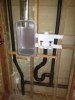
While questions regarding trap arm length have been discussed, ironically, at length -- I'm wondering what you folks do to combat tight spacing. This installation was for a stacked washer dryer, and there wasn't much space to work with. I'm wondering what your interpretation is on the trap arm length. If you look at it from the radius bends, it's just under 4" (this is 2" pipe). I'm wondering if it meets the intent.
![]()
And, by the way, the san t on its back was already changed out to a combo.
The vent could have gone up inside the stud bay to the right of the washer setup, then you would have had plenty of room.
That's a good point. I considered that; however, what you can't see is the framing above that which would have been prohibitive. I considered 45'ing over to it.
Not here it doesn't. The trap is an S trap or more commonly referred to as a 3/4 S trap and I don't know where the 2" lateral to the right goes but here that would have to be 3"
No, plumbing ain't rocket science. Unlike rocket science, plumbing requires a license!
Hi Tom. I've read your points in previous posts regarding S traps and arm length. I understand what you're saying and appreciate your point. The 2" to the right is going to a utility sink, which is also vertically vented.
Anyone who calls THAT an "S" trap, (and it does not even come close to the definition of a "3/4 S" trap), has absolutely no concept of what constitutes an "S" trap. Your installation is no differnent than hundreds, if not thousands or ten thousands, done exactly like that for the same reason. Revising the drain line slightly and using a wall box with the drain at the left end would have made it LOOK prettier but would have done absolutely nothing to make it work better.
Licensed residential and commercial plumber
I know you don't believe it but you western plumbers must play by different rules because that don't pass anywhere in the Northeast. Not Maine, not NH, VT or even liberal Mass. Technically the vent sort of makes it not an strap but the piping arrangement does not meet the trap to inlet minimum. Put one together, get out the tape measure and check for yourself. I have failed literally hundreds just like that and so has every inspector in the region.
No, plumbing ain't rocket science. Unlike rocket science, plumbing requires a license!
A "crown vent" I believe is what that is. It is clearly a violation according to the Uniform Plumbing Code, but it is widely overlooked by
inspectors. Or there might be local libereralizations.
The vent take off is too far back to be considered a true crown vent but you are correct, it is a violation of every code that I know of and I am more than sure that plenty of inspectors overlook it as well but bad plumbing is bad plumbing. I call's them like I see's em
No, plumbing ain't rocket science. Unlike rocket science, plumbing requires a license!
I appreciate the feedback. The trap arm is 3". While I'm a stickler for code compliance and building correctly, 1" is a tough sell for reframing a 70 year old house. Rock lath and cement are no fun to deal with.
If the distance from the crown weir of the trap to the opening in the pipe for the vent is less than 2 pipe diameters it is a crown vent, it need not be at the true crown of the trap. The combo picking up the W/B should have been cut in the next stud bay then run back to the standpipe. While not too many inspectors seem to harp on this issue (min trap arm distance) it is code, and for a reason.
It doesn't appear that you are that much of a stickler, it could have been done correctly without reframing anything or dealing with any cement. Nor is a lack of convenience a valid reason for a code violation. While structural conditions play into an inspectors decision it is not applicable here because it could have easily been done to code by cutting in the fitting in the next stud bay and plumbing back to the standpipe. What load is that wall even picking up with that CMU wall right behind it?
My normal practice would have been to come up in the bay next to the box; not the same bay. That would have allowed for a longer trap arm, and elimated the need for the extra 45's.
Bookmarks