No.
You can't wet vent the washer over the shower.
Also, the shower needs to be vented within five feet.
And the washer should come in above the inlet of the drain for the lavs.
|
|
|
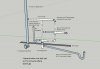
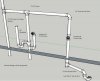
Please take a look at the attached model I just quickly drew. Whoever did the work previously made swiss cheese out of a 2x4 load bearing wall that I'm replacing with a new 2x6 wall to accomodate the proper piping thats replacing pretty much everything but the main stack. You dont even want to see what was there before. So light me up, whats wrong with what I have here? What can I clarify better? And I follow UPC.
Can i wet vent the shower like that?
No.
You can't wet vent the washer over the shower.
Also, the shower needs to be vented within five feet.
And the washer should come in above the inlet of the drain for the lavs.
Damn Terry, you're quick to reply, thank you! Ok, so how about 2 combo wyes stacked, bottom for lavs and top for washer, corrected?
And I know the 5' distance for shower vent, hence annotated. I guess I'll see whats under the slab to tie in the shower drain and run a seperate vent up to the right of the lav drains and take to the main. Better?
I would leave the washing machine connected where it is and keep the vertical stack 3" and install a cleanout and dump one lavatory above it. Install a wye in the shower drain with a short piece and a long sweep 90 turned up to catch the other lavatory and continue up and revent. This will vent your shower properly and get rid of that washing machine connected to the cross fitting you have now.
Lav one is wrong. There is no venting there.
You will need to add the vent and tie it in at the 42" level.
Stupid oversight on my part, thanks again Terry!
Dump the lavatory over the washing machine and leave everything else as it is. No extra vent needed. The washing machine would be wet vented.
Terry says "washer should come in above the inlet of the drain for the lavs" and you say "Dump the lavatory over the washing machine", so which is it?
Based on the first drawing, you had the waste from the lavs coming into a fixture cross that was supposed to be venting the washer. In that drawing, I would have raised the washer santee higher to make sure that the washer was vented higher then the incoming lav.
The double lav on the right of the first drawing was correct with the fixture cross for just the two lavs.
Hackney suggests putting a santee above the washer santee and wet venting the lav over the washer.
Since it is a lav, which normally could use 1.25" waste, you gain your two pipe sizes by dropping it into a 2" wet vent.
If it had been a laundry sink, which requires 2" waste, then it wouldn't be considered a wet vent in some places. Washington no longer allows a laundry sink wet vent over a washer, but the lav over the washer should be fine, since it's rated as a smaller fixture. hj says that Arizona is one place that allows that though for a "laundry sink".
Just so you know, the State doesn't consider us a journeyman plumber until we have worked 6,000 under an apprenticeship, and have passed the test for journeyman. I'm sure all of this seems simple, but the fittings can be arranged many different ways with many different results.
You're getting there though with these drawings. Pretty soon you will have the right one.

Last edited by Terry; 01-20-2012 at 02:53 PM.
Plan on doing this tonight. Whats the bad news?
![]()
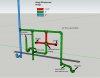
Not a plumber, but it looks good to me. My only question is whether you really have a double fixture fitting and not a double santee or double wye. You will want the double fixture fitting, but I have not seen them in the big box stores. You may need to go to a real plumbing supply place for one of those. The other thing is to make sure to use the right style of elbow under the lav connections. I would use a long turn elbow there. Make sure that you don't use a vent elbow there.
It looks good to me.
And same comments as Nukeman
Double fixture fitting for the lavs
Long turn 90 bend below
Thanks guys. I'm aware of using all long bends and the proper double fixture fitting. I labeled most of them properly to show that, despite not having the correct models to put in the drawing.
Bookmarks