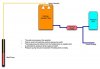
I am putting together an aeration tank. I would like to avoid using a venturi air injector. So, I am planning on filling the tank from the top with agricultural spray nozzles (sized appropriately for GPM and PSI).
Thoughts?
|
|
|
I am putting together an aeration tank. I would like to avoid using a venturi air injector. So, I am planning on filling the tank from the top with agricultural spray nozzles (sized appropriately for GPM and PSI).
Thoughts?
How do you intend to put the air into the tank? How will you bleed air off?
Filtered vent to the outside.
As the tank is drawn down (by a jet pump that is charging the pressure tank), fresh air is drawn into the aeration tank. During the next fill cycle, air is expelled.
I am hoping to avoid a powered vent, but it isn't a big deal if I can't.
Ah, so... non-pressurized hold tank. Is the aeration to remove smell or to precipitate iron? If for iron, then your jet pump will clog up with iron and need frequent cleaning.
For hydrogen sulfide and some other noxious gas. It may be that elemental sulfur will also be an issue with the pump. That is beyond my knowledge.
Edited to add: I am planning on multiple stages of filtration between the jet pump and the pressure tank. Coarser for elemental sulfur produced by the aeration and finer for some colloidal clay issues that I am still playing with.
Last edited by Matt Helm; 10-04-2011 at 07:56 PM.
The aeration/settling tank and any filtration needs to go AFTER the pressure tank. You can the use a Multi-Media backwashing filter to remove particulate matter. The way you have this designed at this point can potentially cause issues with the jet pump operation and pressure switch.
RJ
Here is a very simplified overview. It does not show the air vent, filtration, or control circuitry.
I threw this drawing together for a vendor that I was thinking of getting some parts from.
![]()
Bookmarks