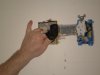
The box should be flush with the face of the drywall. If it is not, you need to use a box extender.
|
|
|
I am doing a condo kitchen remodel and replacing an existing firewall (5/8" fire rated drywall on wooden studs). Code says that the outlet boxes must have no more than a 1/8" air gap between the box and drywall cutout and this air gap is to be fire caulked.
Now, does the box have to extend into the cutout or can a metal expansion ring suffice (the box installed at the rear of the drywall as to enable a more concise cut-out), the problem being cutting such an exact opening and hoping to have it hit the installed box?
Jack of All Trades...
...Master of None...
The box should be flush with the face of the drywall. If it is not, you need to use a box extender.
THANX!
So the box should be set to the outer surface of the drywall and an extension ring used if wall finishing material(s) is used.
Makes perfect sense...
Jack of All Trades...
...Master of None...
First, I am not a licensed professional and gain what little knowledge I have from boards such as this and technical publications. Any guidance I receive is greatly appreciated.
I understand that any opening in a firewall structure must be protected from fire blow-though, pipes, cables and outlet boxes. I have also read through many manufacturers materials that a box penetration be tight and caulked (either with caulk or a pad) to prevent any blow-through which makes sense to me.
From- http://database.ul.com/cgi-bin/XYV/t...818&sequence=1
While the above excerpt does not specifically call for caulking, it may be in another section I have not discovered yet.6. Metallic Electrical Outlet Boxes
Listed metallic outlet boxes with metallic or nonmetallic cover plates may be used in floor-ceiling and roof-ceiling assemblies with ratings not exceeding 2 hours. These assemblies should have gypsum wallboard membranes. The metallic outlet boxes should be securely fastened to the joists and the opening in the wallboard facing should be cut so that the clearance between the box and the gypsum wallboard does not exceed 1/8 in. The surface area of individual boxes should not exceed 16 sq. in. The aggregate surface area of the boxes should not exceed 100 sq. in. per 100 sq. ft of ceiling surface.
So to answer your question, more word of mouth than actual knowledge. Any help is appreciated. This is a condo one hour rated wall and the builder did a terrible job (IMO) (Example- Non-rated ice supply box in fire wall and plastic outlet boxes with no backing).
Jack of All Trades...
...Master of None...
THANX DON... appreciated...
Jack of All Trades...
...Master of None...
If there is two boxes with one looking into two different units that are in the same stud bay then protection is required.
If there is only one box in the stud bay looking into either unit then nothing is required.
A fire wall would separate the two units between the walls and again nothing would be required for the box.
That explains the plastic boxes used by the builder and the fire caulking on the partition wall headers. The firewall is two separate studded walls between the units and now I see what you are telling me.
So as long as there are two walls, one doesn't need to worry about blow out? The fire is considered contained within the unit (sprinklers also)
You think you have it figured out and it bites you in the butt. I am assuming overhead can lights still have to be within a fire rated enclosure here?
So in the grand theme of things, the builder was correct (I was assuming the inspector missed it) in not making the unit wall blow proof?
THANX AGAIN gentlemen for the education....![]()
Jack of All Trades...
...Master of None...
Just a note, some plastic boxes carry a 2 hour fire rating.
A double, or offset stud wall is often just done for sound proofing, and may only have minimal fire rating effect. That comes from blocking and the surface (like the 5/8" rated drywall). The comment about boxes facing either direction was about them being in the same stud bay. If there's only one in that stud bay, no problem. If there's one facing into each unit in the SAME stud bay, then you need to treat it differently since you then could have a cross-over point into both units; otherwise, the wall surface (drywall) would be the fire block.
Jim DeBruycker
Important note - I'm not a pro
Retired Defense Industry Engineer
Jack of All Trades...
...Master of None...
A fire wall will have rock between the two studed walls.
If there is no rock between the studded walls then where is the fire protection?
In a single family dwelling the wall that is between the attached garage and the interior of a house is a fire wall. A box that looks inside the home and a box that looks to the garage would require a fire pad.
Although this is overlooked in most cases for a single family dwelling everyone worries about an apartment, why?
Bookmarks