
You are using an out of date browser. It may not display this or other websites correctly.
You should upgrade or use an alternative browser.
You should upgrade or use an alternative browser.
Dielectric Union
- Thread starter Dlarrivee
- Start date
Users who are viewing this thread
Total: 2 (members: 0, guests: 2)


Dunbar Plumbing
Master Plumber
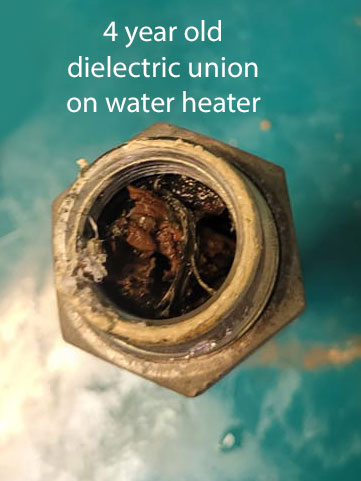
I use dielectric unions on all my water heater installs but I insert plastic flanged inserts directly into the union into the dielectric nipple.
No chance for corrosion to build up and close off the connection at that point.
No chance for corrosion to build up and close off the connection at that point.

Sponsor
Paid Advertisement



hj
Master Plumber
- Messages
- 33,603
- Reaction score
- 1,042
- Points
- 113
- Location
- Cave Creek, Arizona
- Website
- www.terrylove.com
dielectric
Di-electric unions are strictly "cosmetic". They look good and make inspectors happy, but do NOTHING to prevent the electrolytic action, since that occurs through the water, just like the anode rod does to prevent corrosion. Most rusty hot water problems are caused by corroded di-electric unions OR dielectric nipples which can have the same problems.
Di-electric unions are strictly "cosmetic". They look good and make inspectors happy, but do NOTHING to prevent the electrolytic action, since that occurs through the water, just like the anode rod does to prevent corrosion. Most rusty hot water problems are caused by corroded di-electric unions OR dielectric nipples which can have the same problems.
Well I could care less if it was dielectric or not, I'd just prefer any type of union, over having a soldered on one side and threaded on the other fitting.
What is the point of a threaded fitting that can't be threaded off?
What is the point of a threaded fitting that can't be threaded off?

Gary Swart
In the Trades
I believe local code vary widely on how to make the transition for water heater to supply lines, so you need to check with you local code enforcement. In my area, the common way to make this connection is a brass nipple out of the tank (both hot and cold) Then a short length of flexible copper tubing into a male adapter on the water supply. I know some places require a solid connection, so do check you local regulations.
hj
Master Plumber
- Messages
- 33,603
- Reaction score
- 1,042
- Points
- 113
- Location
- Cave Creek, Arizona
- Website
- www.terrylove.com
heater
IN any case, a direct connection between the copper and steel of the heater is NOT advisable. That combined with water, (water being the key component), IS the formula for elecltrolysis to occur. A 6" brass nipple is the most effective separator.
IN any case, a direct connection between the copper and steel of the heater is NOT advisable. That combined with water, (water being the key component), IS the formula for elecltrolysis to occur. A 6" brass nipple is the most effective separator.

Doherty Plumbing
Journeyman & Gas Fitter
I've always thought having 2 unions right off the top of the HWT is a bit goofy and is just another spot(s) to leak....
hj
Master Plumber
- Messages
- 33,603
- Reaction score
- 1,042
- Points
- 113
- Location
- Cave Creek, Arizona
- Website
- www.terrylove.com
heater
NOt if they are installed properly so they DO NOT leak.
NOt if they are installed properly so they DO NOT leak.
Doherty Plumbing
Journeyman & Gas Fitter
NOt if they are installed properly so they DO NOT leak.
It's still goofy. There is no need for this. If people do it planning on having to remove the tank I'd ask why they plan on removing the tank. And if they think doing that will make the tank easier to change out in 12 years when it fails they're hoping the new tank is the EXACT same dimensions as the 12 year old model.
Dialectric unions are much more expensive then a 3/4 cu x 3/4 FIP barstock fitting. If if you have to cut the tank out a few times the extra couplings you might want to account for are still cheaper then 2 dialectric unions.
Not only that but if you have them on a gas tank they're going to be obstructing the draft hood a little bit.
It's just my opinion but to me have two unions right on the top of a domestic HWT looks mickey mouse.


Master Plumber Mark
Sensitivity trainer and plumber of mens souls
Hj is %100 right....unions suck
http://www.brasscraft.com/Products.aspx?Id=227
Dialectric unionis are a total joke...they dont do nothing...
Try out These black brass craft connectors some time
they are the absolute best way to go
and I feel that they are have all around better dialectric
properties and you can certainly knock the job out fast
I have a bunch out in the field since 98 and
still chugging along very well ......
Wont know for another
good 5 years on how much they actually increase
the life of the heater... but Iknow they wont clog up on top
some like the plumbing to look straight and uniform
and that is the only downside to them....

IN any case, a direct connection between the copper and steel of the heater is NOT advisable. That combined with water, (water being the key component), IS the formula for elecltrolysis to occur. A 6" brass nipple is the most effective separator.
http://www.brasscraft.com/Products.aspx?Id=227
Dialectric unionis are a total joke...they dont do nothing...
Try out These black brass craft connectors some time
they are the absolute best way to go
and I feel that they are have all around better dialectric
properties and you can certainly knock the job out fast
I have a bunch out in the field since 98 and
still chugging along very well ......
Wont know for another
good 5 years on how much they actually increase
the life of the heater... but Iknow they wont clog up on top
some like the plumbing to look straight and uniform
and that is the only downside to them....
Last edited:

plumbernj
In the Trades
I use Bradford water heaters with the nipples already in the top of the tank. Mark, have you seen these?Dialectric unionis are a total joke...they dont do nothing... Try out These black brass craft connectors some time they are the absolute best way to go and I feel that they are have all around better dialectric properties and you can certainly knock the job out fast
[/QUOTE]
hj
Master Plumber
- Messages
- 33,603
- Reaction score
- 1,042
- Points
- 113
- Location
- Cave Creek, Arizona
- Website
- www.terrylove.com
flex
My experience with stainless steel flex hoses is that they will kink before you can make a tight turn with them. The corrugated copper is MUCH better.
My experience with stainless steel flex hoses is that they will kink before you can make a tight turn with them. The corrugated copper is MUCH better.
I only use solid copper pipe to my WH because I enjoy the craftmanship of doing everything that way. And it looks straight and uniform.
Even the gas, I like that hard piped.
I only trust flexible connections on my faucets.
Even the gas, I like that hard piped.
I only trust flexible connections on my faucets.
Master Plumber Mark
Sensitivity trainer and plumber of mens souls
I use Bradford water heaters with the nipples already in the top of the tank.
Mark, have you seen these?
the blackones from Brass Craft are much better then those SS ones..
I think those you have posted with the shark bites cost about 18 bucks each ...
my black ones are about 8
Similar threads

- Replies
- 0
- Views
- 175
- Replies
- 7
- Views
- 2K


