Don't see the need for a surge R E C E P T A C L E
|
|
|
I just replaced my refrigerator and wanted to know what your opinions are about installing a receptical surge protector? Thanks![]()
Don't see the need for a surge R E C E P T A C L E
http://www.inspectpa.com/forum/forum.php
My answers are based mostly on the ICC codes. Advice given is my personal opinion and every person performing work should acquire a permit from his/her jurisdiction and get the work inspected. My opinions are not directions to follow for DIYs or professionals
Surge protectors work on very short duration ( microsecond ) transients. They do not do much for brownouts, or a roll up in voltage from the power company. Unless you have a foo-foo model that talks to you and plays mood music, etc.....then the refrig. is not likely to be damaged by spikes.
More and more appliances have electronic controls verses mechanical, so it doesn't hurt. Panamax makes some nice ones. Behind a frig, though, the extra couple of inches could be a problem.
Jim DeBruycker
Important note - I'm not a pro
Retired Defense Industry Engineer
P&S and Levition make outlet surge protectors. With alarm and led indicators.
I would give you the number of the unit I got but I don't have it. It was hospital grade.
rgsgww
Thanks jar546 for the spelling correction as normally I spell very good. I appreciate everyones reply. Thanks!
Surge protection is highly recommended for protection from transients a prefered method would be to install a TVSS at the panel and one at the point of use. This minimizes destructive forces from impulses that may be imposed on the system.
While there are some peddling snke oil out there TVSS's when properly installed are not in that list.
As for a refrigerator as noted most/all newer appliances have electronics in them my kitchen alone has clocks micro wave, stove, dishwasher and clock
The key to lightning protection is good bonding. People think that having a perfect electrode is important. It isn't.
I would have more than just a little tvss installed on your mains, I would also have a multi mode surge suppressor installed on the phone and coax. Make sure that all coax and phone grounds are bonded to the main system ground. A ground rod will NOT do.
rgsgww
Do you have any clue as to what you are saying?
Just what do you think bonding is doing?
You make this statement, “grounds are bonded to the main system ground.”
Just what is the system ground?
Is it not the electrode?
Then I suppose that statement kills your opening statement of, “People think that having a perfect electrode is important. It isn't.”
Just for the record one of the reasons for installing an electrode is to dissipate lightning.
Last edited by jwelectric; 01-20-2009 at 11:46 AM.
Yes I agree that the original poster can believe what he wants to believe but I also believe that he should have the complete facts to make his assessment on before making a decision.
The grounding electrode is installed for four reasons.
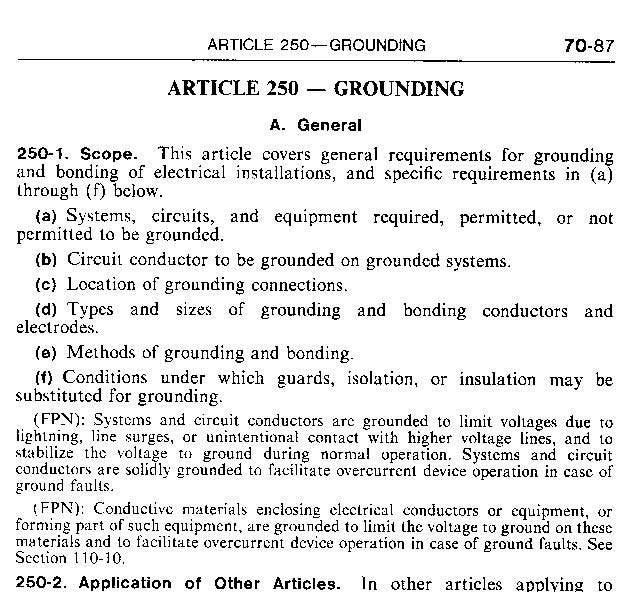
250.4
(A) Grounded Systems.
(1) Electrical System Grounding. Electrical systems that are grounded shall be connected to earth in a manner that will limit the voltage imposed by lightning, line surges, or unintentional contact with higher-voltage lines and that will stabilize the voltage to earth during normal operation.
Bonding on the other hand is done for a different reason,
250.4(A) (3) Bonding of Electrical Equipment. Normally non–current-carrying conductive materials enclosing electrical conductors or equipment, or forming part of such equipment, shall be connected together and to the electrical supply source in a manner that establishes an effective ground-fault current path.
The bonding of equipment is NOT done for lightning but the grounding electrode is installed for lightning.
Bonding is done to facilitate the operation of the overcurrent device (the breaker or fuse) and has no role in a lightning strike
So easy there, lighten up a little, learn a little something but make sure that what you learn is correct and not some opinion of someone that has displayed a complete lack of knowledge. Learn to believe the truth not half baked ideas form the uninformed, unknowing and those who have little or no knowledge.
EDITED TO ADD
Sorry That Guy
After making this post I got to thinking maybe I should look at your profile so I came back to see where you fit into the electrical trade.
I see by your profile that you haven’t had any formal training in the electrical field or at least you didn’t mention any in your profile.
This helps me better understand that you wouldn’t know what I was talking about either unless you take the time to research a little to see which is correct.
The comment made by rgsgww concerning the electrode having nothing to do with a lightning strike is so far off base that it isn’t even in the same ball park.
The grounding electrode is the ONLY thing that plays a role in a lightning strike.
Bonding is what makes the fuses and breakers work. Bonding is done to ensure that there is a low impedance path from every non-current carrying metal part all the way back to the center tap of the utility transformer. The connection to earth will not make a low impedance path back to the center tap of the utility transformer to operate the overcurrent devices.
Earthing does make a path between the electrical system and the earth. During a lightning strike current is trying to complete a path between the cloud and earth. Should the electrical system be in that path we want to ensure that a path is established that will divert the current to earth instead of throughout the electrical system. Therefore we install an electrode that connects the system to earth.
Last edited by jwelectric; 01-20-2009 at 12:11 PM.
An electrode is the most important, but I meant that it is important to keep all electrodes connected together. And not to just install a bunch of separated electrodes.
I did get some of my terms messed up. Bonding is done to clear faults, I know that. I used "bonding" as in connecting the electrodes together. Which is the wrong word to use.
Main system ground, that is the water pipe, ground rods for the service panels, etc.
rgsgww
Most of what you say in this post is true except for the "main system ground". There is no such thing as the main system ground. All electrodes present MUST be bonded together to form ONE electrode system.
250.50 Grounding Electrode System.
All grounding electrodes as described in 250.52(A)(1) through (A)(7) that are present at each building or structure served shall be bonded together to form the grounding electrode system. Where none of these grounding electrodes exist, one or more of the grounding electrodes specified in 250.52(A)(4) through (A)(8) shall be installed and used.
The key word in that section is "the" meaning only one.
. . .All messages express the views of the author, and neither the owners of Terry Love's Plumbing & Remodel DIY forum, nor Jelsoft Enterprises Ltd. (developers of vBulletin) will be held responsible for the content of any message.
. . .Posts that expose a person. . .to. . .shame, disgrace, or ridicule are potentially libelous. . .
and possibly defamatory.
Bookmarks