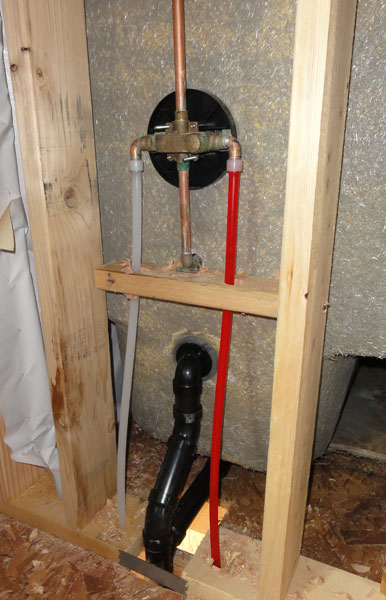
notch the top of the joist,then run 2+8 goeing the other direction to carry the load of the notched joist
|
|
|
I'm installing new platform tub and have discovered there is a floor joist DEAD CENTER under the tub long ways. What can be done now about the drain assembly? I can't imagine I'm the only person this has ever happened too. So, can anyone help with suggestions?![]()
notch the top of the joist,then run 2+8 goeing the other direction to carry the load of the notched joist
not sure I understand the answer...
If it is an IPS drain fitting, then you can notch the joist at the opening and then angle the shoe to the side, After you connect the trap, then run the overflow pipe up to the opening using whatever angle fittings you need to get it positioned properly.
![]()
Last edited by Terry; 06-02-2010 at 02:12 PM.
Plumbers!
As the friendly neighbourhood carpenter, I just want to remind you that notching is only allowed if you're close-ish to one end of the joist. No notches in the middle 3rd of the joist's span.
Also, in terms of how big your notch can be: no deeper than 1/6th the depth of the joist.
If that's not enough room for the fitting... you have two choices:
1 - redesign your layout so that the tub doesn't line up with a joist
2 do this:
EDIT: if your joists are supported, within 3' away, you can do the 1st drawing. But if their support is more than 3' away, you're stuck doing the doubled-up joists on each side, like the 2nd drawing.
Last edited by frenchie; 02-12-2008 at 12:15 PM.
Master Plumber Mark:
there is nothing better than the
manly smell of WD 40 in the air
while banging away on brass with a chisel and hammer...
it smells like......victory......
do not hit your thumb...
__________________
Just so everyone's clear: I'm the POODLE in the picture ("french", get it?) The hot woman is my wife.
If there's room, I'd consider furring the wall in to allow the tub to "miss" the joist altogether. I've built (glued and screwed) additional 2x3 and 2x4 interior walls to help with this sort of scenario. I always cringe when I hear about notching or drilling joists because of the shoddy results I've witnessed all too often. Greg
Frenchie, wouldn't you want to double up those 2x's on either side of the cut joist?
Jason
If it was a wide hole - cutting more than one joist - then yes, you'd have to sister the joists on either side, along their entire length; and also double up the headers (the 2x running at 90 degrees, that the cut joist hangs from).
For a small hole like this, only one joist cut out, singles are fine.
Master Plumber Mark:
there is nothing better than the
manly smell of WD 40 in the air
while banging away on brass with a chisel and hammer...
it smells like......victory......
do not hit your thumb...
__________________
Just so everyone's clear: I'm the POODLE in the picture ("french", get it?) The hot woman is my wife.
Ditto what Frenchie said. I'd like to add that if you have your cross members (not sure of the exact term for them) already outfitted with the hangers it makes the job a whole heck of a lot easier. Then you just pound it in run screws into the adjacent joists.
Tom
The cross members are called headers - I guess because they're positionned kinda like headers in a wall opening.
BTW, you shouldn't use screws on hangers - screws are stiffer, but more brittle - stronger in terms of pullout, but generally VERY weak in shear.
The manufacturer will specify the appropriate nail.
example:
http://www.strongtie.com/products/connectors/nails.asp
Master Plumber Mark:
there is nothing better than the
manly smell of WD 40 in the air
while banging away on brass with a chisel and hammer...
it smells like......victory......
do not hit your thumb...
__________________
Just so everyone's clear: I'm the POODLE in the picture ("french", get it?) The hot woman is my wife.
Really? I'm surprised you don't know that, being in Florida, with your hurricane codes... S'why framing is always done with nails, also sheathing. Nails will pull partway out, bend... but hold. Screws'll just snap. Not only because the shank diameter's smaller, but also the hardening process (so you don't strip out the head) weakens the metal.
There's exceptions - timberlocks have a rated shear strength, as do ledgerlocks, and simpson makes some structural screws - but they're pretty specialized items, and pricey. Can be useful for situations where you need a lot of pullout resistance, though - like to attach strapping, over foam, for a rainscreen wall, in a high-wind zone; or for attaching deck ledgers.
But AFAIK, nobody in the US makes one that you can use in a hanger, or hurricane strap, or whatever.

Master Plumber Mark:
there is nothing better than the
manly smell of WD 40 in the air
while banging away on brass with a chisel and hammer...
it smells like......victory......
do not hit your thumb...
__________________
Just so everyone's clear: I'm the POODLE in the picture ("french", get it?) The hot woman is my wife.
I beg to differ.
You're adding 1.5 times the load on each joist adjacent to the cut joist when you cut that 'center' joist. I'm pretty sure the floor joists are rated to carry loads up to their max and sized accordingly.
By cutting that 'center' joist you're more likely than not exceeding the max load on the adjacent joists.
I would sister another joist to them.
How much does a tub full of water weigh?
Add that to the max load on those joists and you're probably looking for trouble.
The amount that I don't know vastly exceeds the amount that I do in all fields, and the ratio is getting worse... However, I did know that Simpson specifies specific nails for their products, just never knew why (other than for crass marketing reasons). I'm a "gotta know why" kind of guy.
The reason I said use screws is that I've had to header off joists twice in on my current project in the last year. Neither time was I able to get a hammer in there and definetly not my framing nailer. So I had to use screws. I guess I should have used deck screws. Next time.
Tom
Bookmarks