2 parter: Insulating water pipes and ball valve sweating

t-hak

New Member
Messages
5
Reaction score
0
Points
0
Hi,

I'm new here, so if this has been covered, please point me in that direction. I did a quick search but didn't find an answer....

Question 1:
I live in Virginia, and we get some pretty hard freezes once in while each winter. I have a basement that I will be finishing soon. Along the outside of the house, between the sole plate of the middle floor and the first floor joist, I have 3 water pipes. One is to a spigot on the outside of the house, the other 2 go to the kitchen sink/dishwasher. Before I cover the joist space with drywall, should I put pipe wrap on the pipes? I have never noticed condensation on any of the pipes in either summer or winter. Of course, I don't check them every time I use the kitchen or spigot, either! :)

Question 2:
I want to add in another spigot for the other side of the house before I do the final finishing. Of course, I want to put in a ball valve (with a drain for the spigot side) when I do so. I bought one that is a sweat fitting for 1/2" pipe. Do I have to disassemble the ball valve to avoid damaging the internal seals? Or are these things heat-resistant enough for a MAPP torch? I find little info on the net one way or another, and what I do find is contradictory. For example: Should the valve be open or closed when I sweat it?

The valve looks like it can be disassembled with a bit of work with a wrench and a vice, but would I be better off just getting one with female thread fittings? It doesn't look like it was intended for disassembly, and the instructions on it don't say to disassemble it, but they are vague instructions to start with. I prefer to sweat it on, but I'm not against threaded fittings at all.
 
1. I would insulate the piping and the wall cavity. I would also get no-freeze sillcocks for both the existing and new bibbs.

2. Ball valves are designed to be soldered as-is. Nibco does offer these caveats: Solder with ball open, to protect seats. Wrap a damp rag around the body of the valve, away from the sweat socket. Today's solders require a temp of around 460º and the teflon seats can be affected starting at about 500º, so be careful. MAPP is a good choice, because you want to heat quickly, solder, and be done. If you have to continue applying heat for an extended period trying to achieve melting point, you cannot prevent the heat from spreading.

In general, I suspect you will be less likely to damage the valve by soldering in place, than if you try to disassemble and put back together.
 
insulate

Jimbo said it and that is my answer too............

(1. I would insulate the piping and the wall cavity.
 
Watts has what they call ezsweat ball valves. There is a nut on each end with a fitting, seat and o-ring. You solder things together, then screw the fitting into the valve. All of the components that can be damaged by heat are completely disconnected when making up the soldered connections. Now, an o-ring might fail more often than a soldered connection, but still should be pretty reliable, and is easily replaced without resoldering the whole thing. Never used one...
 
Solder with the valve open. Don't be intimidated. I've done a bunch of valves without incident.

Use a wet rag to protect the valve. But be careful. I notice that a wet rag actually 'radiates cool' (to use bad 'phraseology'). That is, it'll prevent heat and a good bond up to a cm or 2 from where the rag ends (on 1/2" copper). If you put the rag too close, you'll be heating the fitting forever, and sizzling away all yr heat into the rag.

I find you actually have to put the wet rag just on the opposite side of the valve to protect the valve itself and to allow the fitting to heat sufficiently.
 
Wow! What great information, much better than what I have found so far anywhere else.

Thanks very much to all you!

I did see in one place that when sweating a ball valve, one wants to get the heat into the joint as quickly as possible. The method recommended there was to heat the pipe rather than the fitting, as is normally done. Is this good advice?
 
Last edited:
t-hak said:
Wow! What great information, much better than what I have found so far anywhere else.

Thanks very much to all you!

I did see in one place that when sweating a ball valve, one wants to get the heat into the joint as quickly as possible. The method recommended there was to heat the pipe rather than the fitting, as is normally done. Is this good advice?

You need to heat both to get the solder to take. What I like to do is solder a long piece of copper to the valve. Then after it cools, trim it to length. This will kind of act as a heatsink making sure you don't get too hot.

Jason
 
Perhaps heating the pipe will work. But from my experience you have to heat the fitting. Solder runs from cold to hot regions. You have to "lead" the solder to the region you want it to go. If you heat the pipe, and position the solder over the joint, it'll run back to the torch - not into the fitting, and likely fall off since I assume yr not fluxing the bare pipe.

I'd also highly recommend Oatey's No.95 tinning flux. I've soldered with 'regular?' flux, and I prefer this one for weekend solderers like myself. When you heat the joint, it turns silver just before it's hot enough to accept solder. Takes a lot of guesswork out of the process. It also seems to hang around longer b4 burning off than other solders.
 
One tip I saw on the Watts site was to avoid aiming the torch toward the valve body when heating the joint.
 
If you heat the pipe, you run the risk that the joint could get just hot enough for solder to melt and flow on the pipe, but not bond to the socket, because it is not hot enough.


Everything I ever read or was taught says to heat the The larger piece....i.e. the fitting, the valve socket, etc.
 
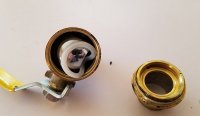
I recently changed out an old gate valve for a ball valve on my water heater inlet. The new valve leaked -- out the body of the valve, a tiny drip between the two mating halves of the valve. I drained the house again (bad design of the original system) and replaced the bad valve with another one that I hoped was OK (it was). After removing the bad valve, my engineer gland kicked in and I disassembled the valve to see what was going on. Here's what I found:

Bad ball valve.jpg

Has anybody seen anything like this? I returned the wreckage to the local big-box store where I bought it, and after some discussion they gave me a new valve, but several plumbing gurus who looked at it said it was impossible; I tend to agree with them. I solder with the ball open, and wonder if the seat somehow expanded into the hole in the ball, and got jammed in there when I closed the valve. No matter what, it doesn't account for the leakage that caused me to replace the valve.
 
If the valve is "open" water, from testing, in the body behind the seals can turn to steam and "blow" the seals out. Open the valve halfway so the steam can escape while still not creating excessive pressure on the joint.
 
Hmmm. The valve was brand new, and should have been dry, but that's something to remember. Thanks.
 
Back
Top