Basic question for Plumbers

Mike50

DIY Senior Member
Messages
698
Reaction score
0
Points
0
Location
Southern California
What is your personal policy on changing out valves when doing an installation for new toilets or new sinks (bathroom)?

If you are replacing old units of say 10 years old +...will you *only* install new valve (s) when the customer requests you to do this.

Inquiring minds want to know. :-)
 
my 2 cents

almost always , I change out angle stops and feeds. usually old valves are
partially frozen. the new hardware is cheap enough. a tip for you. i always open the valve full,then close 1/4 turn. this will keep valve from sticking later. also this works for lite bulbs. ever have one break while removing? :)
 
leave sleeping dogs alone

if the customer wants me to change out the stop , I will.
but I usually am very careful about it and warn the customer
that it could cost more if things go wrong....


So
If it works fine , I leave it alone


remember that no good deed ever goes unpunished.......


If I were to touch a stop, for free just as a favor.....

it would almost certanly be the one that breaks off
inside the wall....the tile glass wall...
with no access from behind

and of course, the homeowner does not want to pay for any repairs
that were never requested in the first place..


so their is a fine line you have to walk when
going that extra mile..........
 
policy

It's easy......The best policy is to to whats best for the customer and they appreciate that.

I agree with the above comments.

My philosophy is to point things out to the home owner before I start to work. I would never suggest something be changed or done that I wouldn't do for my self.

Relate to your customer like you would your own mother or father and make good suggestions. If my customer wants my opinion I'll give them my best. Most people appreciate that......

It's easy to know if a valve needs to be changed. If it does then tell your customer........
 
I'm with Mark.

When I was new to plumbing a friend of mine was remodling a 2nd floor bathroom and installed a new floor. He asked me to reset the toilet. I set the toilet and tried to use the old supply tube. The tube was 1/8" too short. Knowing that sometimes there is play in a pipe I went to pushed up on the valve to see if it would move.

No sooner had I touched the valve than it shot accross the room and hit the opposit wall and the stream of water followed it. I screamed at my helper to go shut the water off in the basement and I tried to stick my finger in the pipe, behind the wall, to slow it down, to no avail.

I laugh now, but not then. Luckly all it cost me was a repainted kitchen ceiling.

The pipe was eat up with electrolisis and busted when I touched it. That was my introduction to electrolisis.

That fun that was !!!!![/
 
Last edited:
Mike - Perhaps the question can also be what would the professionals do if they were working in their own house on a 10 year old installation. Would they change out the valves then?
 
If it were my own house?

Yes.

When I'm working on other homes, I don't usually replace the stop unless it's the type with the brazed on copper tubing. Those will break when bent one time too many. I refuse to reuse them.

I have a basic set price for replacing stops, to make it easier for the customer and for my workers. Get rid of the over thinking and get it done.

If it has a IP galvanized threaded nipple for the stop, I replace with brass.

sleeve_puller_2.jpg


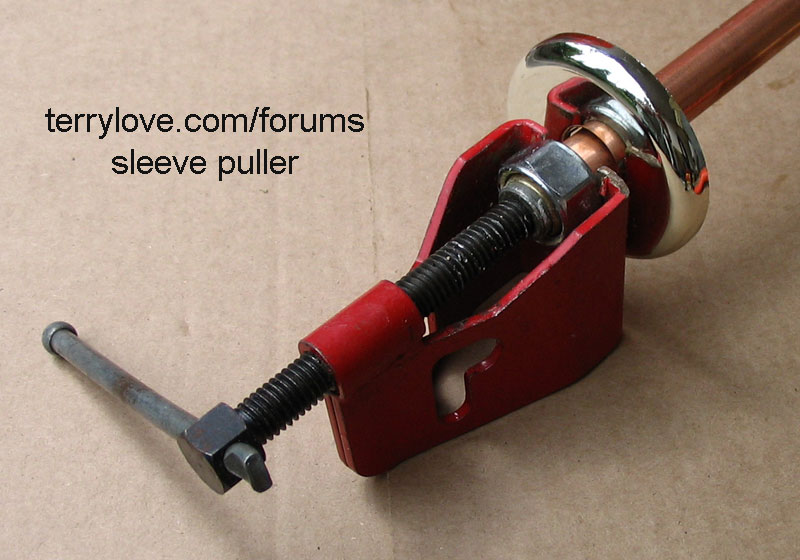
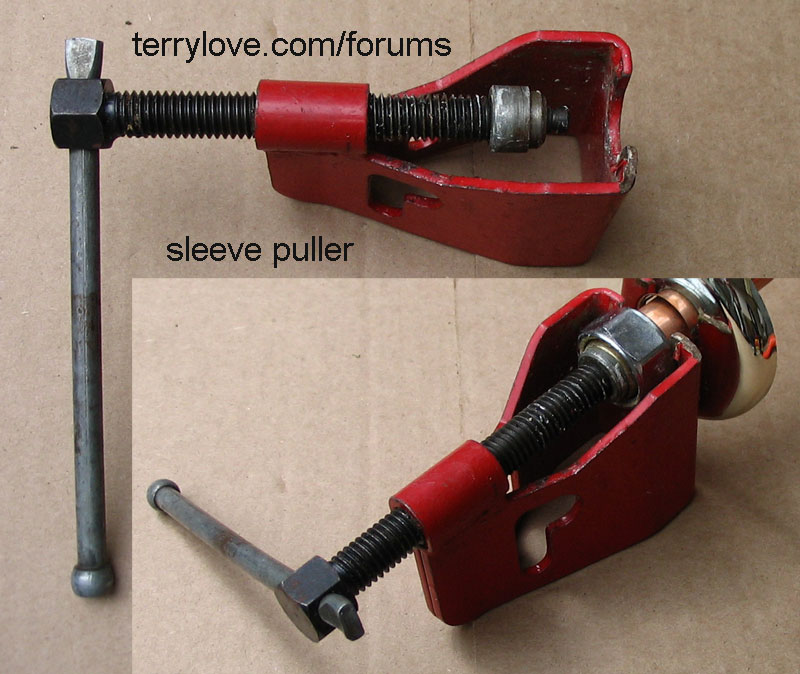
If it's compression, I use my compression sleeve puller and slide off the nut and sleeve holding the old stop on. This way I can replace the wall plate too. It's not a big deal, I do them all week long.
 
Last edited:
If a stop is fine I leave it. If it is iffy or looks like crap I change it out for a few bucks more.

Fellas,,,, have had that galv/ broken nipple thing happen also ! Mark you are TOO right,,,you never forget THAT ! HA,HA ,,,,, (now it's funny)
 
Well, mine was not a Gal. nipple. Mine was all copper and at the 90 on the toilet side the pipe wall was as thick as tin foil!!! Thats why it snapped.
 
3/8" nipples at stops were worse yet for plugging and deteriorating because of the dissimilar metals and also could break off in the wall.

I don't believe galv. nipples have been used with copper in Michigan for at least 40 or so years.
 
Last edited:
Our flat-rape price for toilet replacements includes replacing the stop, or emergency valve, if you care for that terminology.

Myself, I look for signs of previous leakage, whether the stop holds or not, and age.

For that being said, replacement of a stop and/or a supply tube is cheap insurance when one thinks of a callback.
 
Well..boy Howdy. who knew all these responses..?

My plumber recently did because I requested it.
Then he didnt charge me extra (which I was expecting)

JK-I agree. Would you.. if it were your home might be a better question...

thanks...
 
Mike50 said:
Well..boy Howdy. who knew all these responses..?

My plumber recently did because I requested it.
Then he didnt charge me extra (which I was expecting)

JK-I agree. Would you.. if it were your home might be a better question...

thanks...


You must not know plumbers that well.

Most of us will wait to do (our) things until it's problem. While we hold the customer in high regard, the wife is always on our backs, lol.
 
valve

In the flat rate book does an "emergency valve" cost more than a "shut off" valve? The usual reason for upgrading the terminology is to show that it is a more expensive option, such as calling a ballcock a "fluid level controller".
 
Also to make the part names sound less offensive to women.

I use the term "fill valve" for that thing that lets water into the toilet tank.
In the past, some were called "ball cocks" which to most people has no meaning that would be good.

Incoming water = fill valve
Outgoing water = flush valve

Some part books also replace the term "nipple" with "pipe extension"
 
plumber1 said:
It's easy......The best policy is to to whats best for the customer and they appreciate that.

I agree with the above comments.

My philosophy is to point things out to the home owner before I start to work. I would never suggest something be changed or done that I wouldn't do for my self.

Relate to your customer like you would your own mother or father and make good suggestions. If my customer wants my opinion I'll give them my best. Most people appreciate that......

It's easy to know if a valve needs to be changed. If it does then tell your customer........

I like your philosophy,,, all of them.... How much would you you fellows charge for a house call to northwest Flroida??? :eek: :eek:
 
Terry said:
If it's compression, I use my compression sleeve puller and slide off the nut and sleeve holding the old stop on. This way I can replace the wall plate too. It's not a big deal, I do them all week long.

Terry - I saw a picture of this compression sleeve puller in one of your previous threads. Sure could have used one recently when I replaced two stops while installing a Grundfos recirculation pump. I struggled for awhile until I was able to get the sleeves off the pipe. Terry if you don't mind my asking is the puller that you have pictured previously made by Pasco?

Thank you,

Jerry

sleeve_puller_1.jpg
 
Last edited by a moderator:
Back
Top