Wet vent question

madtoms

New Member
Messages
4
Reaction score
0
Points
0
Location
Louisiana
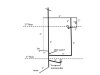
Several factors are confounding my desire to add a partial bath on the second floor above a partial bath in my utility room. The main drain and toilet branch on the first floor are not accessible through the floor, eliminating the addition of an independent vent for the toilet. I don't suppose the configuration outlined would be acceptable, would it?

Slide1.jpg

Thanks for your help.
 
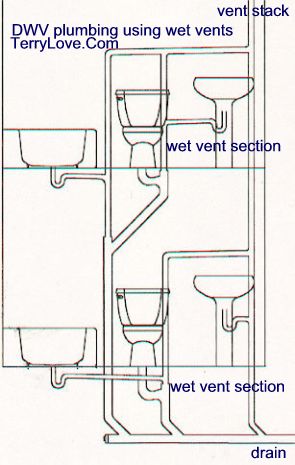
You are correct, it is not acceptable. The section of 3" BELOW the one you have labled "wet vent" is also a "wet vent" but since it comes from the second floor it CANNOT be connected there. You have to find someplace under the floor to connect the new toilet to. The 2" riser from the downstairs lavatory has absolutely no purpose or function. There is nothing which is "inaccessible", they are just "difficult to access". As my father used to say, "Nothing is impossible if you have enough time and money".
 
Thanks Terry and hj. That is what my limited understanding of plumbing led me to believe. However, I thought it worth the risk of asking since 'inaccessible' in this sense means 18" of heavily reinforced 5,000 psi concrete. Neither my bank account nor my back is quite prepared for that. Without either, time is a moot point.

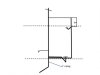
Since my father used to say, "Nothing is impossible with a little ingenuity," is elevating the downstairs toilet an option? It's a utility room, so stepping up to the 'throne' wouldn't be entirely out of place?

Thanks once again.

Slide2.jpg
 
Last edited:
Okay, not acceptable by new standards. But unacceptable for the guys finances, so let me offer my situation - very similiar.

For me, an added bath would have meant 5 grand for the septic and 3000$ in school fees. So I later added a toilet into the 3" vent for the first floor toilet. the top toilet is about 13' above the lower one, and the turds get a very good drop going.

After 15 years, the lower toilet has never seen any suction in the bowl or trap, so illegal and wrong, its my 8,000$ risk that worked. Use the lowest flow unit you can find to reduce the issues. For the poster, if he doubts me and the vagaries of his piping, take a 5 gallon bucket on the roof and pour it in at a toilet like rate, station an observer at your suspect fixtures and see if anything goes wrong. then put the garden hose in the vent and let ir run for 1/2 an hour at half blast. Use the other fixtures and evaluate the performance. "not acceptable" doesnt mean not possible.

To "fill" a 3" pipe and guarantee a clean sweep of the traps would likely require a 50 gallon tank and a fast opening 3" valve. that is NOT a toilet. Besides, probably all the older homes had wet vents if any at all. I dont advocate NO vents.

But I get sick when I see these new homes peppered with 6 or 8+ vents all over the roof helter skelter, just waiting to leak. My homes get one or 2] 3" vents out a sidewall or hidden portion of roof. The roofers LOVE me.

 
Last edited:
A plumbing inspector will require that the plumbing is to code.

The reason some homes have many vents, is that the plumbing is distributed over the home. That's a design issue, not a plumbing issue. If the architect wants to keep it simple, they can have all the plumbing in a column. The plumbers do whatever it takes to make sure that the plumbing works, wherever they find it.

Plumbing code also requires that the vents go through the roof, not out the side.
 
Ball and Terry,

I am grateful for both perspectives on my predicament. Thanks for taking the time to respond. I'll reassess the situation and re-post if any alternatives emerge. But first I'm going to calculate the drop my turds will be experiencing from about 9.5 feet; they probably won't reach terminal velocity.

By the way, was my suggestion of elevating the downstairs toilet to eliminate the second section of wet vent (as hj noted) completely misguided?

Thanks.
 
The newer toilets do cause a problem.
You have a 3" flush valve going through a 2" trapway. It does affect the lower toilet. The water goes through much quicker than water being poured from a bucket. It will affect the water in the lower bowl, most likely causing it to lower it's water level.
 
Plumbing code also requires that the vents go through the roof, not out the side.

My inspector with his book says fine except for specific clearance to windows. Logically, why would it be other wise? You can elbow them up Or cut at a 45' angle if you want some rain washout.
 
Back
Top