Another Tub Dap/Box Out Question

JimPA

New Member
Messages
3
Reaction score
0
Points
0
Location
Pennsylvania
I thinking that there are two kinds of Tub Dap/Box Outs. When the rough plumbing in a basement is laid at the beginning of construction, I'm thinking that they perhaps have an outer concrete wall that the plumbing rests in (I'll call this the box out). But when you add plumbing after the fact, there is no outer wall, just a hole in the foundation to access the plumbing (I'll call this the dap out).

My house has the latter. We are adding a basement and the contractor has broken up the foundation to locate the waste line and has tied in. He filled back in all but a square hole that will allow the placement of the tub drain.

Originally, he said he wasn't going to fill it in at all, then he said he would add some gravel. But I'm concerned that it should be covered with concrete as well once the tub drain is set. I guess it wouldn't need to be a thick layer, but something that would protect against radon, water, bugs, vermin, etc.

I'm in Pennsylvania in case code comes into play. I would love for this to be the case so I wouldn't sound like a PITA paranoid customer. I've been told we always to it this way. I'll stand up for what I need, but I'm looking for advice to make my argument easier and perhaps also make sure that I can limit any additional cost (if what I am asking for is code or the norm rather than the exception).

Thank you.
 
The plumbing code does not reference this, as there is no requirement for a floor in the plumbing code.

One of the final steps in setting the tub will be to adjust the positioning of the trap and riser so that it lines up correctly with the tub outlet. The floor must be open for this to be done. It is pretty common to leave a box open under the tub. If the walls around the foot of the tub are open, it wouldn't be a big deal to overlay the hole with mortar once the tub is set.

IMO, repairing wall or floor cutouts is not part of the plumber's job. If you are using a general contractor, they should be arranging such repairs with an appropriate tradesman.
 
More info and some pictures

Attached are some pictures and a diagram. Any advice? Thanks in advance.

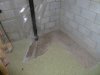
Here is the empty hole...
Pic2s.jpg

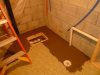
This is a wide view. You can see where the toilet is to go, where the sink comes down from the right, and then the tub dap out...
Pic1s.jpg

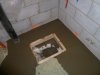
A close-up of the tub dap-out...
pic3s.jpg

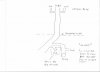
A rough diagram (I never was much of a drawer)...
diagram1s.jpg
 
A little late to be asking about your layout isn't it?

I also like how the old lino was left in place and the concrete finished up to it... wow.
 
I suspect this work is not being done by a licensed plumber.

Did the contractor pull a permit for this work? Have there been any inspections done?

There must be a vent, and it cannot go horizontal where the existing trap arm for the sink does.

I would call the local inspector over now, as the contractor will then be left with 2 choices,
one to run away (hopefully unpaid) or two to make everything right.
 
A little late to be asking about your layout isn't it?

I also like how the old lino was left in place and the concrete finished up to it... wow.

Sorry. I trusted my contractor to do it right. The tub dap-out had me concerned, and after researching and reading sites like this I got a little nervous. Late, but maybe not too late.

There are only the pictures, my comments, and any questions you might ask, but what are the points, from what you can see, read, or ask, that I need to bring to my contractor about this work. He subcontracted the plumbing, but is ultimately responsible for the job.

There is a vent for this 'stack' set as part of the upstairs bathroom. I'm curious if a secondary venting was required with this new addition.

Thanks again.
 
Last edited:
Here's a good start-

SECTION 708 CLEANOUTS 708.3.3 Changes of direction. Cleanouts shall be installed at each change of direction greater than 45 degrees (0.79 rad) in the building sewer, building drain and horizontal waste or soil lines. Where more than one change of direction occurs in a run of piping, only one cleanout shall be required for each 40 feet (12 192 mm) of developed length of the drainage piping. 708.3.4 Base of stack. A cleanout shall be provided at the base of each waste or soil stack. 708.3.5 Building drain and building sewer junction. There shall be a cleanout near the junction of the building drain and the building sewer. The cleanout shall be either inside or outside the building wall and shall be brought up to the finished ground level or to the basement floor level. An approved two-way cleanout is allowed to be used at this location to serve as a required cleanout for both the building drain and building sewer. The cleanout at the junction of the building drain and building sewer shall not be required if the cleanout on a 3-inch (76 mm) or larger diameter soil stack is located within a developed length of 10 feet (3048 mm) of the building drain and building sewer connection. The mini- mum size of the cleanout at the junction of the building drain and building sewer shall comply with Section 708.7.

CHAPTER 9 VENTS SECTION 901 GENERAL 901.1 Scope. The provisions of this chapter shall govern the materials, design, construction and installation of vent sys- tems. 901.2 Trap seal protection. The plumbing system shall be provided with a system of vent piping that will permit the admission or emission of air so that the seal of any fixture trap shall not be subjected to a pneumatic pressure differential of more than 1 inch of water column (249 Pa). 901.2.1 Venting required. Every trap and trapped fixture shall be vented in accordance with one of the venting meth- ods specified in this chapter. 901.5 Tests. The vent system shall be tested in accordance with Section 312.
905.1 Connection. All individual, branch and circuit vents shall connect to a vent stack, stack vent, air admittance valve or extend to the open air. 905.2 Grade. All vent and branch vent pipes shall be so graded and connected as to drain back to the drainage pipe by gravity. 905.3 Vent connection to drainage system. Every dry vent connecting to a horizontal drain shall connect above the center- line of the horizontal drain pipe. 905.4 Vertical rise of vent. Every dry vent shall rise vertically to a minimum of 6 inches (152 mm) above the flood level rim of the highest trap or trapped fixture being vented. 905.5 Height above fixtures. A connection between a vent pipe and a vent stack or stack vent shall be made at least 6 inches (152 mm) above the flood level rim of the highest fixture served by the vent. Horizontal vent pipes forming branch vents, relief vents or loop vents shall be at least 6 inches (152 mm) above the flood level ri
 
Back
Top