
View Full Version : Replacing Cast Iron flange
David Duffield
01-17-2012, 06:25 AM
Hi all, new to the forum but hoping to get some good information from here. I've been a homeowner for about a year after living in military housing for 13 years. Definitely a change.
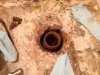
Anyway, my particular question is this, with a little background: My house is a 1967, built on slab, in California15163. I'm remodeling both downstairs bathrooms and have completed one without problems. The one I'm currently working on, however, had an unlevel, and upon closer inspection, broken cast iron flange. One of the slots for the closet bolts was also broken. After looking through the many forums online, I fairly easily removed the old flange and now have my 4" cast iron pipe. I looked in HD and found a replacement flange that fits over the pipe and clamps down on it. My main problem is that I won't be able to bolt the flange down to the slab, as there is about an inch gap all around the pipe. The old flange wasn't bolted to the slab, but it was also leaded in. Do I need to bolt the new flange down to the slab or will the clamping pressure around the pipe be enough. I'm concerned that, even though you don't have to tighten the closet bolts too much, the force being pulled against the new flange would cause it to eventually start loosening or sliding up off the pipe.
Any and all help is greatly appreciated!!
Thanks,
David
johnjh2o1
01-17-2012, 07:14 AM
The flange should be fastened down. If you don't have any concrete directly under the flange could you drill on a angle through the holes into the concrete you have? If so then long tap cons will work. Not sure what flange your looking at but here is a link to a clamp on cast iron flange. They call it a torque set flange.
http://www.plumbingsupply.com/toiletflanges.html
John
David Duffield
01-17-2012, 08:38 AM
Thanks, John. Yes, the torque set flange with test cap is the one I have. I was contemplating doing the angle drill thing. I'll have to check when I get home and see if that is an option. I wanted to make sure I was correct in that it had to be attached to the slab. Like I said, the previous one wasn't but it was leaded in and I'm sure they figure that's more than enough to hold it in place. Thanks again! Dave
Gary Swart
01-17-2012, 12:33 PM
I don't like the idea of a pit beneath the slab. Sure, it's never supposed to have water in it, but stuff happens. I would suggest you fill the cavity with concrete. You would have to use a spacer around the cast iron pipe so your flange would still fit over the pipe, but that pretty what you do when you pour a slab. Once the concrete has set up, you can anchor straight in. One very respected pro on this forum, HJ, has stated that you don't need to anchor a flange set on concrete. Before I had his pearl of wisdom, I did anchor the flange for my basement toilet, and needed or not, it sure doesn't hurt anything. I don't think you would have to worry too much about the new concrete bonding to the old, is isn't going anywhere and is just to offer a solid base for the flange, but I would clean up the hole as best I could anyway. My personal choice for anchoring into concrete is to use lead sleeves. I drill a 5/16 hole in the concrete, tap the sleeve in flush, then use #12 stainless steel screws into the sleeves. I think they are easier to use than Tapcon, but that is just my personal opinion.
jadnashua
01-17-2012, 01:14 PM
If you go to the trouble to add concrete, install the new flange, slap some tapcons in while the concrete is settup up...no drilling at all!
Gary Swart
01-17-2012, 02:33 PM
Yep, that's not a bad idea at all. Drilling with a roto hammer is easy, but not as easy as sticking 'em into wet cement LOL!
nukeman
01-17-2012, 02:55 PM
Yep, that's not a bad idea at all. Drilling with a roto hammer is easy, but not as easy as sticking 'em into wet cement LOL!
Just don't be around when the next guy tries to unscrew them and can't figure out why they aren't coming out (or why the heads are snapping off). ;)
I used the lead shield with the #12 SS screws on mine. Worked well and easy to remove later (if needed). Be sure to set the flange at the correct height (on top of finished floor). If set too low, you may have to use multiple wax rings and may have a hard time getting a good seal.
Hackney plumbing
01-17-2012, 03:25 PM
Lead a new cast iron flange in. After that mix you up some hydraulic cement as it expands as it sets and you can pour it into the void beween the flange and the existing concrete.
After that sets a day or so use a 1/4" mason bit to drill a few holes and use some nail drive lead anchors that expand when the steel pin is driven into the lead insert.
I would give anyone 100 grand if they could get a cast iron flange off the pipe in one piece or even get it loose after I pack oakum and lead into the joint.....I'd give a million to anyone who could pull it off in one piece after the expanding concrete gets poured in
With that said,code says the flange must be anchored to the floor so by all means do it.
ADD> I would like to up my offering to 100 grand
cacher_chick
01-17-2012, 03:35 PM
The flange you have purchased requires a reasonably smooth pipe surface for the seal to work. I don't know if you will find much good smooth iron under all that rust.
David Duffield
01-17-2012, 04:37 PM
Thanks for all of the input!! It is truly appreciated. And yes, cacher_chick, I definitely have some work to do so I can get a reasonably smooth surface. I do have plenty of elbow grease though...2 sons! :-)
A cast iron flange installed with a lead/oakum joint does not have to be screwed down. It has enough structural integrity to stay in place by itself. The former one must have been installed using the curved slots for the bolts instead of the two notches, and that is why it broke.