Slow leaky and plumber wants to replace the whole pipe

HouseWifwBeth

New Member
Messages
10
Reaction score
0
Points
0
Location
Washington, DC
Hi all, first timer here. I know nothing about plumbing, so bear with me. I really need some advise here.

We are in a 80 y.o. house with galvanized steel pipes. One of the pipe has a really slow leak. It's like a drip every 2 minutes or something like that. Plumber comes and he puts a clamp on the leaky. He says if this doesn't fix it, he needs to replace the entire pipe. It's a lot of money for us. well, it is still leaking.

Husby is out of town, he calls and says why can't the plumber just cut the leaky section out and joint it back with a new section. I don't know. Didn't think of it when the plumber was here. Hubby is kinda mad that I didn't ask, in his words, a simple question. Anyway, I am going to call the plumber on Mon but I want to know more so that I'll know if they give me some B.S. (not saying they are or will), don't want husby get mad again.

So, why does he want to replace the whole pipe when there is just a tiny leak? Gosh, to do that he has to open up a large area of the ceiling and spends a whole day there, costing us an arm and a leg. Is there any legitimate reason why he can't just replace the section that has the leak? I suppose doing that will cost much less, right?
 
When galvanized pipe is cut out, you normally go to the next fitting. I don't' know many plumbers that are cutting and threading galvanized pipe for a repair.
Of course it can be done with a hand threader if there is space, if you find someone that still knows how to do that. But it tends to be quicker in most cases and more likely to get a good seal by going to a fitting.
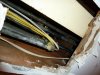
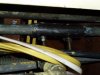
Can you attach some pictures?
800 pixels or less.
 
hw_beth_1.jpghw_beth_2.jpg

Hi Terry. So, cutting the bad section and jointing it with a new pipe is a bad idea? What are the concerns? Can he replace the cut section with PVC or copper pipe?
 
Last edited by a moderator:
Wow, look at the electrical...no regards/respect for codes and workmanship!

Repairing galvanized piping is not easy...especially with so much stuff in the way. You seem to have found a skilled plumber, I would suggest you compare his/her bid to several others if you doubt it.

...owning a home is expensive, and homeowners need to budget for repairs; even in tough times like these. Sadly all the DIY shows make it all seem so easy that people have no idea what's actually involved.
 
Yes, we like this plumber, he seems honest and skillful. And, we know it's best to replace the whole pipe. Yet, to be totally honesty, we just can't afford it right now. Not sure we are allow to post pricing here or not (some forums don't) but we all know how expensive plumbing repairs are. That's why I want to know if there is any cheaper alternative. So, is there really no other cheaper way that will effectively tide us over for manybe a year or two?

(In regard to the wiring. This is an old house with many previous owners. Who knows what they have done. We bought the house knowing there are many things need to be repaired / re-done down the road. But being first time home owners, we under estimated the cost of things and the stress and involvements . And yes, I use to love those DIY shows but as you pointed out, they make everything seems so easy when in fact they are not.)
 
Maybe he can. It's scary though. Sometimes messing around with pipe that old, stuff happens. And then the homeowner isn't happy about it.
When working with old pipe, you kind of hope that you can isolate the problem to the nearest fitting. Sometimes the next fitting or two can break. It gets a little tense. What he did with the clamp is the easy and safe quick fix; if it works. There is very little harm to the existing pipe since you don't really move it.

Your pipe is leaking in the middle of a section of pipe. Anything he does will be tempary until the next leak springs.
 
One show that I enjoy involves ripping everything that the previous workers did with a sledge hammer.
The put back, winds up costing someone tens of thousands. But it is fun to watch; smashing things up with no regard for dust flying everywhere.
 
So, sounds like we just have to bite the bullet and find ways to cut other expenses in order to pay for this.

So if he is replacing the pipe, should he replace it with another galvanized? Or should he use copper or plastic (CPVC?) pipe. What are the options?
 
I'm not saying it can't be done. But I'm not there on site either. You may even be able to just reposition the clamp.

If he does replace the section, then my choices would be either copper or PEX, though certainly CPVC is an option too.
With a complete repipe, saying you were to ever go that route, PEX would cut up the home the least, being able to bend around corners and all.
 
Sorry to keep asking but I am still struggling with this ... how about those plumber epoxy / putty thing I come across when googling this issue. Some say it's like steel when it hardens. Are they not effective? I know it is not a permanent solution but will it hold up for a year at least. I ask b/c I think using the epoxy will disturb the pipe least.
 
Last edited:
Yes, it's difficult to really say anything without actually being on site. If money is really tight (as it is right now for a lot of people), then there certainly are temporary measures that can be taken depending on the severity of the leak (like the clamp you have now)...but any temporary fix can certainly lead to failure and flood! But at least you will be able to save up to have it repaired properly as it should be. Let this be a lesson to you should you sell this home and purchase another one in the future, buying a home requires attention to the type of wiring and plumbing installed!

Terry is absolutely right when he is telling you that working on old plumbing, especially galv piping, can lead to big headaches as soon as you touch it...a small repair can easily turn into a nightmare. Even with copper, if the joint wasn't soldered properly, a plumber can work on the system years later and joints will fail or even separate when being worked on.
 
And when we do repipes, I like to replace everything.
Tub and shower faucets with pressure balanced valves, outside hosebibs, new shutoffs and supplies to every faucet and toilet.
I'll take everything to the fitting that comes into the home, and I'm very careful with that fitting too, not wanting to extend the job to water service piping.
That's a whole nuther job.

And the home gets a new ball valve for the main shutoff.
 
Rather than just the mighty putty, look for a pipe repair kit. It is a strip of water-activated epoxy resing coated fibreglass tape. You dip it into water, then wrap a few turns aroung the pipe, over-lapping the damaged area a couple of inches. Any hardware store should have this kit. It works.
 
In an old house, once you get to the point that the galvanized piping starts to leak (unless you've done some maintenance near it and maybe moved something), it is the notice that the whole shebang is ready to blow. So, as noted, the less you disturb to patch it, the better, since who knows what will break in the process of repair. It's time to budget a whole-house repipe. You can probably put it off for awhile, but it is coming (and maybe sooner than you'd like). Just the act of cleaning up the pipe to enable a fiberglass or epoxy patch to work may be enough to open up another hole. They are a temporary fix, at best, but sometimes work and are cheap. The clamps conceptually, seem best, since they support the now weak pipe. Once galvanized wears enough, it exposes the steel underneath, and that rusts. Since iron rust is bigger than metalic iron, it swells up, exposing more steel that can now rust. The insides of the pipe might be narrowed down to the size of a pencil, and any jossling will break it and a new leak will show up.

In the process of trying to remove that section, that will put some stress on other joints and pipe sections, and one of them may start to leak as a result. It's a tough call. Try for the minimum impact to resolve the leak, and start saving before the sprinkler system starts and you have no choice.
 
I am now thoroughly confused ... and totally stressed out! At first, I think cutting and re-attaching a new section is a bad idea b/c it disturb and stress the pipe too much. Fine, then, bite the bullet and replace this entire pipe. Now I get the feeling from what you guys say is that, replacing the entire length of the pipe is too stressful for the pipe also and will likely cause problems. And now even just wrapping the leak with fiberglass strips is not good either b/c the preparation of the pipe will stress the pipe too. So, basically, we are f...ed whichever way we choose except to re-pipe the whole house. We can't afford that! We'd rather just sell this d..ned house b4 we'd go broke fixing it. I don't know what to say to my husband when he calls tonight. I am sitting here looking at this d..ned house feeling totally defeated and stupid to have thought that we've got a good deal on it and will slowly turn it into our dream home. How stupid I am!!!
 
The only way to really know is to be there and evaluate what is there. You have to trust the plumber to make the best decision for you. But, also keep in mind that what may look like the best remedy from afar, might not be so when you can see what's really there, how good the access is, and to actually see the results and conditions of any actions. There are ways to minimize impact on surrounding pipe and fittings, but it is often impossible to tell their condition until it is too late, and you end up going a bit further and costing more. Hope for the best, expect the worst, and probably get something inbetween. He already seemed to have tried the least risky, and it didn't work. Now its time to up the anty. There is no way to know for sure until you try. Old houses always have their issues. They call them money pits for a reason!
 
When I put one of those clamps on a pipe, I tell the customer that it will last longer than the pipe, or at least until it starts leaking someplace else. If he did it correctly, you do not have to worry about THAT leak, just any new ones that develop later. For all practical purposes there is not enough room to cut the piece out, then rethread the pieces which are left so he could install a new section.
 
I tell husby of all your replies. He think that I should ask the plumber on Monday about using the fiberglass wrap. He says he has faith in our plumber (and I agree) that he will give us good professional advice. We are just hoping, hoping and hoping that he will tell us that the fiberglass wrap thing may not be perfect but would be enough for a good while ... we are not looking for perfect at this point. Thank you all for the advice. i'll keep you posted.

p.s., any particular type / brand of those epoxy fiberglass wrap I should consider for galvanized? Or are they are just about the same?)
 
Last edited:
Back
Top