PDA

View Full Version : Max trap arm length for a shower drain (2")


RenoChris
10-18-2005, 10:13 AM
I've been reading that the max length of a shower trap arm is 60" before the vent. I'm assuming this is a standard 2" drain and trap. If so, I was under the impression that a 2" trap could be 8 feet before vent (2" drop).

I checked the provincial codes (Canada) and there's nothing specific about a shower, just the standard:

<the total fall of the fixture drain from a P-trap is not greater than the size of the fixture drain>

Is there a different code that limits a shower? Or is this a different location code specific?

Thanks

Terry
10-18-2005, 10:50 AM
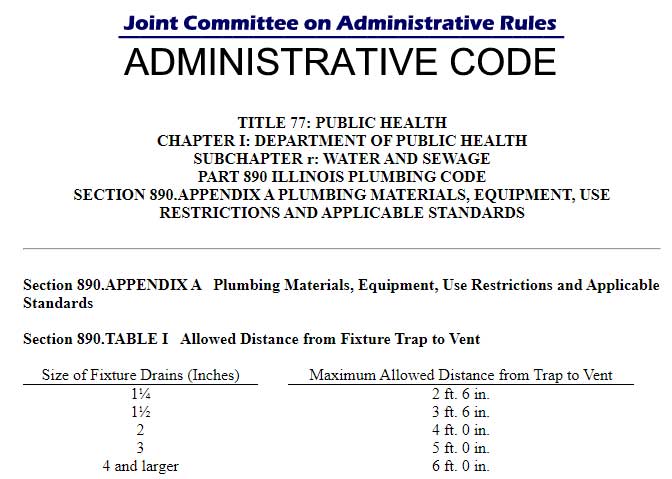
(UPC) Uniform Plumbing Code calls for 60" (five feet) on a 2" drain.

I don't know what they use in Canada, but the reason to limit length, is to prevent the trap from siphoning.
The goal is to have some air breaking the siphon. By extending all the way out to eight feet, you get near the point where it becomes an S trap.

The first goal, should be to maintain a trap seal.

Kristi
10-18-2005, 01:18 PM
The code is the same here in Canada... if you want an 8' trap arm on that shower drain, you'll need an additional vent on the arm tying into the original vent you are planning to use. No more than 5' without a relief vent!
Look in the venting section of the code (section 5) and find the chart (table 5.7.A in my way too old code book!) that tells you the maximum developed length of a trap arm. The vent distance cannot exceed 1.5m from an 1.5-2.5" trap size... who uses 2.5"??? lol...so there you have it.

RenoChris
10-18-2005, 02:23 PM
Thanks guys.

I do remember reading about that. I didn't find that table in the code... I guess they updated it... But I did find this:

(a) the developed length of a fixture drain measured from the trap weir is
(i) not less than twice the pipe size of the fixture drain , and
(ii) not more than 1 500 mm,

I missed that complete - thought they were talking about the drain, not the trap arm and saw the measurement in mm and it didn't click in that was what I was looking at. So, they're all 1.5m. (Other than some 3" floor drains that do not have to be vented in certain cases.)

I was looking at 6 1/2 feet to cleanly put it in a nice wall where it can join in with the other vents. Not a problem, I'll go to the closer wall, connect the vents in the floor joists above.

Thanks guys...

Oliver
10-19-2005, 08:31 AM
A shower, a bath tube and a lavatory drain are within 60” distance. Can I use one 2” common vent for all three under UPC?

Terry
10-19-2005, 09:14 AM
UPC Code

2" shower trap arm, 60" to vent
1.5" tub trap arm, 42" to vent.
1.5" trap arm for lav, 42" to vent.
3" trap arm, 72" to vent.
4" trap arm, 120" to vent, except for a toilet which would still be 72".

Each one get's a vent, which can be tied together into one at 42" above the floor.

RenoChris
10-19-2005, 09:31 AM
Well, do you mean, is 2" big enough? Yes.

But, if they're indivdually vented, you'll have 3 vents that would tie in together 42" above the floor into a 2" vent.

Or, do you mean, can you wet vent all three with one 2" vent? Here's how I understand it...

Basically, vent the toilet 2" horizontal, connect the shower into the toilet vent, and continue that vent up to the lav trap arm. Then continue up as your common vent. That means, you're using horizontal wet vents, so you have to roll the wyes so they are up past the drain center line and add the 1/8 bends. This is not accepted as code everywhere. I'm not even sure if they are code here.

Kristi
10-19-2005, 09:40 AM
RenoChris, they wouldn't be wet vents - there is nothing else draining into these vents you're referring to (that I can tell). You can have an 1.5" vent for each fixture, tie them all together into one 2" vent that can ultimately tie into the other vents in the area (2" should be plenty for your house). You can't have one 2" vent for all the fixtures alone.

RenoChris
10-19-2005, 10:26 AM
Correct - if they are individually vented, they're not wet vents.

My second portion there was (hopefully) how I think some places actually use a wet vent to do all three fixtures with one 2" vent. I don't know if it's code in Canada, I've never done it.

But, the lav would drain into the shower vent, the shower drain into the toilet vent. Some plumbers on the **** forum claim this is the preferred way in their state.

Oliver
10-19-2005, 11:46 AM
Horizontal drain pipe (2", 1/4" min slop).
- Shower after trap drains vertically it.
- One foot down bath tub drains vertically in it (after trap).
- One foot further lavatory drains in it (after trap).
- Somewhere in the midle of this arrangment off the drain pipe, the 2" vent pipe goes vertically to the roof.

What would be the UPC violation?

RenoChris
10-19-2005, 12:08 PM
Assuming the vent is between the shower and the tub drain, then the tub isn't vented. And a lav always has to be vented in the wall behind the sink, it can't go vertical unless it is vented there. Actually, the tub and shower can't drain vertically either, unless it is vented at that turn.

So... I guess there's a few violations.

srdenny
10-25-2005, 10:12 AM
Running the trap arm and trap in 4" and belling down to 2" on the riser to the drain would meet code under UPC.

Mikey
11-08-2005, 02:39 PM
In moving my bathroom fixtures around, it becomes easier to vent each fixture (pair of sinks, shower, toilet) up its adjacent wall with a 2" vent, but I want to join all these in the attic in some fashion to use the former 3" stack that goes through the roof, without the whole thing looking like a jungle gym. So far, I'm thinking of venting the shower (the most - upstream fixture) to a 3x2 reducing fitting at the bottom of the 3" stack (allowing rainwater to flow through the whole waste line), and the other 2 to Ts or a double T. Is this reasonable?